Update, Oct. 26: Federal prosecutors and defense attorneys for two of the three South Alabama students, Amare Jemal Woods and Kayla Leaann Smith, filed joint motions Monday indicating that confidential negotiations are underway to resolve the cases. No new motions had been filed in Cameron Lamark Lewis’ case as of Monday. Details are below.
Latest developments: Talks underway to resolve two cases
On Monday, Oct. 26, lawyers for the U.S. Department of Justice joined defense attorneys for Woods and Smith in asking the court for permission to file documents under seal.
The filings state the parties submit the subject matter is sensitive and concerns confidential matters pertaining to the defendant and negotiations for potential resolution.
The filings do not say what a resolution might involve. In federal criminal cases, a “resolution” can include a plea agreement, a pretrial diversion agreement or a dismissal, and the terms are typically not public until they are presented to the court.
All three students were arrested Oct. 2 after an FBI investigation into social media posts and were held in custody during President Donald Trump’s visit to South Alabama’s Mitchell Center. They were released from federal custody on Oct. 5 under conditions.
Attorneys for Woods and Lewis have argued that their clients’ comments were protected speech under the First Amendment and did not amount to criminal threats. According to FBI affidavits:
- Woods allegedly posted a comment beneath a TikTok about Trump’s upcoming visit expressing a desire for the president to die.
- Lewis allegedly posted on X that people would remember the University of South Alabama the same way they remember Utah Valley University, where conservative activist Charlie Kirk was assassinated in September 2025.
- Smith allegedly responded to a TikTok about Trump attending South Alabama’s homecoming by saying they only have one chance and posting an image of a person mimicking holding a firearm.
All three are presumed innocent unless and until proven guilty.
The earlier report follows.
MOBILE, Ala. — Three South Alabama students charged with threatening President Donald Trump appeared in federal court Friday, the same day the president traveled to Mobile for a political rally on their university’s campus.
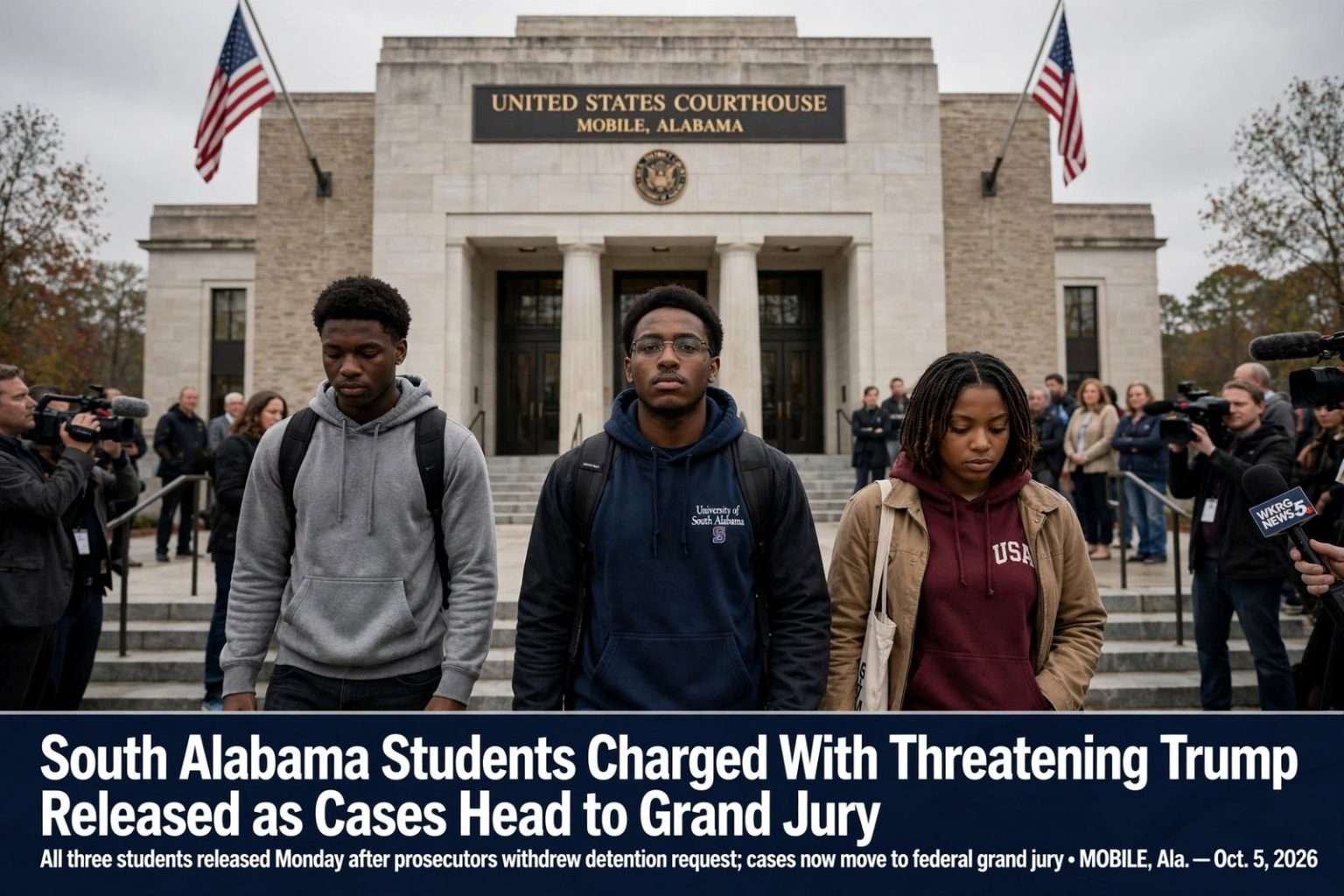
Update, Oct. 5, 2026: All three students were released from federal custody Monday after prosecutors withdrew their requests to keep them jailed. Each waived a preliminary hearing, and a federal magistrate judge said the cases will be presented to a grand jury within 30 days. Details are in the “Latest developments” section below.
Amare Jemal Woods, Cameron Lamark Lewis and Kayla Leaann Smith, all students at the University of South Alabama, are charged with making threats against the president. Federal investigators allege each of them posted threatening messages on social media in the days leading up to Trump’s Friday evening rally at the university’s Mitchell Center.
The charges are accusations. All three are presumed innocent unless and until they are proven guilty in court.
A federal magistrate judge ordered the three held over the weekend. They are scheduled to appear Monday for detention hearings, where a judge will consider whether they should remain in custody while their cases proceed.
FBI Cites Coordinated Effort
The FBI’s Mobile Division announced the arrests Friday night, saying the three had allegedly made “threatening communications” directed at the president. The bureau said it worked with the U.S. Secret Service, the U.S. Attorney’s Office, the University of South Alabama, the USA Police Department, the Mobile Police Department, the Saraland Police Department and the Alabama Fusion Center.
FBI Mobile said the arrests result from continued efforts to identify and mitigate targeted violence, threats, and criminal activity against government personnel, entities, and operations as outlined in the September 2025 National Security Presidential Memorandum (NSPM-7) on Countering Domestic Terrorism and Organized Political Violence, and were closely coordinated with the Joint Mission Center (JMC).
The FBI said more information would be released as it becomes available.
According to court records made public Friday, the alleged posts were made separately and were not connected to one another. Investigators said they found the messages Sept. 29 while conducting an intelligence review of social media ahead of the president’s visit. All three students were taken into custody Friday.
What the Affidavits Allege
Affidavits filed by federal agents describe the specific posts at the center of each case. The following are allegations made by investigators and have not been proven in court.
Amare Jemal Woods
Woods, a freshman studying aerospace engineering, is accused of posting on TikTok under the handle jemaltherealone. According to the affidavit, on Sept. 27 he wrote a comment under a post about the president’s rally saying he gotta die bro with a crying emoji.
An FBI agent wrote the post was made in a comment responding to a post about the president’s intended visit to the University of South Alabama campus on Oct. 2.
Cameron Lamark Lewis
Lewis is accused of posting two threatening statements on X on Sept. 26. Reports differ on his field of study. Charging documents also describe him as a Walgreens pharmacy technician.
According to investigators, one post, which contained a racial slur, said people would remember the University of South Alabama the way they remember Utah Valley University. Agents said that was a reference to the assassination of conservative political activist Charlie Kirk, who was fatally shot during an event at Utah Valley University in September 2025.
The second post, which also contained a racial slur, included a reference to “Q50.” The FBI agent wrote that the term referred to the ambush shooting death of rapper Mikquale Cooper, who was known as “Bloodhound Q50.”
Kayla Leaann Smith
Smith, who is studying elementary education, is accused of responding on Sept. 29 to a TikTok post about overhearing people at South Alabama talking about Trump coming to homecoming.
According to the FBI, Smith replied that they only have one chance and posted an image of a person pretending to hold a firearm.
Defense Attorney: ‘I Don’t Honestly Think Any of These Three Are Threats’
Jason Darley, the attorney representing Woods, said the Secret Service treats threats against the president with great seriousness and that the timing of the president’s visit played a role.
Darley said the problem is the president is on campus and Woods is a student.
Still, Darley said he does not believe his client ever meant to harm the president.
He said if this kid is a threat, then everyone pecking on a keyboard is a threat.
Darley described Woods as a recent graduate of a Mobile-area high school who comes from a good family, and as a “diminutive kid” who, like many people, may have been swept up in the hostility of social media.
Darley said it is unfortunate because he is a very young, small kid sitting in federal court, telling the judge this kid is the furthest from any defendant he has represented in 21 years.
Darley said the First Amendment may offer a possible defense, though he acknowledged the law takes a hard line on threats.
He said the statute is so broad it doesn’t require the person to have any capability of carrying it out.
He said he understands why the judge ordered the three held while Trump was in town, but he plans to argue at Monday’s hearing that his client poses no danger.
Darley said he doesn’t honestly think any of the three are threats.
Attorneys for Lewis and Smith could not immediately be reached for comment.
University Responds
University officials confirmed that three current students had been arrested after allegedly making online threats toward the president. The university released a statement Friday night:
The University of South Alabama unequivocally condemns any threats directed at elected officials or individuals with whom they disagree, encouraging open dialogue and civic participation while drawing a clear line between free expression and intimidation or unlawful conduct.
Trump was scheduled to hold a 6 p.m. midterm rally Friday at the Mitchell Center, the university’s arena. Earlier in the day, he was the subject of repeated praise at the groundbreaking ceremony for the new Interstate 10 Mobile River Bridge in downtown Mobile.
Understanding the Charge
Making threats against the president is a federal crime. The maximum penalty for the offense the students are charged with is five years in prison.
As Darley noted, the law does not require prosecutors to show that a person had the means to carry out a threat. Courts have long drawn a line, however, between protected speech, including political hyperbole, and what the law treats as a true threat. Where that line falls in a particular case is typically argued by prosecutors and defense attorneys and decided by a judge or jury.
The Secret Service, which protects the president, routinely works with the FBI and local law enforcement to review potential threats before presidential visits.
What Happens Next
With the detention question resolved, the cases now move to a federal grand jury. U.S. Magistrate Judge Katherine Nelson said the complaints will be presented within the next 30 days, and Woods’ attorney said he expects the grand jury to meet toward the end of October.
A grand jury does not decide guilt. It hears the government’s evidence in private and decides whether there is probable cause to return an indictment. If it does not indict, the charges do not move forward on that basis; if it does, each student would be arraigned and enter a plea before the case proceeds toward trial or another resolution.
The government would still need to prove any charges in court, and each defendant has the right to contest the allegations. The FBI has said it will release more information as it becomes available.
Update: More Details on the Allegations and Other Online Threats
Additional details have emerged about the three students and the online climate ahead of the rally. According to reports, Cameron Lamark Lewis serves as a resident assistant at the university and as vice president of USA’s National Pan-Hellenic Council. Investigators said he made two posts on X, one suggesting people would remember South Alabama the way they remember Utah Valley University, where conservative activist Charlie Kirk was assassinated in 2025, and another that investigators said urged a killing.
Federal court records indicate the three alleged threats were separate and not part of a coordinated plot.
The arrests came amid other violent or threatening remarks posted online before the rally, including messages in a group chat titled USA PROTEST organizing demonstrations against the president’s visit. Screenshots show one participant wrote help me rise up to blow up Trump, and later wrote if they suddenly aren’t supportive then we whack em. Other public comments included shoot him and Kirk him, referencing Kirk’s assassination.
Federal authorities have not publicly identified any of those other posts as the basis for the charges against Woods, Lewis or Smith.
Several student organizations, including USA’s Young Democratic Socialists of America and Jags Against Fascism, promoted demonstrations opposing the visit. Protesters gathered Friday afternoon before marching toward the Mitchell Center, and Trump spoke as scheduled that evening.
The University of South Alabama condemned the alleged threats, saying it unequivocally condemns threats against elected officials or individuals with whom they disagree, encourages open dialogue and civic participation, and draws a clear line between free expression and intimidation or unlawful conduct.
All three students are presumed innocent unless proven guilty in court.
Latest Developments: Students Released, Cases Head to Grand Jury
The three students walked out of federal court in Mobile on Monday, Oct. 5, after separate hearings before Judge Nelson. They had been held since their arrests Friday on criminal complaints filed last week.
Prosecutors had originally asked that all three remain in federal custody while their cases were pending. On Monday, the government withdrew those motions. Nelson noted during the proceedings that the students had already been processed for release in anticipation of how the hearings were expected to go. They appeared in court in street clothes and left with friends and family.
Pretrial reports found no danger or flight risk
The three hearings were nearly identical. In each case, a pretrial assessment concluded that the student did not pose a danger to the community or a risk of flight, and recommended release under a set of conditions. Assistant U.S. Attorney Justin Roller, the lead prosecutor, said the U.S. Attorney’s Office accepted that recommendation.
All three waived their right to a preliminary hearing, a step that allows a case to go directly to the grand jury without a judge first reviewing whether there is probable cause.
Conditions of release
The judge ordered the same conditions for each student. While their cases are pending, they must:
- Report to a pretrial services officer and submit to drug testing.
- Stay off social media.
- Not possess weapons.
- Have no contact with one another.
- Limit travel to within the Southern District of Alabama.
- Report any contact with law enforcement, including traffic tickets.
No evidence was presented in court that the three knew each other before their arrests. Each is represented by a different attorney.
More about the three students
- Amare Jemal Woods, 18, of Saraland, is a freshman aerospace engineering student with no criminal history. His attorney said he turned 18 in June.
- Cameron Lamark Lewis is a biology major who works as a university resident assistant and as a pharmacy technician. According to court documents, one of his posts encouraged killing the president and the other compared South Alabama to Utah Valley University.
- Kayla Leaann Smith, of Birmingham, is an elementary education major.
All three remain enrolled at the University of South Alabama. A university spokesperson said the school will hold its own hearing with each student to determine their future there.
A packed courtroom and supporters outside
The hearings drew an unusually large audience. Family and friends filled seats for Lewis and Smith, and Woods’ parents were in court. Outside, a large group supported the students, with one sign reading Pardon for January 6th, but not for a post.
The students and their supporters declined to speak publicly, as did most of the attorneys involved.
Defense: ‘A comment versus a threat’
Darley, who represents Woods, said the central question in his client’s case is whether the post was a real threat at all.
Darley said there will be genuine question whether this was a comment versus a threat.
He explained federal law criminalizes a threat that need not be communicated to the president but must be credible to a reasonable person. He said you can criticize the president’s weight, color, policies on economics and the Iran war, but you cannot make a threat.
Jason Darley, attorney for Amare Woods, said when you are a student at the school the president is visiting, the timing was horrible and it’s a sad situation that will impact his life, though he thinks they will get a favorable result.
Darley said unfortunately these young kids, 18 and just turned 18 in June, get wrapped up in social media and suddenly the FBI is calling.
The grand jury will weigh whether the students’ posts amount to online hyperbole or true threats that warrant criminal charges.
How the posts were found
According to the criminal complaints, multiple FBI agents swept social media in the days before the Oct. 2 rally and flagged the posts that led to the arrests. Security planning began about a week before the event, as soon as the president announced the Mobile visit. Mobile police and the Mobile County Sheriff’s Office worked with the Secret Service and federal authorities ahead of the rally; security gates were installed and the Mobile Police Department’s bomb squad conducted a walk-through of the Mitchell Center.
The charges remain accusations. Woods, Lewis and Smith are presumed innocent unless and until proven guilty in court.
Update: Defense Attorneys Say Posts Were Protected Speech
Lawyers for two of the three students say their clients’ posts may have been offensive or unwise but were not criminal threats. They argue the posts are speech protected by the First Amendment and expect to beat the charges.
Woods’ attorney: ‘in poor taste,’ but not a threat
Jason Darley, who represents Amare Woods, called the “he gotta die” comment immature and insensitive. He said it was not a direct threat against the president. Darley said the context and timing mattered but argued that prosecutors were stretching the comment beyond what Woods actually wrote.
Darley said Tuesday the timing is bad and in poor taste, noting Woods just turned 18 and is at South on a scholarship.
Darley said there is a difference between a threat and cheering something on, explaining that saying you will beat someone right now is a threat, while cheering it on is different.
Darley said he understands why federal authorities were on high alert before the visit. He pointed to the September 2025 assassination of Charlie Kirk and earlier attempts on Trump’s life. Still, he questioned whether Woods’ comment moved from offensive speech into a criminal threat.
Darley also suggested that prosecutors may be trying to make an example of the three students, and he noted that all three are African American. He said some other comments in the same social media thread were more severe than Woods’ remark, but the people who posted them were not charged. Darley said Woods’ case might be resolved before it goes to a federal grand jury later this month.
Lewis’ attorney: comments ‘subject to interpretation’
Chase Dearman represents Cameron Lewis. He made a similar argument about his client’s references to Utah Valley University, where Kirk was killed, and to the rapper Bloodhound Q50.
Dearman said he doesn’t believe it is an express threat; it’s not smart to say, but he doesn’t believe the president’s life was in danger.
Dearman said Lewis’ references were “subject to interpretation” and contained no direct statement threatening Trump. He described Lewis as a student leader with a good reputation on campus who is active in student government and serves in the student senate. Dearman said Lewis’ comments were ill-advised but still protected speech.
He said he is confident U.S. attorneys or a jury will see Lewis was not trying to threaten the president’s life in any way.
Arthur Madden, the attorney for Kayla Smith, did not return messages seeking comment.
The law at issue
Federal law makes it a crime to knowingly and willfully threaten to kill, kidnap or inflict bodily harm on the president. A conviction can bring up to five years in prison, a fine or both.
Update: Students have been indicted
The cases have moved past the grand jury stage, and the three students are now under federal indictment. The dates of the indictments and the specific counts have not been detailed publicly. The joint motions by prosecutors and the defense to file sealed documents apply only to Woods and Smith.
Related coverage from South AL News
- Federal Grand Jury Charges Mobile Woman With Retaliating Against Witnesses Who Testified Against Glennie McGee
- Loxley Man Sentenced to Time Served for Instagram Threat to ‘Blow Yo Head Off’
- Two Green Card Holders Charged With Illegally Voting in Baldwin and Clarke County Elections
- Trump Rally in Mobile Set for Oct. 2: Smaller Arena, Security Plans and Reactions From Both Parties