South Alabama Takes Its First Road Trip to Tulane for the ‘Battle of Mardi Gras’
The Jaguars travel to New Orleans on Saturday for a 6 p.m. kickoff at Yulman Stadium, their first road test after a 39-14 win over Southeastern Louisiana in which they held the ball for a program-record 37:48.
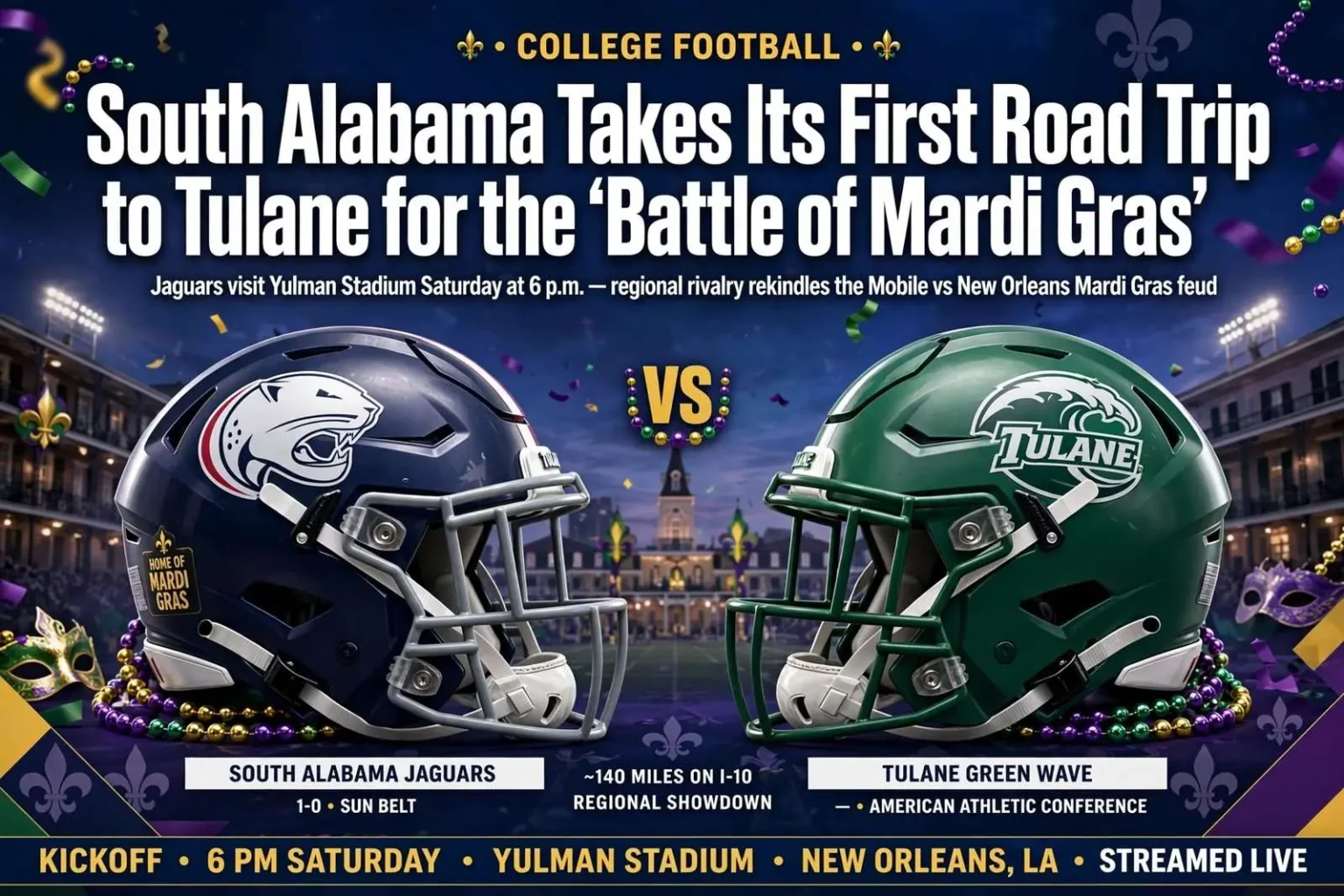
South Alabama will hit the road for the first time this season Saturday, traveling to New Orleans to face Tulane in a matchup that carries more than regional bragging rights — though it carries plenty of those too.
The Jaguars and Green Wave meet as part of Tulane’s Mardi Gras-themed home opener, which rekindles the familiar argument between Mobile and New Orleans over which city owns Mardi Gras. Kickoff is set for 6 p.m. at Yulman Stadium, and the game will be streamed live.
The Argument Behind the Nickname
Mobile’s claim rests on chronology. The city’s Carnival traditions predate New Orleans’ by a considerable margin, a fact Mobilians tend to state early and often. New Orleans’ claim rests on scale, visibility and the simple weight of what Mardi Gras has become there. Neither side has ever conceded, which is precisely why the argument endures.
It has found its way onto the field before. South Alabama wore helmets carrying a “Home of Mardi Gras” decal when the Jaguars traveled to Tulane in 2023 — a piece of trolling delivered at 65 mph on a Saturday afternoon, in a matchup between schools separated by roughly 140 miles of Interstate 10.
Familiar Faces on Both Sidelines
The regional connection runs deeper than Carnival. Tulane coach Will Hall spent part of his coaching career in the Sun Belt, serving as Southern Miss’ head coach from 2021 through the first seven games of the 2024 season. Hall and South Alabama coach Major Applewhite have crossed paths repeatedly over the years, giving each a working familiarity with the other and with the region they recruit.
Applewhite framed that kind of overlap as the normal way coaches are built.
“You take from people that you work with,” Applewhite said. “You take from experiences that you have.”
He also made clear he likes the matchup on its own terms.
“Love that game for us,” Applewhite said. “Played them a few times there and at home and like that kind of regional matchup.”
Part of the appeal is logistical as much as competitive. New Orleans is close enough that families and fans can make the drive, which changes the character of a road game. A regional trip produces a different atmosphere — and a different traveling crowd — than a flight to an unfamiliar city.
Yulman Is Small, and That Is the Point
Yulman Stadium opened in 2014, returning Tulane football to campus after decades of playing off-site, and it has spent the years since developing an atmosphere that visiting staffs talk about.
Applewhite described the venue as tight, close and intimate — the kind of building where the crowd sits near the field and noise has nowhere to dissipate. For an offense, that translates into a specific and practical problem: communication. Snap counts, protection calls, motion adjustments and audibles all depend on players hearing one another, and in a compact stadium a modest crowd can produce disproportionate difficulty.
Teams prepare for it the way everyone does — piped-in noise at practice, silent counts, hand signals — but preparation and execution are different things, and Saturday will be the first time this year’s South Alabama roster has to do it for real.
What the Opener Showed
The Jaguars opened the season with a 39-14 win over Southeastern Louisiana at Hancock Whitney Stadium. The headline numbers were emphatic: South Alabama scored on each of its first three offensive possessions, forced two interceptions, committed no turnovers, and controlled the ball for a program-record 37 minutes and 48 seconds.
A time-of-possession figure that large is not an accident. It is the product of sustained drives, third-down conversions and a run game that keeps the chains moving, and it has a defensive benefit as well — a defense that spends 22 minutes on the field is fresher in the fourth quarter than one that spends 35.
The interceptions came from Damyrion Darby and Jaylen Moson.
The Coaching Staff Was Not Satisfied
Both coordinators and the head coach spent the week pointing at the film rather than the scoreboard.
Defensive coordinator Todd Orlando said the unit missed tackles, had communication breakdowns that led to touchdowns, and generally did not play with the physicality he wants.
“We’re not as violent as we want it to be,” Orlando said.
He also framed the trip as a diagnostic.
“This is going to be the first time we’re on the road,” Orlando said. “It’s going to be good for us to figure out what we’re all about.”
Applewhite’s list on the offensive side was similarly specific: ball security, quarterback eyes, wide receiver timing and anticipation, and a lull that followed the three-possession opening burst. He also noted that fundamentals and pad level slipped as the game wore on, something he attributed in part to the sheer volume of snaps the offense ran while holding the ball for nearly 38 minutes.
The encouraging counterpoint came in the second half. After Southeastern Louisiana scored, the Jaguars answered as a complete team — special teams flipped field position, the defense forced a turnover, and the offense converted it into points. That sequence is the one Applewhite pointed to when asked what Saturday will require.
“You’ve got to prepare your mind, your body and your soul for a long game,” Applewhite said. “And we’re going to have to play that type of game in New Orleans.”
The Road Is a Different Test
For a roster with a large number of new faces — South Alabama opened the season with substantial turnover on the depth chart and a reshaped staff — Saturday is the first exposure to the parts of college football that do not show up in a home opener.
Orlando named them plainly: travel, crowd noise, an unfamiliar environment, and the requirement to hold the same standard of focus in all of it. Young players tend to discover on their first road trip that the game itself is the easy part. The bus, the hotel, the walk-through in a strange building, the pregame routine compressed into someone else’s schedule — all of it eats at preparation in ways that are hard to simulate.
What to Watch
- Time of possession, again. The opener’s 37:48 was a program record. If South Alabama can hold the ball anywhere near that on the road, it takes the crowd out of the equation for long stretches.
- Communication on offense. Applewhite flagged quarterback eyes and receiver timing after a home game. Yulman’s acoustics will not make either easier.
- Tackling. Orlando’s central complaint. Missed tackles that cost a few yards against an FCS opponent cost considerably more against an American Conference team.
- The response drive. Every road team gets punched at some point. The Jaguars showed in the second half of the opener that they could answer with all three phases; doing it in New Orleans is the actual test.
Kickoff Details
South Alabama at Tulane kicks off at 6 p.m. Saturday at Yulman Stadium in New Orleans. The game will be streamed live.
The Series and the Distance
South Alabama and Tulane are separated by about 140 miles of Interstate 10, which puts this in the small category of games that function as a regional matchup for both programs rather than for one of them. That distance is short enough that a Mobile family can leave in the afternoon and be in their seats by kickoff, and short enough that recruiting territories overlap meaningfully.
Applewhite’s comment about liking “that kind of regional matchup” reflects something programs at this level weigh carefully in scheduling. Non-conference games serve several purposes at once: they generate revenue, they test a roster before conference play, and they either build or spend goodwill with a fan base. A trip to New Orleans does all three better than a flight to an unfamiliar market, because the traveling support actually travels.
What a Program-Record Possession Number Actually Means
South Alabama’s 37 minutes and 48 seconds of possession in the opener is the kind of statistic that gets cited without much examination. It is worth unpacking, because it describes a philosophy rather than a fluke.
Time of possession is the downstream result of three things: converting third downs, running the ball efficiently enough to stay ahead of the chains, and avoiding the negative plays that create long-yardage situations. A team does not hold the ball for 38 minutes by accident, and it does not do it by throwing on every down — incompletions stop the clock.
The benefits are real but frequently overstated. Possession time does not score points; scoring efficiency does. What it does provide is a defensive advantage. A defense that plays 22 minutes instead of 35 is fresher in the fourth quarter, rotates fewer snaps onto backups, and gives up fewer explosive plays late. Against a team that wants to play fast, controlling the clock is also a way of limiting the number of possessions the opponent gets — which is a legitimate strategy for a team that believes it is the less explosive of the two.
The cost, as Applewhite noted, is snap volume on the offensive line and the fundamentals that erode with it. He specifically cited pad level slipping as the game went on, which is exactly what fatigue looks like in the trenches.
The Turnover Margin Question
The opener produced a plus-two turnover margin: two interceptions taken, none given away. Over a full season, turnover margin correlates with winning about as strongly as any single team statistic in college football.
It is also among the least stable statistics from week to week. Interceptions depend heavily on tipped balls, coverage disguise and quarterback decisions that vary by opponent. Fumble recovery is close to random. Coaches consequently talk about the process behind turnovers — ball security drills, punching at the ball, disguising coverage — rather than the number itself, because the number regresses.
Applewhite’s inclusion of “ball security” on his list of things to clean up after a game in which his team committed no turnovers is a version of that. He is describing near-misses that did not show up in the box score.
How to Watch
South Alabama at Tulane kicks off at 6 p.m. Saturday at Yulman Stadium in New Orleans, and the game will be streamed live. Fans making the drive should account for the same Interstate 10 congestion this newsroom has covered repeatedly, including the Wallace Tunnel bottleneck heading west out of Mobile — a factor on any Saturday afternoon departure toward New Orleans.