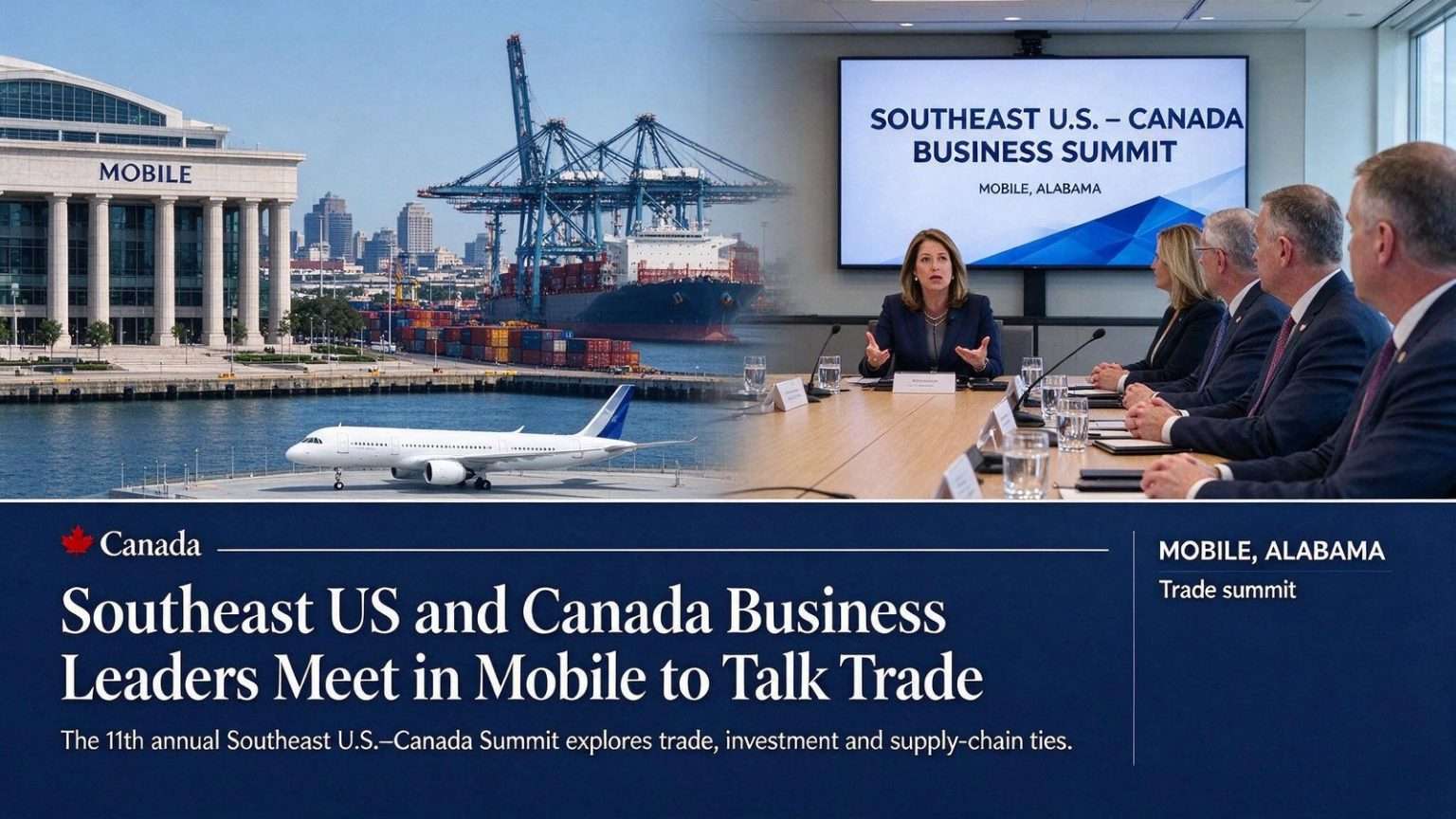
Business leaders from across the Southeastern United States and Canada gathered in Mobile this week to explore trade and investment opportunities, with one topic casting a shadow over the talks: newly announced steel and aluminum tariffs. The meeting marks the 11th year of a special trade relationship between Canada and six southeastern states, including Alabama, a partnership that has brought delegations of executives, economic developers and government officials together annually to deepen commercial ties across borders.
The summit’s return to Mobile underscores the Port City’s growing role in international commerce. Mobile is home to one of the fastest-growing deepwater ports on the Gulf of Mexico, a major Airbus final assembly line, and a manufacturing base that depends heavily on imported steel and aluminum for everything from shipbuilding to aerospace components. Those realities made the city a natural stage for conversations about what new trade barriers could mean for the region’s economy.
“The relationship between the southeast and Canada is strong, it is deep, it is broad,” said Nadia Theodore, Consul General of Canada for the Southeast United States. Theodore’s office covers a stretch of states whose companies export everything from automotive parts to agricultural products to Canadian buyers, and whose ports and factories in turn receive Canadian raw materials and investment. Her message to the assembled executives was that the relationship has weathered disputes before and is built on decades of mutual investment rather than any single transaction.
Tariffs Loom Over the Talks
President Donald Trump had announced tariffs on steel and aluminum imports from Canada just days before the summit, and the issue came up repeatedly in discussions. For delegates who had planned sessions around supply chains, logistics and investment attraction, the timing turned a routine economic development gathering into something closer to a strategy session. Company representatives traded notes on how the measures would hit procurement costs, and economic developers fielded questions about whether existing projects could be affected.
“Canada is Alabama’s number one trade partner,” said Greg Canfield, the Alabama Secretary of Commerce, who called this “a very opportune time” to discuss the partnership. Canfield’s department has spent years recruiting Canadian investment into Alabama and steering state exporters north, and he framed the tariffs not as an abstraction but as a direct question mark over some of the state’s most important industrial relationships.
Governor Kay Ivey said she planned to raise the state’s concerns directly with the president. “I have a good working relationship with President Trump and I certainly look forward to again letting him know our firm standings in support of the firms we have in our state that use those products,” Ivey said. Her comments reflected a tension playing out across manufacturing states: loyalty to a administration whose trade policies she broadly supported, set against the immediate interests of Alabama employers who buy Canadian steel and aluminum by the ton.
Alabama’s manufacturing economy gives those concerns particular weight. The state’s automotive industry, anchored by major foreign-owned assembly plants and a deep network of suppliers, depends on steady access to affordable metals. Shipbuilding operations along the Gulf Coast and the aerospace cluster growing around Airbus in Mobile draw on the same inputs. When the price of a raw material rises because of a tariff, that cost ripples through supplier contracts, project budgets and, ultimately, hiring plans.
Canfield pointed to the depth of the Alabama-Canada relationship as evidence of what is at stake. The partnership has produced a net export gain for the state, co-assembled vehicles that cross the border more than once before reaching a customer, shared technology between companies on both sides, and the Airbus-Bombardier C Series project that officials hope to see finalized in Mobile. None of those arrangements, he suggested, was created with national borders in mind, which is precisely why tariffs aimed at one segment of the flow can disturb all of it.
A Deep and Established Partnership
The annual Southeast-Canada summits have become a fixture of the region’s economic development calendar, rotating among member states and pairing formal programming with one-on-one matchmaking between companies. Over eleven years, the format has helped small and mid-sized firms find their first export customers and given Canadian companies a familiar landing spot when they look to expand into the American Southeast. Officials on both sides describe the relationship as less a trade agreement than a standing network of personal and corporate connections.
Canada consistently ranks among the top destinations for exports from southeastern states, buying automobiles and parts, chemicals, paper products, agricultural goods and aerospace components. In the other direction, Canadian firms have invested billions in the region, building plants, distribution centers and research operations that employ thousands. That two-way flow is why state commerce officials treat disruptions to Canadian trade as local economic news rather than foreign policy drama.
Quebec’s View From the Supply Side
Eric Marquis of the Quebec government noted that steel and aluminum make up about 15 percent of Canadian exports to the United States, much of it flowing into southeastern states like Alabama and Tennessee. Quebec is a major producer of both metals, and its delegates came to Mobile looking to reassure customers that Canadian supply is not a threat but a complement to the region’s manufacturing base. The province’s argument, familiar from prior trade disputes, is that Canadian metal is often processed and finished in American plants, meaning tariffs tax the same companies the measures claim to protect.
Marquis and other Canadian representatives warned that the measures would have a disruptive effect on the broader trade relationship, beyond the metals sector itself. History has shown, they argued, that when one layer of a supply chain is taxed, retaliation and re-routing follow, and the customers who ultimately pay are manufacturers and consumers on both sides of the border. They urged the American officials and executives in attendance to consider the tariffs’ cumulative effect on the investment climate, not just their impact on any single industry.
Questions for Mobile’s Aerospace Bet
Officials said it was too soon to say whether the tariffs would affect the Airbus-Bombardier project, but the uncertainty was enough to put the program back at the center of the conversation. The project, which would see work on the Canadian-designed C Series airliner carried out at the Airbus facility in Mobile, has been touted as a signature example of Alabama-Canada industrial cooperation. Any new cost pressure on aluminum or components crossing the border feeds directly into calculations about where that work will be performed and how quickly it will scale.
The C Series is a narrow-body airliner developed by Bombardier of Montreal, and Airbus’s involvement tied the program to both countries at once. Mobile’s assembly line, which already produces commercial aircraft for carriers around the world, was presented at the summit as proof that international partnerships can build entire industries in Alabama. The delegates’ challenge, several speakers acknowledged, is making sure trade policy does not undercut the very model that made those wins possible.
As the sessions closed, participants struck a pragmatic tone. The 11th edition of the summit produced the same handshakes and pipeline conversations as prior years, but with a shared understanding that the next year would test the partnership’s durability in ways the previous decade had not. Organizers said planning for the following year’s gathering was already underway, and both Canadian and southeastern officials pledged to keep the dialogue open — through whatever the tariff fight brings.
What the Partnership Looks Like on the Ground
The trade relationship shows up in places most Alabamians never think to look. Canadian-built components arrive at Gulf Coast shipyards alongside domestic steel. Alabama wood products, poultry and industrial chemicals move north through ports and rail lines in volume that keeps freight corridors busy year-round. Corporate travel between Birmingham, Huntsville and Toronto or Montreal is routine enough that economic development teams on both sides can name the executives who make the trip without consulting a directory.
Economic developers at the summit emphasized that these relationships compound over time. A supplier that locates in Alabama to serve one automaker often grows to serve several, and a Canadian firm that opens a small distribution office may expand into manufacturing once it understands the local workforce. Those slow-building investments are the hardest to replace if trade conditions sour, which is why state officials describe the tariff question as a threat to accumulated goodwill as much as to any single shipment.
The summit also served as a reminder of how Mobile fits into the picture. The city’s port handles container traffic and bulk cargo linking the Southeast to Atlantic markets, and its aerospace sector gives Alabama a stake in international aviation supply chains that most states its size lack. Local officials used the gathering to showcase the port’s expansion and the growth of the aircraft manufacturing campus, arguing that the region’s infrastructure is built for exactly the kind of cross-border commerce the partnership encourages.
For the Canadian delegations, the message they carried home was caution mixed with commitment. Representatives said their companies value the southeastern market and the relationships built over a decade of summits, but that trade friction raises the cost of every decision to invest or expand. For Alabama officials, the task in the months ahead will be demonstrating that the state’s welcome for Canadian business can survive a policy dispute neither side of the border asked for.