Spanish Fort’s Flag Football Team Wins the Area’s First Team of the Week After Beating McGill-Toolen
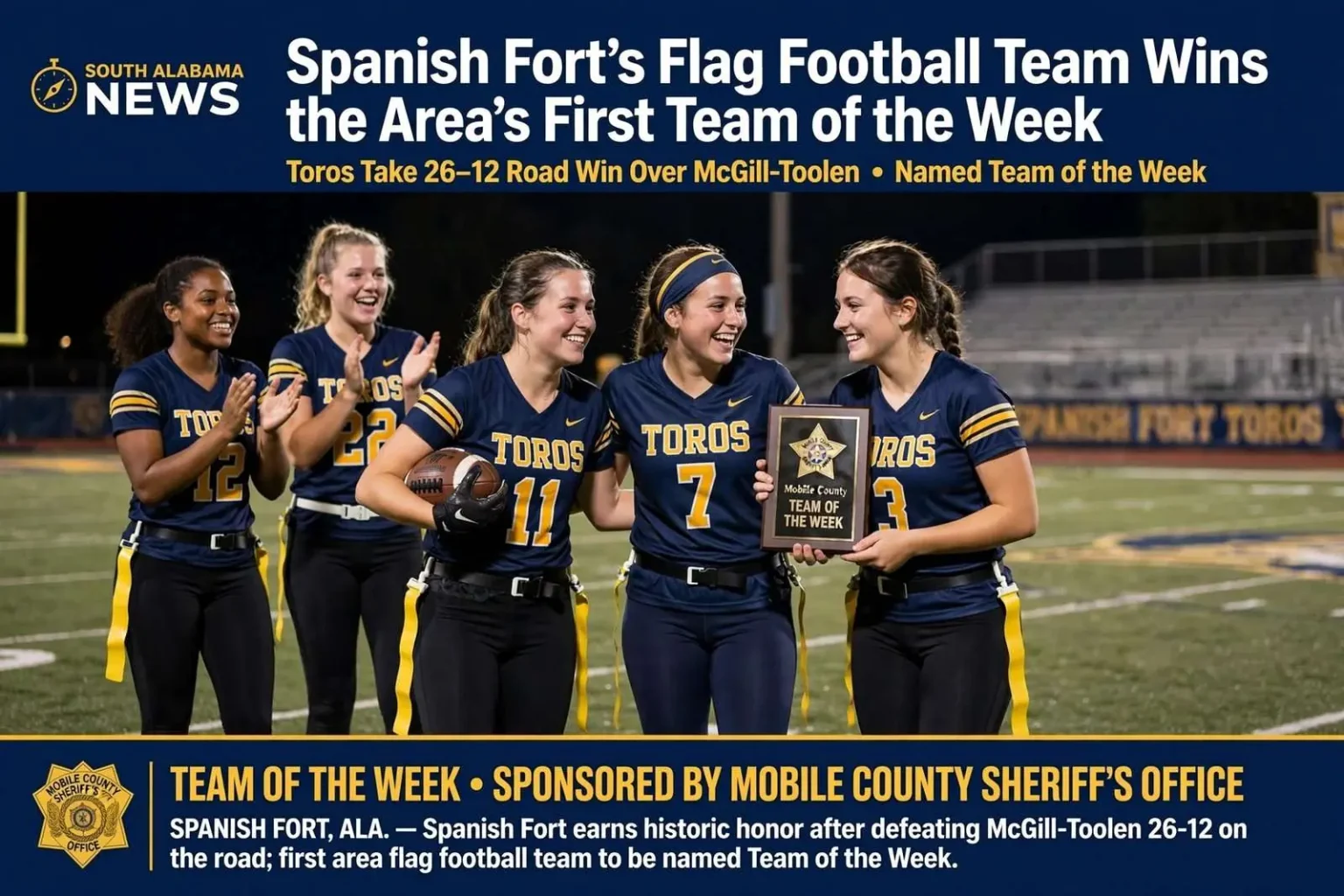
Spanish Fort beat McGill-Toolen 26-12 behind three touchdown passes from quarterback Kimberly Slaton and three team interceptions, earning the first Team of the Week award for an area flag football program.
SPANISH FORT, Ala. — Steady improvement is the goal of every team, and perhaps especially of Alabama High School Athletic Association flag football teams, in a sport still in the early stages of its organization.
That is the approach Spanish Fort has taken this season, and the Toros have shown improved play from their first game to their most recent outings — including a 26-12 road victory over McGill-Toolen.
That win earned Spanish Fort the Team of the Week award, sponsored by the Mobile County Sheriff’s Office. The Toros are the first flag football team from the area to claim the honor.
“We’re going to be good before it’s all said and done,” coach Matthew McDonald said. “I think right now we’re not as good as we’re going to be, but we keep getting better and better every day. That’s all you can ask. They’re doing everything we ask. We’ve got a few sayings that we go by, and they [include] forgetting every play and moving on to the next one; we’re going to be alright, we’ve just got to execute a little better.”
How They Beat McGill-Toolen
The Toros’ offense carried the day against the Yellow Jackets.
Quarterback Kimberly Slaton threw three touchdown passes. Ali Hollinger caught two of them. Maggie Pollock hauled in the other, a 57-yard score. Kylei Prescott opened the scoring with a 1-yard touchdown run.
Defensively, Hollinger added an interception to her two touchdown catches. Callie Wieck and Prescott also recorded interceptions.
The Toros converted most of their offensive possessions and forced McGill-Toolen to punt three times.
Three interceptions in a single game is a substantial number in any form of football, and in flag football — where the passing game accounts for nearly all offensive production — takeaways are close to decisive. A defense that intercepts three passes has ended three drives outright and handed its own offense three extra possessions.
“We’ve got a quarterback that can throw it, and we’ve got a couple of receivers that can go get it, and we’ve got speed on defense,” McDonald said. “If we can put it all together, we’ll be tough to deal with come November. I hope that’s going to be the case. You never know, though. You never know how a team’s going to gel together. We’re actually going faster and gelling faster than I thought we would this year.”
Measuring Against Last Year
McDonald was specific about the benchmark he is using.
“We’ve still got a long way to go. We’ll see what happens. They’re better, and it’s not even from the first practice; it’s from last year to this year is kind of what I’m judging on,” he said. “They’re kind of like your kids. Every team’s got a different personality, and even though we’ve got a bunch of people coming back, the personality is completely different than it was last year.”
That last observation — a returning roster producing a different team personality — is one coaches in every sport recognize and one that is difficult to plan around. Continuity of personnel does not guarantee continuity of chemistry.
The Season So Far
Spanish Fort opened with a close loss to Fairhope, then recorded a shutout victory over Robertsdale before beating McGill-Toolen.
A narrow opening loss followed by a shutout and a road win over a Mobile program is a reasonable trajectory, and it supports McDonald’s read that the team is improving week to week rather than holding steady.
A Difficult Region
The Toros compete in Class 5A, Region 1, alongside Baldwin County, Blount, Elberta, Murphy, Saraland and Theodore.
Asked how he expects Spanish Fort to fare under the new classifications, McDonald was candid about how far ahead he is looking.
“To be honest, I don’t know. I know we’ve got [Alma] Bryant next, and that’s all I know. I try not to focus on that,” McDonald said. “When we get to those teams, I’ll start watching film on them, and me and Coach [Jonathan] Raspberry will break it all down. But until then, I have not seen anything on anybody in our region yet. I imagine they’re pretty good. … It’s not going to be easy, and we’re not guaranteed anything.”
A Sport Still Taking Shape
McDonald’s framing of flag football as being in the early stages of organization is accurate and worth explaining for readers unfamiliar with how quickly this has developed.
Girls flag football has been among the fastest-growing high school sports in the United States over the past several years. State athletic associations have moved to sanction it in rapid succession, driven by participation demand, support from professional football organizations, and the sport’s addition to the Olympic program.
A newly sanctioned sport goes through a period that established sports have long since passed. Classifications and regions get redrawn as participation grows. Coaching staffs are assembled from people with varying backgrounds. There is limited film on opponents, no long history of head-to-head results, and no settled sense of which programs are traditionally strong.
McDonald’s comment that he has not seen anything on anybody in his region reflects that reality directly. In an established sport, a coach would have years of film and a clear sense of every regional opponent. In flag football, much of that simply does not exist yet.
What the sport does offer is genuine opportunity. Programs that build early can establish themselves before the competitive hierarchy hardens, and athletes have a competitive outlet that did not exist for previous classes.
What He Wants to See
“I want to see us execute a little better,” McDonald said. “We play hard, we’ll be physical, we’re fast and we’ve got speed. We’ve got skill. I just want to see us execute a little bit better. And we will. The more that we play and the more that we practice, when it matters, we’ll be executing.”
Next up for the Toros: Alma Bryant.
South Alabama News covers high school athletics across the region, including the growing flag football programs in Mobile and Baldwin counties.