Rep. Collier Steps Away From Bayou la Batre Consulting Deal
State Rep. Spencer Collier took a temporary leave from his consulting contract with the City of Bayou la Batre after the Ethics Commission advised him to step aside while BP oil spill money was moving through the state.
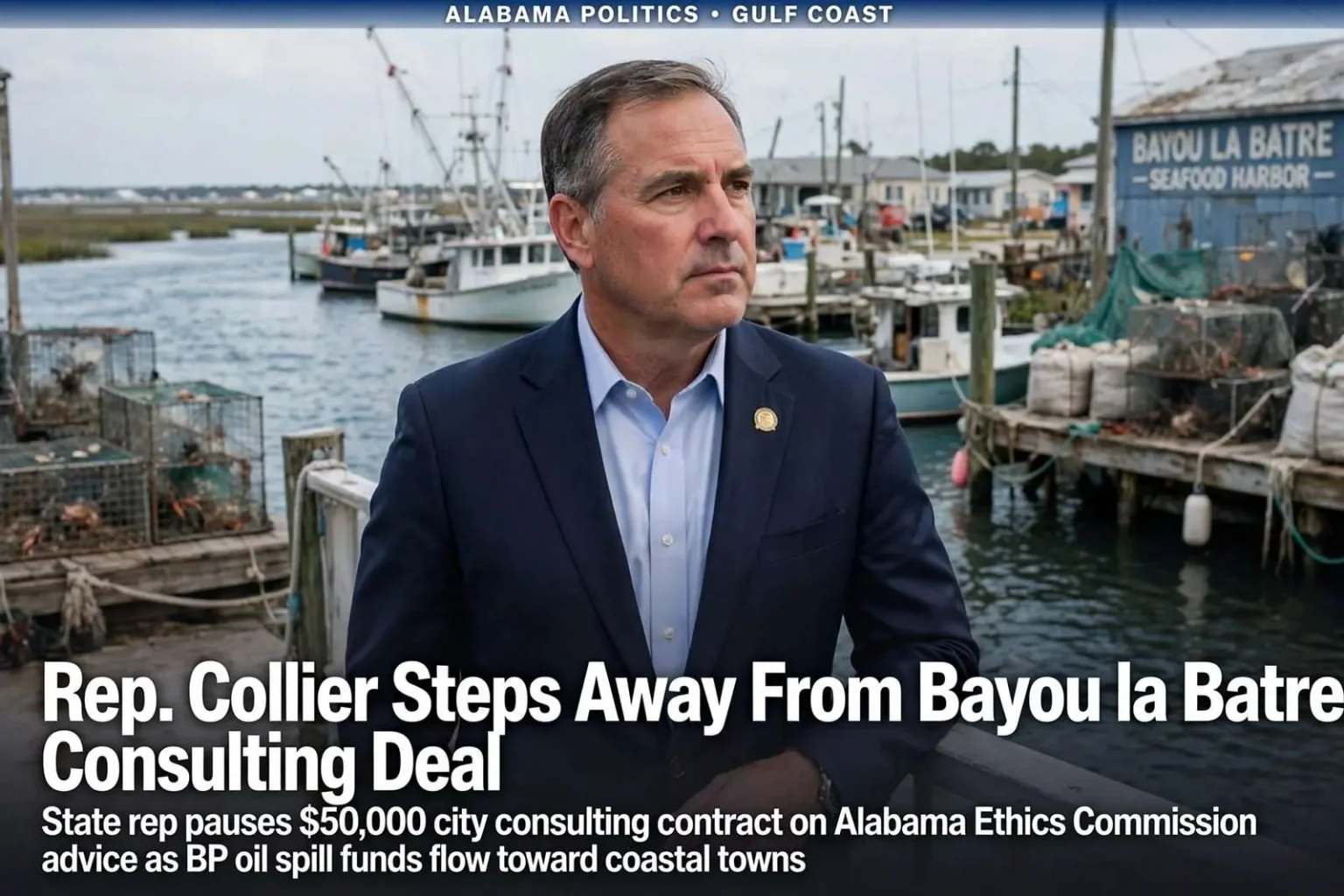
State Rep. Spencer Collier, R-Bayou la Batre, temporarily stepped away from a consulting contract with the city he represented, acting on the advice of the Alabama Ethics Commission as federal oil spill money began flowing through state channels. The move was a pre-emptive one — no complaint had been filed and no accusation made — but it reflected how treacherous the ethical ground had become along the Gulf Coast, where a single public figure could hold a hand in both the distribution and the receipt of the largest economic settlement in state history.
Collier took a temporary leave of absence from an annual $50,000 contract with the City of Bayou la Batre, under which he worked as an economic development consultant. He said the state Ethics Commission had advised him to step aside from the arrangement for as long as BP funding connected to the oil spill cleanup was passing through the state. The guidance reflected the tangle of roles that the Deepwater Horizon disaster created for public officials along the coast. Collier was at once a state legislator with a hand in how Alabama responded to the spill and a paid consultant to a city that stood to receive spill-related dollars. Rather than risk the appearance of a conflict, he chose to pause the contract while the money moved.
The amount at stake was not incidental. Fifty thousand dollars a year is a meaningful consulting engagement in a city the size of Bayou la Batre, and the fact that Collier walked away from it voluntarily — even temporarily — sent a signal to other coastal officials about the standard of care the moment demanded. Ethics advisors across the Gulf states spent the months after the spill fielding exactly this kind of question: which relationships are safe to keep, which must be suspended, and how public servants can do their jobs without their private business becoming an appendix to the disaster’s payouts.
Collier, a former state trooper and legal investigator, said he remained active in other business ventures during the leave. Those included logistics work and investigative assignments for both plaintiff and defense law firms, lines of work separate from his municipal consulting role. His decision to step back voluntarily, on the commission’s advice rather than in response to any complaint, underscored how carefully coastal officials were treading as unprecedented sums of BP money headed toward local governments. With claims, cleanup contracts and relief funds all in motion, the potential for overlapping interests was considerable, and ethics questions were never far from the surface.
A busy figure on the coast
Collier was among the more visible legislators in south Mobile County during the crisis. He represented a district that included some of the communities most exposed to the spill, from Bayou la Batre to the surrounding fishing and shipbuilding areas, and he had taken an active role in connecting his constituents with candidates and officials responding to the disaster. In a district where livelihoods were tied directly to the health of the Gulf — boats tied up at the dock, processors running short on product, shipyards waiting on insurance — the local legislator became a front-line figure almost overnight.
He had helped arrange gatherings between statewide candidates and local seafood and coastal industry figures, and he was a familiar presence at community events. Those forums gave residents of the Bayou a direct line to the officials who would decide how spill money, relief programs and regulatory responses reached their communities, and they made Collier a central connector in a region where every meeting about the spill packed the house. The visibility was earned: south Mobile County’s seafood towns were among the hardest-hit communities in Alabama, and their recovery questions were the most urgent in the district.
By setting aside the Bayou la Batre contract, Collier aimed to keep his legislative duties clear of any question tied to the flow of oil spill funds. The arrangement was described as temporary, with the expectation that the consulting relationship could resume once the extraordinary circumstances that prompted the pause had passed. In the meantime, the city’s economic development work would go on under other direction while its consultant-legislator could advocate for his district without a daily conflict of interest in the background.
The Alabama Ethics Commission’s role in the episode was quiet but pivotal. The commission, which issues advisory opinions and informal guidance to public officials on conflicts of interest, operates on the principle that prevention is the enforcement tool that matters most. An official who asks the question before the money moves can structure his affairs cleanly; one who asks afterward does so under a cloud. Collier’s decision to seek and follow the commission’s guidance placed his situation squarely in the advisory channel the state built for exactly these moments, and the leave of absence was the practical answer the guidance produced.
The temporary nature of the arrangement matters for the city as well as the legislator. Bayou la Batre’s economic development needs did not pause with the contract — the spill made the city’s need for diversification, waterfront investment and grant writing more urgent than ever — and a permanent gap in consulting support would have compounded the disaster. The expectation that the arrangement would resume once the extraordinary circumstances passed allowed both sides to plan around a known gap rather than an open-ended one, preserving a working relationship that predated the spill and would be needed in the recovery that followed it.
For the public, the episode was a rare transparent look at how conflict-of-interest management actually works at the local level. The dramatic version of an ethics story involves accusations and hearings; the common version involves a phone call to Montgomery, some candid advice and a public official giving something up. Collier’s pause of a $50,000 contract fell into the second category, and its visibility — in a region where every family was touched by the spill — helped set expectations for how the business of recovery would be conducted: carefully, openly, and with the appearance of propriety treated as seriously as the law itself.
For Bayou la Batre, a small city heavily dependent on the seafood industry, the episode was one more example of how the spill reached into nearly every corner of coastal governance, reshaping even the routine contracts and consulting deals that ordinarily drew little notice. A consulting arrangement that would have attracted no attention in an ordinary year became, in the spill economy, a matter for the Ethics Commission. The same recalibration was happening everywhere along the coast — city attorneys re-reading contracts, council members disclosing relationships that had never before required disclosure, mayors asking whether their own business ties touched the money now moving through the system.
The scale of the funds explains the caution. Billions of dollars in cleanup spending, claims payments and economic damages were flowing toward the Gulf Coast, and Alabama’s share was routed through state agencies and then out to local governments. Every dollar that reached Bayou la Batre passed through hands that legislators could influence — appropriations, oversight, emergency measures — and it was that overlap between the statehouse and the payout pipeline that the Ethics Commission’s advice was designed to manage. A legislator who also consulted for a receiving city could not fully separate the two roles in the public’s mind, and the appearance of a conflict, in ethics law as in politics, is often as damaging as the reality.
Bayou la Batre’s dependence on the seafood industry made the stakes concrete. The city’s shrimp and oyster fleets, its processing houses and its shipyards form the backbone of the local economy, and when the fishing grounds closed and the brand of Gulf seafood took a hit, the damage ran straight through the city’s tax base. Spill-related funds were not abstract windfalls for Bayou la Batre; they were the difference between a fleet that survives and one that dissolves. That urgency made the integrity of the city’s dealings in the process all the more important, and Collier’s pause — uncomfortable as it was — preserved the cleanliness of the city’s claim to every dollar it pursued.
The episode also became a reference point for other officials facing similar choices. Stepping aside from real income is a genuine sacrifice, and Collier’s willingness to do it on advice rather than compulsion modeled the kind of judgment that, ethics officials hoped, would become the norm rather than the exception during the payout years. As the recovery stretched on and the money kept moving, the question was never just how much would reach the coast, but whether the process of getting it there would hold up to scrutiny. For a season at least, in Bayou la Batre, it did — because the people involved chose caution over convenience.