State and Baldwin County Break Ground on $17 Million Six-Lane Boat Launch in Orange Beach
The Launch at ICW brings a $17 million GOMESA-funded six-lane boat ramp to Orange Beach at the Foley Beach Express toll bridge.
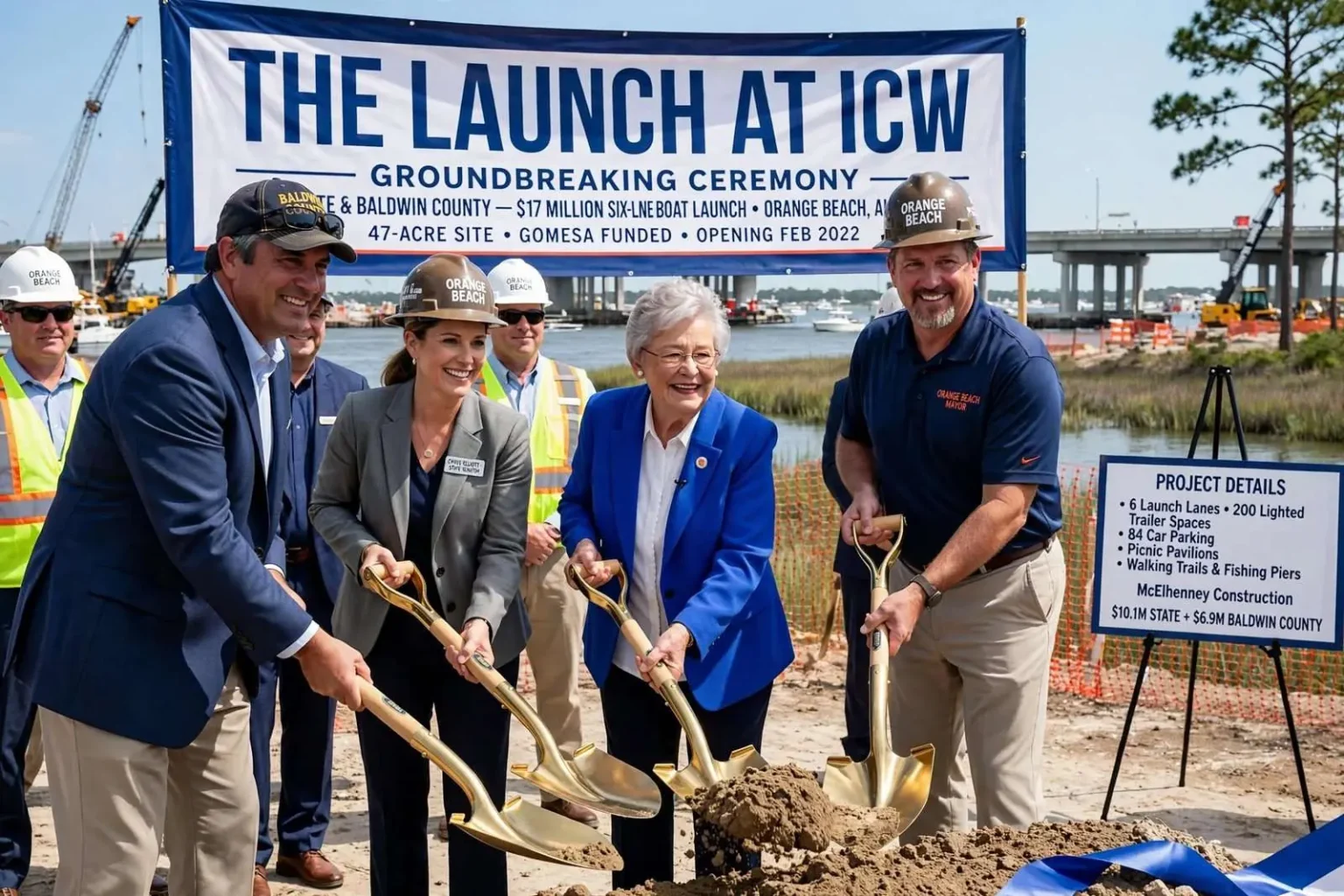
Gov. Kay Ivey joined local and state officials in Orange Beach to break ground on “The Launch at ICW,” a $17 million, six-lane boat launch rising on 47 acres at the foot of the Foley Beach Express toll bridge. The project is funded with Gulf of Mexico Energy Security Act dollars — $10.1 million from the state and $6.9 million from Baldwin County — drawn from offshore oil revenue that Ivey has pushed to keep on Alabama’s coast.
“This will truly be an asset to the entire coast,” the governor said at the ceremony.
What the Site Will Include
Plans call for six launch lanes, 200 lighted boat-and-trailer spaces, 84 passenger car spots, six covered picnic pavilions, a 600-square-foot grand pavilion and a restroom facility, along with more than a half-mile of sidewalks. Walking trails, wooden bridges and fishing piers are to follow in later phases, rounding out a site designed to function as much as a waterfront park as a working boat ramp.
McElhenney Construction is the lead contractor, and officials projected an eight-month build for an opening around February 2022, weather permitting. That timeline puts the new facility on line well before the next peak boating season, when demand along the Baldwin County shoreline historically overwhelms the public access points that exist today.
The location is central to the project’s promise. The Foley Beach Express bridge carries the Intracoastal Waterway crossing that links central Baldwin County to the beach communities, and the 47-acre tract beside it sits directly on the waterway that connects Mobile Bay to Perdido Bay. Boaters launching there can run the Intracoastal in either direction, reach the back bays and bayous that shelter small craft, or head toward the Gulf passes without first idling through miles of residential canals.
Where the Money Came From
The financing arrangement is as notable as the facility itself. The Gulf of Mexico Energy Security Act, passed by Congress in 2006, directs a share of federal offshore oil and gas revenue to the four Gulf Coast states, with Alabama’s portion earmarked for coastal conservation, hurricane protection and public access projects. For years, debate raged in Montgomery over whether those dollars should flow into the state’s general budget or remain on the coast that generates them.
Ivey has been a consistent advocate for keeping the money on Alabama’s coastline, and the launch project is a direct product of that position. The state’s $10.1 million share and Baldwin County’s $6.9 million contribution together cover the full construction cost, meaning the facility will be built without local tax increases or entrance fees to recoup it, and the revenue that built it comes from energy production in federal waters off the very shoreline it serves.
A Coast Running Out of Ramp Space
The need for the project has been building for years. Alabama Conservation Commissioner Chris Blankenship said demand for outdoor recreation access was “through the roof,” noting that the Ivey administration had already upgraded launches in Bayou La Batre, Dauphin Island, on the Causeway, in Daphne and Satsuma while repairing the storm-damaged Fort Morgan pier and facilities at Gulf State Park. Taken together, those projects amount to the most sustained investment in public coastal access the state has undertaken in recent memory.
Orange Beach Mayor Tony Kennon framed the moment in blunter terms, calling 2021 the busiest beach year on record. Boaters arriving with trailers found public ramps overflowing, he said, and some were forced to park miles from the water before shuttling back to retrieve their vehicles. The city’s existing launches, built for a smaller community, were never designed to absorb the traffic that comes with Baldwin County’s explosive residential growth and the resort boom along the beach strip.
The pressure extends beyond Orange Beach city limits. State Sen. Chris Elliott, who proposed the project, called it transformational for boaters in Orange Beach and across Baldwin County, where county launches in Lillian, Seminole and at Stockton’s Live Oak Landing and Fish River have kept growing more crowded as the county’s population expands. Each new subdivision in Foley, Summerdale or Magnolia Springs adds trailers to the same limited network of public ramps, and weekend mornings during warm months routinely find every one of them at capacity.
What It Means for the Region
For residents, the launch changes the arithmetic of a day on the water. A six-lane facility with 200 trailer spaces can process in an hour what a two-lane ramp handles in a morning, cutting the dawn-patrol competition for parking and shortening the lines that snake out of ramp entrances on summer Saturdays. Lighted spaces extend the usable day for anglers who launch before sunrise or return after dark.
The site also positions the city for the kind of regional events that require serious infrastructure, from fishing tournaments that draw hundreds of boats to paddle-sport races and waterfront festivals. A grand pavilion and picnic areas give non-boating family members a place to spend the day, which broadens the facility’s reach beyond the ramp itself.
Kennon’s longer-range vision reaches further than the launch itself. He said the city eventually plans trail connections along the Intracoastal Canal to The Wharf, the entertainment district a short distance west that draws visitors with its amphitheater, marina and giant Ferris wheel. Linking the two by a continuous waterfront trail would tie the launch into Orange Beach’s broader network of paths and make it a stop for cyclists and pedestrians as well as boaters.
The walking trails and wooden bridges planned for the site’s later phases point in the same direction, threading through the acreage between the bridge approach and the water and giving the public access to stretches of shoreline that have long been invisible behind private property and roadside marsh.
The Bigger Picture for Baldwin County
The Launch at ICW arrives as Baldwin County continues to rank among the fastest-growing counties in Alabama, with new rooftops following the beach highway corridor south from Foley and Gulf Shores spreading toward the state line. Growth of that magnitude strains every kind of public infrastructure, but water access is uniquely unforgiving: there is only so much shoreline, and ramp construction requires both waterfront land and the upland acreage to store trailers, a combination that grows scarcer and more expensive each year.
Securing 47 acres at the base of a major bridge — before it could be carved into condominium parcels — is the kind of opportunity that rarely presents itself twice, which is why local officials moved to lock it in with a mix of state and county GOMESA dollars. The alternative, officials have noted, was watching the last large undeveloped tract on the waterway disappear while the county’s trailer counts kept climbing.
For now, the cranes and construction fencing mark the beginning of an eight-month countdown. When the gates open around February 2022, weather permitting, the first boaters to back down the new lanes will be testing whether six lanes and 200 spaces are enough — and for the first time in years, the answer on a summer Saturday morning may actually be yes.
The groundbreaking itself carried symbolic weight for the officials who attended. Ivey’s presence underscored the state’s commitment to the coastal-access agenda her administration has pursued through the Conservation Department, and it marked the culmination of a planning effort that involved the city, the county and state agencies working from the same set of drawings rather than competing for the same dollars. Elected officials from across Baldwin County filled the podium roster at the ceremony, a reflection of how many municipalities stand to benefit when ramp capacity on the waterway finally expands.
Blankenship’s department will ultimately play a role in the facility’s life beyond construction, as the state’s marine resources and conservation arms regularly coordinate with local governments on the operation and upkeep of major public launches. Maintenance dredging at the launch basins, lighting and security, and the long-term care of the trails and pavilions will all outlast the eight-month build, and the GOMESA revenue stream is expected to keep contributing to coastal projects of exactly this type for years to come. The launch joins a portfolio of access improvements stretching from the western shore of Mobile Bay to the Florida line.
For the boaters who endured the overflowing ramps of the past two seasons, the timeline is the part that matters. Eight months from groundbreaking to opening is an aggressive schedule for a project of this size, but a facility that arrives before the next peak season will deliver relief exactly when the pressure peaks. If the weather cooperates and the contractor holds the schedule, the Launch at ICW will open its six lanes with the spring fishing run already underway, transforming one of the coast’s most frustrating morning rituals into something closer to a routine trip to the water.