
State Senator’s Company Received Hundreds of Thousands in Oil Spill Contracts While He Oversaw BP Funds
State Sen. Trip Pittman's company received hundreds of thousands in oil spill cleanup contracts while he controlled $15 million in BP funds.
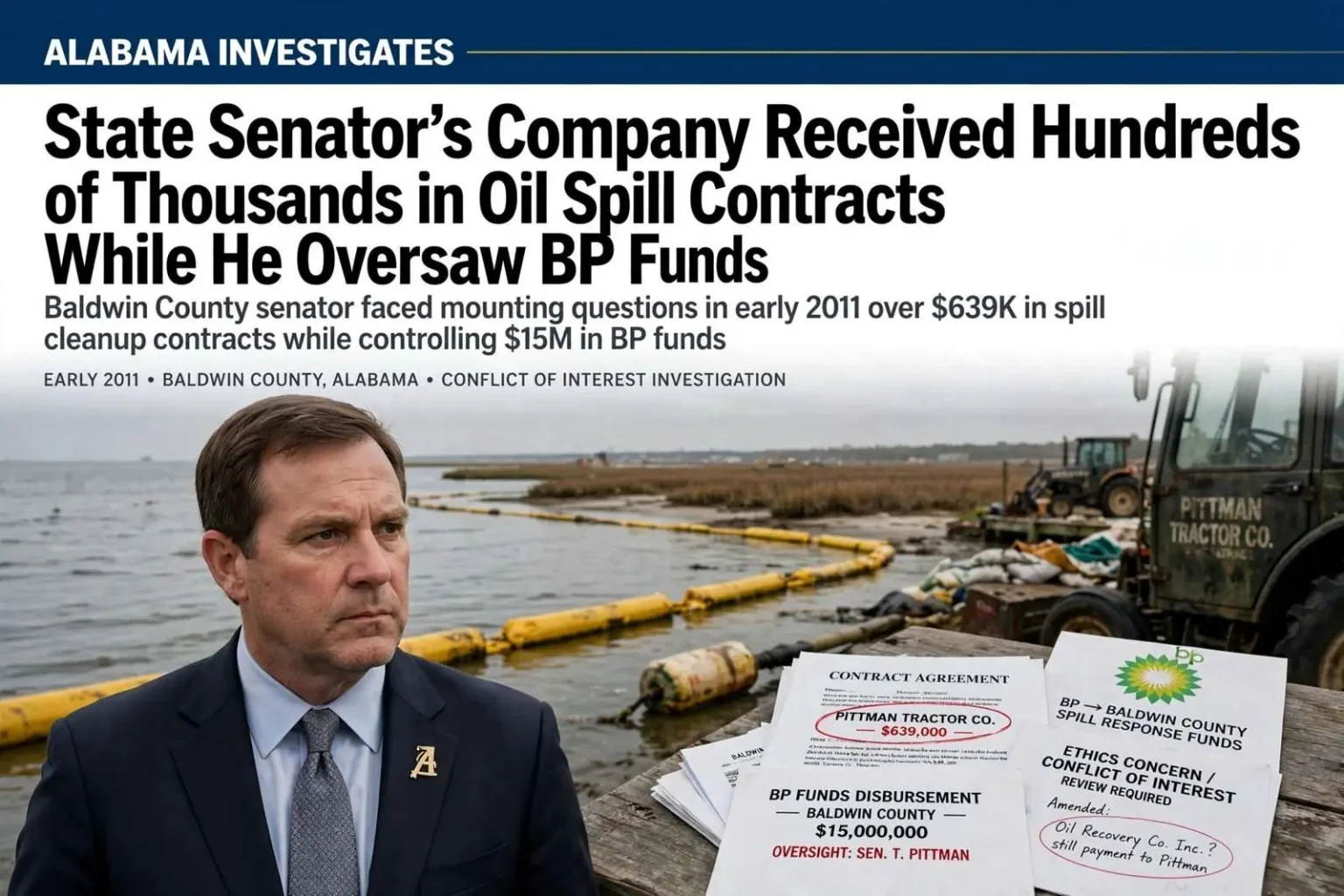
A Baldwin County state senator faced mounting questions in early 2011 over his company’s receipt of substantial oil spill cleanup contracts — even as he held authority over the disbursement of millions in BP funds earmarked for the county.
State Sen. Trip Pittman’s firm, Pittman Tractor Co., was awarded $639,000 by the City of Fairhope for oil spill response work. At the time, Pittman was responsible for overseeing the distribution of $15 million that BP had provided to Baldwin County for spill-related costs.
The dual role was the problem critics kept returning to. The Deepwater Horizon disaster had put money and cleanup work in motion at once: BP was writing checks to local governments for response costs, and someone had to decide how the county’s share was spent. Pittman held both sides of that equation in his own hands — a company doing paid spill work for municipalities, and a senator deciding where BP’s county money went.
Ethics Concerns and Paperwork Changes
When Baldwin County Emergency Management Agency Director Leigh Anne Ryals flagged the arrangement as a potential conflict of interest, county legal counsel Scott Barnett reportedly determined that it posed an ethics violation.
According to reports, Pittman subsequently submitted revised paperwork listing a different entity, Oil Recovery Co. Inc., as the contractor rather than Pittman Tractor. Despite the change in documentation, the city still directed payment to Pittman for the work.
The paperwork revision became a focal point of the controversy. Changing the named contractor after questions were raised — while the payment still flowed to the same man — struck critics as cosmetics rather than cure, and it handed ethicists the kind of document trail that makes a conflict case easy to follow: the concern, the legal opinion, the amended form, and the check.
Other local business owners said they were excluded from the contracting process. Silverhill businessman Don White told the Press-Register that he had shown Pittman an absorbent barrier boom product but received no follow-up, and was never informed that Pittman had authority over the BP funds.
White’s account touched the most sensitive nerve in any emergency contracting dispute: fairness to the local businesses that depend on public work. The spill had idled fishing fleets, charter boats and coastal tourism operators across Baldwin County, and many of them hoped to recoup losses through response contracts. An owner who believed the channel to those contracts ran through a competitor who was also the official overseeing the fund had reason — and standing — to be angry.
Complaints Filed, Calls for Resignation
Fairhope resident Paul Ripp filed formal complaints with the Alabama Attorney General’s Office, the Alabama Ethics Commission, and other agencies. The Constitution Party of Alabama called publicly for Pittman’s resignation.
The complaints moved the dispute from the editorial page into the institutions built for it. The state Ethics Commission hears alleged violations of Alabama’s ethics law, and the Attorney General’s Office can pursue criminal referrals; both bodies could examine the contract records, the amended paperwork and the payment trail. Formal complaints also preserve a record that outlasts news cycles — a fact that would matter as the story faded and returned. And they gave the episode a paper trail independent of any newspaper’s reporting.
Meanwhile, several Baldwin County officials who had raised questions about the contracting arrangements reportedly faced professional consequences. Ryals and County Administrator Michael Thompson, among others who questioned Pittman’s involvement, either resigned or were demoted from their positions.
That sequence drew its own scrutiny. In most accounts of government contracting disputes, the officials who raise conflicts of interest are treated as the control system working; when those officials leave or lose standing afterward, observers ask whether the process punishes disclosure. Ryals had run the county’s emergency management through the spill itself, and her departure was read locally as a cost of the controversy that had nothing to do with the cleanup.
Additional Contracts and Financial Interests
The Town of Perdido Beach separately paid Pittman $98,000 for oil spill work. In that municipality, City Councilman William Kelley received more than $300,000 and Councilman Ronnie Resmondo nearly $10,000 for similar work.
The Perdido Beach figures broadened the pattern beyond a single city’s contract. The small eastern-shore town had been directly in the spill’s path, and its response spending — distributed to a sitting senator’s company and to two of its own council members — illustrated how widely spill money moved through public offices where private business and public authority overlapped.
Baldwin County Commissioner Bob James, who was a business partner of Pittman’s through Eastern Shore Materials Inc., was quoted by the Press-Register saying he did not support continuing certain county contracts after taking office. James said the “legislative delegation” had expressed concerns about Ryals, though members of the local legislative delegation told the newspaper they had nothing negative to say about her and praised her leadership.
The exchange left James’s account contradicted by the very delegation he cited. When the senators named as sources of the concerns disavowed them, the commissioner’s stated reason for moving against the county’s emergency management director stood unsupported — a discrepancy that fed the wider suspicion that the contracting dispute and the personnel changes were connected.
County and state records also showed that Pittman and Commissioner James held financial interests in property near a proposed interchange at Baldwin County Road 13 and Interstate 10 — a project Pittman had been actively promoting.
James’ company, James Bros. Excavating Inc., was also awarded a $1.1 million contract by Fairhope for hurricane debris removal, a contract previously held by Pittman Tractor Co. Both companies operated from adjacent properties on Milton Jones Road in Daphne, with their joint venture, Eastern Shore Materials Inc., located behind them.
The geography told the story compactly: a senator’s firm and a commissioner’s firm side by side on the same road, sharing a joint venture between them, trading a municipal contract, and both holding land near a highway project the senator was promoting. None of the individual elements was automatically improper, but together they drew a map of intersecting public and private interests that residents could trace without a lawyer.
Former Daphne Mayor Harry Brown publicly questioned no-bid contracts issued in connection with Renaissance LLC, a company partly owned by Pittman and Eastern Shore Materials, which had received a large municipal bond issue. Brown also drew attention to related political contributions.
Brown’s objections reached back before the spill, into the larger pattern of development deals in which Pittman’s companies figured. No-bid municipal contracts and bond-financed development are the areas where Alabama’s weak competitive-bidding rules give public officials the most discretion, and a former mayor raising them gave the criticism the weight of someone who had sat on the other side of the council dais.
Pittman Fires Back: ‘Vendetta,’ Says Mayor Calls Criticism Conspiracy Theory
In early February 2011, Pittman publicly responded to the ethics complaints for the first time, dismissing them as a political grudge or vendetta, while Fairhope Mayor Tim Kant characterized accusations implicating the city as conspiracy theories.
Kant acknowledged to reporters that Pittman had an adverse reaction when told the spill-response contract should have gone out to bid rather than being awarded directly.
The mayor’s concession was notable. While defending the city against conspiracy characterizations, Kant confirmed that the question of competitive bidding on the spill work had been raised directly with the senator — and that the senator’s reaction had been adverse. It placed the dispute’s origin not in rumor but in a specific, acknowledged exchange about process.
The controversy did not slow Pittman’s rise in Montgomery: despite the pending claims, he was named chairman of the Senate Finance and Taxation-Education Committee, the panel responsible for the state education budget.
Observers noted that no investigation of the complaints had been announced by the new legislature.
The chairmanship demonstrated how Alabama’s legislative seniority and leadership structures absorb controversy. The budget-writing committee chairmanship is among the most powerful positions in state government, controlling the flow of the education trust fund, and a first-term senator’s ascent to it signaled that his colleagues weighted the unresolved complaints lightly — or that the alternative accounts of the episode had persuaded them.
Pittman expressed regret about the optics in comments to Lagniappe: “Certainly I didn’t understand public perception of how seriously some people take that you shouldn’t do business when you’re in office, and I understand that now.” He later told the Press-Register editorial board he wouldn’t do it again.
The admissions stopped short of conceding any violation — they addressed perception, not conduct. But they amounted to a rare acknowledgment from a sitting legislator that the practice itself was the problem, and they became the quotes to which every later account of the episode returned.