Historic Mobile Church Marks 195th Anniversary With Revival, Concert and Guest Speakers
State Street AME Zion Church in Mobile is celebrating its 195th anniversary with a revival, a free gospel concert and a visit from Alabama State's president.
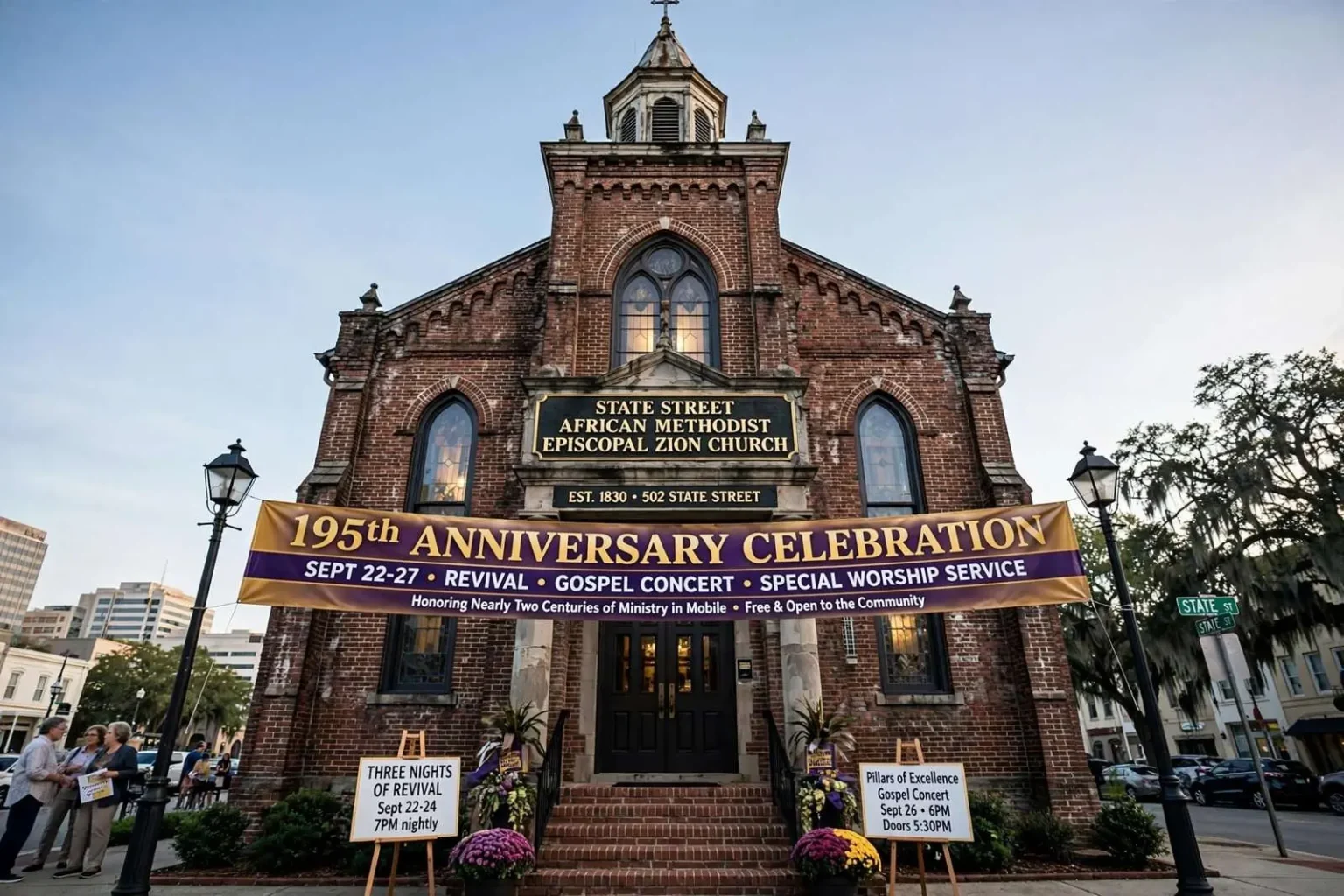
One of Mobile’s most historic congregations, State Street African Methodist Episcopal Zion Church, is marking a major milestone this month with a multi-day celebration honoring nearly two centuries of ministry in the city.
The church, located at 502 State Street in downtown Mobile, is observing its 195th anniversary with a schedule of revival services, a community gospel concert and a special worship service featuring a prominent guest speaker. The anniversary celebration reflects the congregation’s long-standing role as one of the anchor institutions in Mobile’s historically Black church community, a tradition that stretches back to the early 19th century.
A congregation old enough to count its age at 195 years has been part of the city’s story through events most institutions never touch: the antebellum era, the Civil War and Reconstruction, the rise and dismantling of Jim Crow, the civil rights movement and the long demographic and economic shifts that have reshaped downtown Mobile around it. Churches like State Street AME Zion survived those eras because they were never only places of worship — they were schools before public education was open to Black children, meeting halls, mutual aid societies, and the organizational backbone of a community whose institutions were often built by its churches first.
State Street itself runs through the heart of downtown Mobile, and the church’s location places it among the oldest congregations in the city center, within reach of the neighborhoods its members have historically called home. Anniversaries of this scale are as much reunions as services, drawing former members, clergy who have passed through the pulpit over the years, and civic guests from across the Gulf Coast.
Three nights of revival
The celebration opens with a three-night revival running from September 22 through 24, with evening services beginning at 7 p.m. each night. The visiting evangelist leading the revival serves as first assistant pastor at a large congregation in New Orleans, bringing a regional perspective to the anniversary observance.
Revivals hold a particular place in the rhythm of Black church life on the Gulf Coast. A multi-night series gives a congregation time to build — attendance grows night by night, the preaching develops a thread across the evenings, and the extended music and prayer services create the kind of sustained fellowship that single Sunday services cannot. Inviting a New Orleans minister to lead the series also honors the deep ecclesiastical ties between Mobile’s and New Orleans’ Black church communities, two port cities whose religious traditions have traveled back and forth across the Gulf for generations.
Evening revival services at 7 p.m. are timed to be accessible — after work, after school, early enough for older members — and congregations typically open the services to the public, welcoming sister churches and visitors to fill the pews alongside the host membership.
The Pillars of Excellence Gospel Concert
The concert’s billing as “Pillars of Excellence” reflects the anniversary theme in miniature: the evening is designed to honor the people and institutions — churches, schools, families, civic organizations — that have held up the community the congregation has served for nearly two centuries. For a downtown church whose blocks have changed dramatically around it, the concert doubles as an invitation to the newer downtown, the residents and workers who have arrived with the city’s revitalization, to step inside a building whose history long predates them. Events like this, free and open to all, are how congregations of State Street’s age keep the surrounding neighborhood acquainted with their presence and purpose.
On September 26, the church is hosting a free community event billed as the Pillars of Excellence Gospel Concert. Doors are set to open at 5:30 p.m. ahead of a 6 p.m. start, and the evening will be hosted by a familiar face to Gulf Coast television viewers, a local news anchor who has emceed numerous community events across the Mobile area.
Gospel concerts of this kind have long served as a way for Mobile-area churches to draw in the broader community, regardless of denomination, for an evening of music and fellowship. The form blends choirs, soloists and groups drawn from the host congregation and its guests, and the free-admission format is deliberate: the event is offered to the neighborhood as much as to the membership, a gesture of thanks and outreach that mirrors the community role the church has played for nearly two centuries.
Gwendolyn Boyd and the HBCU connection
The anniversary festivities culminate on September 27 with a 10 a.m. worship service featuring Gwendolyn Boyd, president of Alabama State University, as the guest speaker. Boyd’s appearance ties the anniversary to the broader network of historically Black colleges and universities and their long relationship with AME Zion congregations across the South.
Alabama State University, founded in Montgomery in the 19th century by freedmen determined to educate themselves, carries an origin story that parallels the church’s own — institutions built by Black Alabamians for their communities at times when the wider society offered none. Boyd, an Alabama State alumna and engineer who rose through the ranks of the nation’s aerospace and engineering establishments before returning to lead her alma mater, embodies the trajectory such institutions make possible, and her presence at a 195th anniversary service connects the pulpit to the classroom in a way both traditions recognize.
The ties between HBCUs and historically Black denominations run deep and practical. Churches hosted early classes and fundraising drives when the colleges had no campuses of their own; ministers promoted higher education from their pulpits; and generations of students arrived at campuses like Alabama State carrying the encouragement of their home congregations. A university president speaking from an anniversary pulpit is a continuation of that exchange, bringing the institution back to the communities that built it.
A denomination born of separation
AME Zion churches trace their roots to the late 18th century, when the denomination was formed in response to racial discrimination within predominantly white Methodist congregations. What began as Black Methodists in New York insisting on their right to worship with dignity grew into a full denomination — the African Methodist Episcopal Zion Church — that spread across the northern states and, after the Civil War, southward with missionaries, educators and freedmen organizing congregations across the former Confederacy.
Churches like State Street AME Zion became central gathering places for Black communities in the decades that followed, serving not only as houses of worship but as hubs for education, mutual aid and civic organizing. Their buildings housed meetings that other venues would not allow; their pastors served as negotiators, advocates and community spokesmen; and their membership rolls read like directories of the local Black professionals, craftsmen, educators and families who anchored each generation. In cities like Mobile, the presence of a longstanding AME Zion congregation marked the existence of a settled, self-sustaining Black community at a time when such communities faced every institutional barrier the state and city could devise.
That history is precisely what a 195th anniversary measures. A congregation reaching 195 years in a single city reflects generations of continuous ministry through Mobile’s most turbulent and transformative periods — through pandemics, wars, depressions and hurricanes, and through the slow, contested expansion of civil rights in Alabama.
The choice of a Sunday morning closing service follows the pattern of major church anniversaries across the region: the celebration builds across the week — revival, concert, worship — and ends where the congregation’s life is centered, in the Sunday service, with the sanctuary filled beyond its usual attendance. Music, collections and fellowship meals typically extend the morning well past noon, and members who moved away from Mobile often time home visits to coincide with milestone celebrations of this kind, making the closing service part reunion, part homecoming and part civic occasion.
Looking back, looking forward
Church leaders framed this year’s celebration as both a look back at nearly two centuries of service and a chance to bring in new voices, from touring evangelists to local broadcasters to university leadership, for a broader community conversation. The mix of guests is itself a statement about the congregation’s self-image — rooted enough in its history to honor it, outward-facing enough to fill the anniversary events with partners from beyond its own walls.
Anniversaries also serve the practical purpose every long-lived institution eventually confronts: renewing the connection between the congregation and the generations that will carry it forward. The revival, the concert and the closing worship service are structured to reach different audiences — the devoted, the curious and the civic-minded — the way churches in Mobile’s Black community have always reached outward, through music, through preaching and through the doors standing open on State Street.
Additional information about the anniversary schedule and the church’s ongoing ministries is available through the congregation directly. The celebration is open to the community, and the church’s leaders have emphasized that neighbors of any denomination are welcome at every event on the anniversary calendar.