Storm Knocks Out Power to 16,000 in Citronelle, Saraland Area
Weekend storms cut power to 16,000 Alabama Power customers around Citronelle and Saraland, with crews working through the night to restore it.
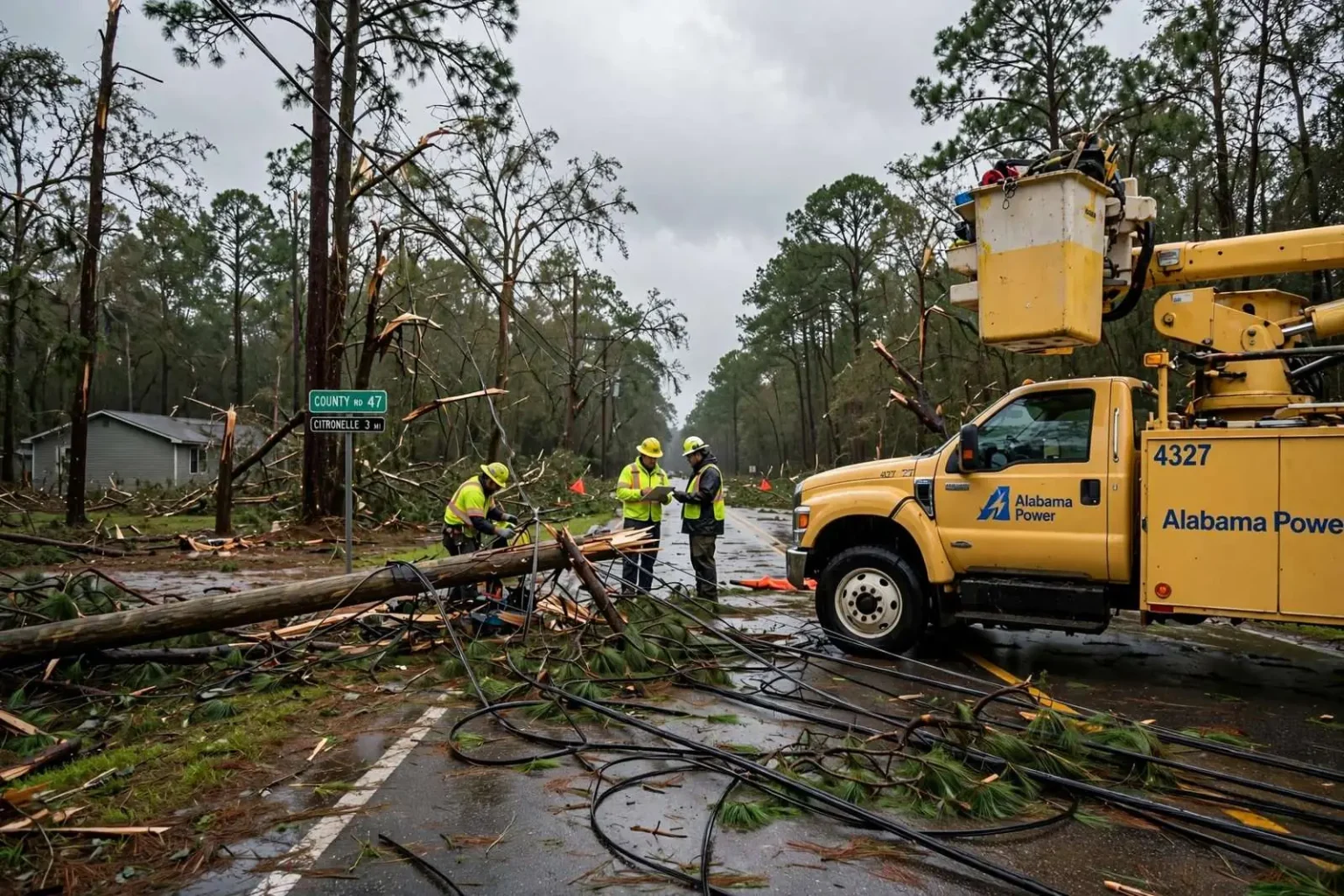
Weekend storms swept through parts of Mobile County, knocking out electricity to roughly 16,000 Alabama Power customers, with the heaviest impact concentrated around Citronelle and Saraland. The outages began as a line of severe thunderstorms moved across the county, toppling utility poles and bringing power lines down across roads, yards and rights-of-way in communities north and west of Mobile.
By Sunday morning, utility officials said crews had restored service to the vast majority of affected customers, though about 1,500 households and businesses remained without power. That figure covered a mix of customers across the outage footprint, from scattered rural homes along county roads in the Citronelle area to neighborhoods on Saraland’s edges where storm damage had been heaviest.
An Alabama Power spokesperson said crews worked through the night and continued restoration efforts into the weekend, with additional line crews brought in from other parts of the state to speed up repairs. The company routinely moves crews between its divisions during major outage events, staging them at local service centers so they can be dispatched to the hardest-hit circuits as damage assessments come in.
Storm damage in the area included downed utility poles and lines, which crews spent the weekend replacing and re-stringing throughout the affected communities. Replacing a broken pole and rehanging wire is slow, physical work: each structure must be set, secured and inspected before lines can be re-strung and energized, and damaged sections cannot be re-energized until crews confirm every span between switches is clear.
Utility officials said they expected to have power restored to all remaining customers by that night. They cautioned that restoration estimates can shift as crews working in the field uncover additional damage, but said the pace of repairs through the weekend had tracked with their projections.
A Familiar Gulf Coast Pattern
Severe summer storms are a routine, if disruptive, feature of the Gulf Coast’s late-summer weather pattern, often producing localized damage even without reaching hurricane or tropical storm strength. In August, afternoon thunderstorms along the central Gulf Coast routinely produce damaging straight-line winds, frequent cloud-to-ground lightning and bursts of heavy rain, and the strongest cells can snap trees and utility poles in a matter of minutes.
The storms that develop over the region typically ride in on the prevailing southwesterly flow off the Gulf, feeding on intense daytime heating and abundant moisture. When a single storm complex organizes and tracks across a populated county like Mobile, the resulting damage can stretch utility crews thin even though the event lasts only a few hours.
Mobile County’s rural and semi-rural communities, including Citronelle in the county’s north and Saraland closer to the Mobile metro area, can be particularly vulnerable to prolonged outages given the more spread-out nature of the power distribution infrastructure serving those areas compared with denser parts of the county. In older cities and close-in suburbs, one mile of distribution line may serve hundreds of customers; in rural northern Mobile County, the same mile of line may serve a handful.
That math matters after a storm. When wind knocks a tree into a line serving a dense subdivision, repairs restore power to many people at once. When the same kind of damage occurs on a rural spur serving a scattering of homes, each repair benefits relatively few customers, and the cumulative work of restoring a widespread outage grows accordingly.
Citronelle, sitting near the northern edge of Mobile County along the line where the coastal plain begins to rise toward the Red Hills, is surrounded by heavily wooded terrain that makes overhead distribution lines especially exposed to falling limbs. Saraland, straddling U.S. 43 and the CSX rail corridor just north of Prichard, sits in a more suburban landscape but still has long stretches of line running through mature tree cover between the highway and the Mobile River bottom.
How Utilities Restore Power After a Storm
Utility crews typically prioritize restoring service to critical infrastructure such as hospitals and water treatment facilities before moving on to residential areas, a standard practice during large-scale outage events. Keeping hospitals, nursing homes, sewage lift stations and municipal water systems powered protects public health and prevents secondary problems like sewer overflows while repairs proceed elsewhere.
After critical facilities, repair work generally follows the path of the electrical system itself. Crews first repair transmission lines and substations, then the main feeder lines that carry power to broad areas, and only then the smaller lateral lines and individual service drops that connect homes and businesses. That sequencing means some customers see the lights come back hours before neighbors on a damaged lateral a few hundred yards away.
During the weekend, Alabama Power’s damage assessment teams worked ahead of repair crews, patrolling lines by truck and, in areas made inaccessible by downed trees, on foot. Their reports allowed the utility to assign the crews brought in from other divisions to the repairs that would restore power to the largest number of customers first, then cycle back to the scattered single-home outages that always trail the end of a major restoration.
The utility also leaned on automated outage reporting data to map the damage in real time. When limbs hit lines or poles snap, protective equipment de-energizes the affected circuit, and the resulting loss of voltage registers at the substation, giving operators a picture of where problems are clustered before the first assessment truck rolls.
Staying Safe Around Storm Damage
Residents in affected areas were encouraged to report ongoing outages directly to Alabama Power and to stay clear of any downed lines, which can remain energized even after a storm has passed. A line lying on the ground, tangled in a tree or draped across a fence can carry lethal current, and utilities warn that callers should never assume a fallen wire is dead.
Safety guidance issued during outage events also covers the hazards customers create at home. Portable generators, which many households without power pressed into service over the weekend, must be operated outdoors and well away from windows, doors and vents, because generator exhaust contains carbon monoxide that can build to fatal concentrations inside a closed home. Utilities also warn customers never to back-feed a house by wiring a generator into an outlet or dryer connection, a practice that can energize downed lines and endanger the crews working on them.
Residents were likewise advised to treat tree limbs hanging over or tangled in power lines as utility property until crews cleared them. Homeowners with storm-damaged trees generally should have the electrical hazard addressed before any cutting begins, since conductors can be hidden inside a limb or canopy that still looks intact.
No injuries were reported in connection with the weekend storms, and officials did not indicate any additional severe weather was expected in the immediate aftermath that could complicate ongoing restoration work. That outlook allowed crews to work steadily through the day without pausing for cover, a factor that often determines whether a utility meets its evening restoration target in the aftermath of a summer storm.
For the roughly 16,000 customers who lost power, the episode was a reminder of how quickly late-summer weather can disrupt life along the central Gulf Coast, and of how dependent modern households are on a distribution grid that runs, for the most part, overhead through some of the most storm-prone terrain in the country. Utility officials urged customers who remained without power into Sunday evening to report their outage individually, since scattered outages on secondary lines can go unreported and unaddressed until someone calls them in.
For Citronelle and Saraland, the weekend added one more entry to a long local history of weather-related outages. Mobile County sits in one of the most lightning-active corridors of the United States, and its exposure runs from tropical systems in the summer and fall to tornado-producing storm lines in the spring. Utilities here design and maintain their systems with that reality in mind, trimming vegetation on a rotating cycle and hardening substations, but no overhead system in a heavily wooded county can come through repeated severe wind events untouched.
The concentration of damage around Citronelle and Saraland also illustrates how unevenly thunderstorm damage falls across a single county. Mobile’s metro core, with its buried service lines in the downtown district and dense network of circuits, often weathers the same storm with far fewer outages than the county’s northern and western communities, where overhead lines run for miles between poles through pine and mixed hardwood forest.
Alabama Power, headquartered in Birmingham, serves most of Mobile County’s electrical load and maintains a storm-response playbook it has refined through hurricanes from Frederic in 1979 through Sally in 2020. The utility’s Mobile division stages crews and materials at area service centers, and when a storm outruns local resources, the company pulls line crews, tree crews and assessment teams from its other divisions across the state, as it did over this weekend.
Mutual aid is a two-way street on the Gulf Coast. Alabama Power crews regularly travel to neighboring utilities in Florida, Louisiana and Mississippi after major hurricanes, and those relationships flow back toward Mobile when a smaller event, like this weekend’s storm line, damages more of the local grid than the permanent workforce can repair quickly on its own.
What Customers Can Expect During Restoration
During large outages, the utility’s published guidance asks customers to report their own outage rather than assume neighbors have already done so, because report data helps the company size up each event. Customers who lose power are asked to check their breakers first, since a tripped main breaker inside the home can look identical from the street to a neighborhood outage and need no utility response at all.
The company also asks customers to keep the phone lines around an outage clear where possible, and to check on elderly or medically vulnerable neighbors during extended outages. Households that depend on powered medical equipment are encouraged to register with the utility in advance so their locations are flagged in the restoration planning process.
Local governments in the affected communities monitored the outage through the weekend, coordinating with the utility on any traffic signals left dark and on intersections where downed lines forced road closures. Law enforcement agencies in Saraland and the surrounding communities patrolled darkened intersections and directed traffic where signals were out, a routine but essential piece of storm response that often goes unnoticed when it goes well.
Looking Past the Weekend
Once the final customers were restored, the focus shifts to the quieter work that follows every storm: replacing damaged poles permanently, clearing debris from rights-of-way, and reviewing the response for lessons that can shorten the next restoration. Gulf Coast utilities conduct after-action reviews following significant outage events, looking at how quickly damage was assessed, whether crew staging locations were well chosen and which circuits proved most vulnerable.
For residents of Citronelle, Saraland and the surrounding communities, preparedness remains the practical takeaway. Emergency management officials across south Alabama encourage households to maintain a basic severe-weather kit, including water, nonperishable food, flashlights, batteries and a way to charge mobile phones, and to keep medications and important documents accessible during storm season.
The late-summer pattern that produced this weekend’s storms will continue through September and often into October along the central Gulf Coast, with the added variable of the tropical season overlapping the peak of the daily thunderstorm cycle. Utility crews that spent the weekend replacing poles in northern Mobile County will likely see that work tested again before the season ends.
Alabama Power reminds customers that outage information and reporting are available around the clock through the company’s website, mobile application and automated phone system, and that restoration updates during major events are posted as they become available. Customers were encouraged to sign up for outage alerts so they receive restoration notices directly rather than waiting for word of mouth to spread through a neighborhood.