Storms rip roof off Pensacola brewery
Emerald Republic Brewing in Pensacola lost most of its roof when storms tore through the building Saturday morning.
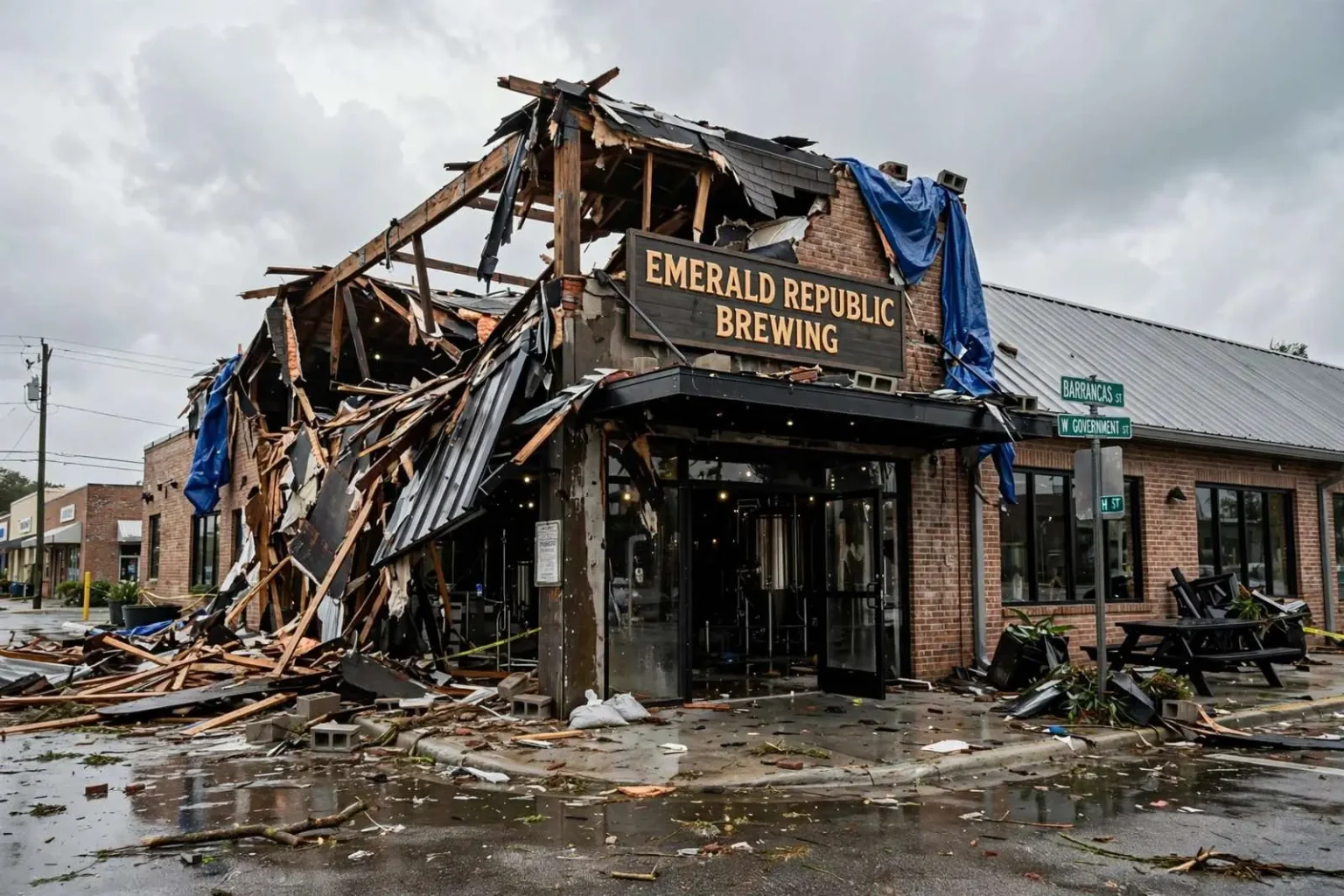
A Pensacola brewery lost much of its roof Saturday morning as strong storms swept across the area. Emerald Republic Brewing, located off Barrancas Street at West Government and H streets, posted on Facebook that it woke up to reports of an apparent tornado or microburst that hit the front half of the brewery, tearing off most of the roof and causing extensive damage inside. Since then, the business said, countless neighbors have reached out and stopped by with offers to help. “This is devastating, but we will be ok, and we will be back,” the brewery wrote. “We’ll keep everyone posted on what’s next and progress on renovations and reopening. Love you, Pensacola.”
The damage was concentrated with brutal precision. According to the brewery’s own account, the storm hit the front half of the building and tore off most of the roof over that section, leaving the interior exposed to the rain that followed the storm’s passage. Roof loss of that scale means far more than shingles: water pours into the structure beneath, soaking ceilings, walls, equipment, electrical systems and anything stored under the opening. For a brewery, whose production depends on climate-controlled fermentation spaces and a public taproom, water intrusion compounds the structural damage into an operational shutdown.
The business described the culprit as an apparent tornado or microburst, a phrasing that captures the uncertainty of the minutes after such a storm. Tornadoes and microbursts produce strikingly similar damage on the ground — localized, violent winds that strip roofs and scatter debris — and distinguishing between them requires either radar evidence or a National Weather Service damage survey. Until such a survey is completed, or confirmed never to have been, businesses and residents describe what happened in exactly the conditional terms the brewery used.
Tornado Versus Microburst
A microburst is a concentrated column of sinking air that reaches the ground and spreads outward in straight-line winds that can exceed 100 miles per hour in the strongest cases. A tornado is a rotating column of air in contact with the ground, with winds that move circularly around a center. On radar, meteorologists can often tell them apart; from a damaged rooftop on Barrancas Street, Saturday morning, the distinction was academic. Both can rip a roof off in seconds, and both arrive with the same suddenness — a band of strong storms sweeping across the Pensacola area, a minute of violence, and then a landscape changed.
Microbursts in particular are notorious for this kind of damage because they strike with little warning relative to their intensity. Doppler radar detects the signatures of severe storms, and forecasters issue warnings, but the most violent outflow winds sometimes develop in the minutes between a radar scan and the wind’s arrival. Pensacola sits in a region where strong thunderstorms occur year-round, with a secondary severe weather peak in the fall and early spring alongside the summer afternoon storm machine, and straight-line wind damage from thunderstorm outflow is among the most common severe weather losses in Northwest Florida.
The timing — a Saturday morning hit — shaped what happened next. Storms that strike overnight or in the early hours catch buildings occupied by no one, which was the case here; the brewery’s post said it woke up to reports of the damage, meaning staff and owners learned of it like the rest of the neighborhood did. No injuries were reported in the brewery’s account, and the fact that the building was empty when the roof tore off is the quiet mercy in every storm damage story of this kind.
The Aftermath on Barrancas Street
Emerald Republic Brewing occupies a spot in Pensacola’s historic industrial pocket near Barrancas Street, where West Government Street and H streets intersect — an area south of the city’s main downtown grid that has become home to local businesses, breweries, and makers’ spaces in older warehouse and commercial buildings. The brewery has been part of the Pensacola craft beer scene’s growth, pouring its own lineups in a taproom that serves as a neighborhood gathering spot as much as a commercial one.
What followed the damage announcement was the part of the story the brewery emphasized. Countless neighbors reached out and stopped by with offers to help, according to the business’s post — a response pattern familiar to anyone who has watched Pensacola’s neighborhoods recover from hurricanes. The city has absorbed Ivan, Dennis, Sally and lesser storms in between, and each one has hardened the same instinct: when a local business takes a hit, the community shows up with tarps, tools, equipment, and hands.
The brewery’s response to that response was a promise framed in two sentences. “This is devastating, but we will be ok, and we will be back,” the business wrote. “We’ll keep everyone posted on what’s next and progress on renovations and reopening. Love you, Pensacola.” The message commits to reopening while setting expectations honestly — renovations, progress reports, a timeline to come. For a business whose roof is gone, that sequence means insurance claims, contractors, permits, inspections and construction before the taproom pours again.
What Roof Loss Means for a Business
The practical recovery from losing most of a roof over half a building runs through a well-worn but grueling process. The first days are about mitigation: tarping the open section, extracting water, drying out the structure, and protecting equipment and inventory from further damage. Documentation for the insurance claim happens in parallel — photographs, itemized losses, contractor assessments. Only then does rebuilding begin, and for commercial buildings the repair of structural roof systems, electrical, and interior finishes can stretch from weeks into months.
For a brewery specifically, the damage assessment has to account for the production side. Brewhouses, fermentation tanks, kegs and cold storage represent heavy capital investment, and even equipment that survived the storm can be compromised by humidity, water or the loss of power and climate control. Brewery operations also carry regulatory requirements for the spaces where beer is produced and served, so reopening involves more than reconstruction — the facility has to be brought back to standard as well as restored.
During that stretch, the business’s communication with its customers becomes its lifeline. The brewery promised to keep everyone posted on what’s next and on progress toward reopening, and social media is the channel through which Pensacola’s craft beer community follows such recoveries. Support in the weeks after a storm damage announcement often translates into sales at temporary locations, participation in fundraiser events, and a crowd waiting at the door when the reopening date finally arrives.
Pensacola’s Storm History in View
Northwest Florida’s experience with sudden storm damage runs deep, and every hurricane season reminds the region that wind does not need a named storm to destroy a roof. Severe thunderstorms capable of producing tornadoes and destructive straight-line winds fire across the Panhandle in every month of the year, and the National Weather Service office serving the area issues the warnings that give residents and businesses whatever lead time the atmosphere allows. Saturday morning’s hit on Emerald Republic Brewing fits the region’s pattern: a localized, violent, fast event that spared most of the city and devastated one building.
The brewery’s closing line — love for the city that showed up at its door — points to the equation that keeps small businesses in Pensacola through disasters. The storm took the roof. The neighbors took the promise of help. And the business, in promising to be back, made the only commitment that matters in a community that has rebuilt itself after every storm it has ever faced. Renovation news will follow, the brewery said, and when the doors reopen on West Government Street, the taproom will pour again for the neighborhood that spent the rebuild standing beside it.
The Craft Beer Community Rallies
Pensacola’s brewery scene has grown into a genuine cluster in the past decade, with taprooms across the downtown grid and the corridors south of it, and the community’s habit of mutual support runs through all of them. When one brewery suffers a loss, the others typically respond — hosting fundraisers, pouring guest taps, and steering their customers toward the damaged business’s accounts. Neighbors stopping by with offers of help, as Emerald Republic described, is both sentiment and practical assistance: recovery from storm damage is labor, and a business with a missing roof needs every set of hands it can get.
The offers also carry the taproom’s social weight. A brewery functions as a third place for its neighborhood — a room where regulars gather, where events and live music fill the calendar, where the loss of the space is felt as a community absence and not merely a commercial one. That is why the response to the damage post read less like customer sympathy and more like neighbors repairing their own gathering place.
Staying Safe in Sudden Wind Storms
The storm that hit the brewery overnight also serves as the region’s periodic reminder about wind safety, particularly for buildings with large roof spans. When severe thunderstorm warnings are issued, the guidance is the same whether the threat is a tornado or a microburst: move to the lowest floor, put as many walls between yourself and the outside as possible, and stay away from windows and large open rooms. Businesses in warehouse-style buildings, where roofs are structurally vulnerable to uplift, are among the places that guidance applies most directly.
After a storm passes, the hazards change but do not end. Downed power lines, gas odors, structural instability and water intrusion are the immediate risks, and property owners are advised to have the building inspected before reoccupying damaged sections. The brewery’s situation — an entire section of roof gone and extensive water damage inside — is precisely the scenario where professional assessment, not a quick cleanup, comes first.
For now, the story of Saturday morning on Barrancas Street is the one the brewery told itself on Facebook: a devastating loss, a neighborhood that arrived before the tarps were even up, and a business that answered with two promises — it will be ok, and it will be back. Pensacola has heard those promises before, from families and shops and churches after worse storms than this one, and the city’s track record on keeping them is the reason the brewery could make its own with confidence. Progress updates will follow, the taproom’s regulars will watch for them, and one Saturday morning’s damage will eventually become another Saturday’s grand reopening — with the whole neighborhood invited.