Student arrested after bringing BB gun to Escambia County High School in Atmore
A student was arrested after bringing a BB gun onto the campus of Escambia County High School in Atmore, prompting a brief lockdown, Sheriff Heath Jackson.
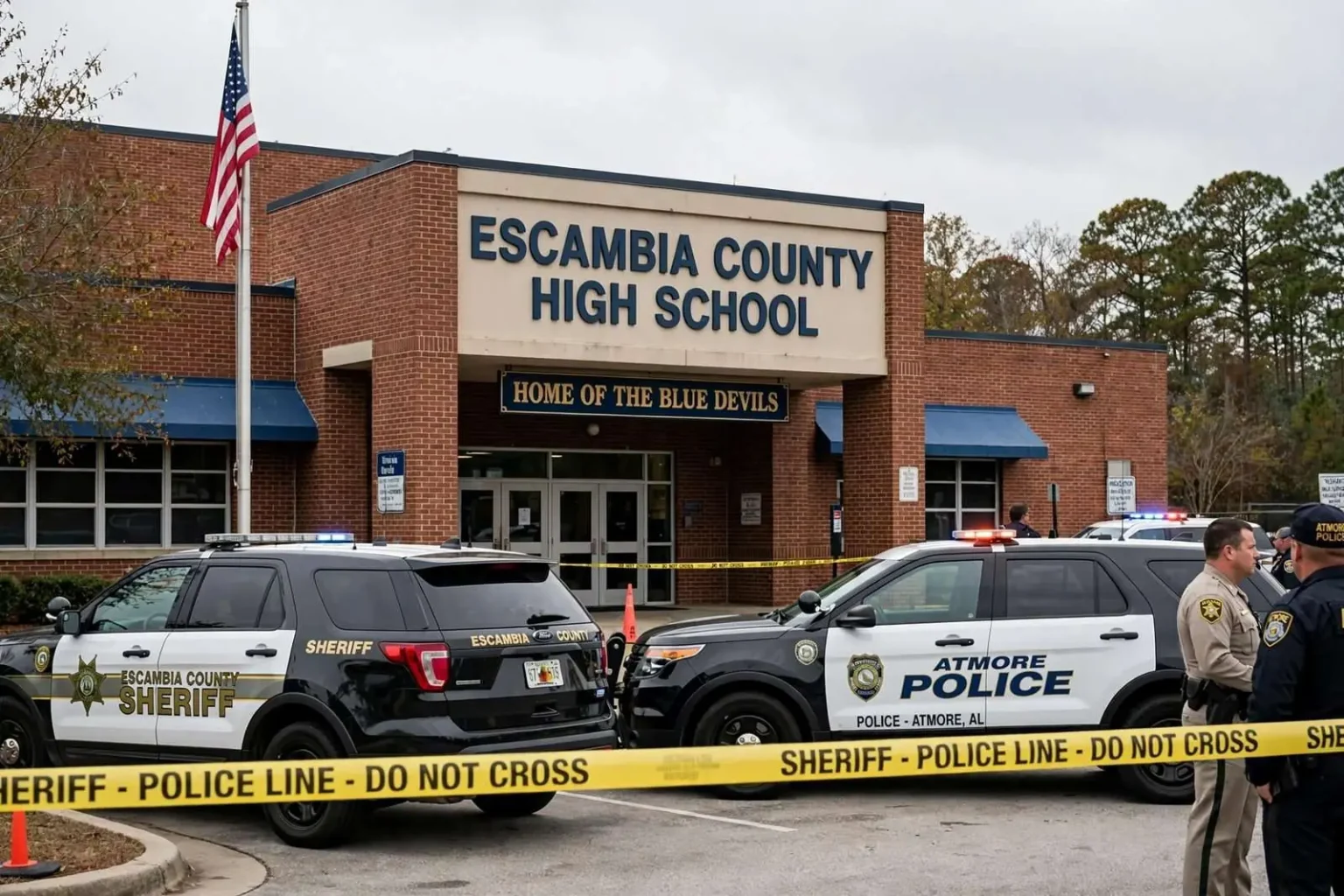
ATMORE, Ala. — A student was taken into custody Friday morning after bringing a BB gun onto the campus of Escambia County High School, according to Escambia County Sheriff Heath Jackson. The sheriff’s office received a call about a student carrying a firearm on campus. As a precaution, the school was placed on lockdown while officers from the Atmore Police Department and the Escambia County Sheriff’s Office located the student. Sheriff Jackson said the weapon was recovered without incident and was not loaded at the time of the arrest. The student was taken to a juvenile detention center. Charges were not immediately known.
The episode unfolded the way school-threat calls are supposed to: a report came in, officers moved, the campus was locked down and the student was found before anything happened. From the first call to the recovery of the weapon, the morning followed the response playbook that Alabama schools and law enforcement agencies have refined over the years, and it ended without injury to anyone on campus.
How the Morning Unfolded
The sheriff’s office received the call reporting a student carrying a firearm on campus Friday morning, and the response was immediate. Atmore police officers and Escambia County deputies converged on Escambia County High School, and the school was placed on lockdown while they searched for the student described in the report. Lockdown procedures keep students in classrooms with doors secured, moving no one through the halls until administrators and officers give the all-clear, a step that protects students from whatever may be happening while the search proceeds.
Officers located the student and recovered the weapon without incident, Sheriff Jackson said. The weapon turned out to be a BB gun, and it was not loaded at the time of the arrest. The student was taken into custody and transported to a juvenile detention center, where the process of determining charges — which were not immediately known Friday — would move through the juvenile justice system.
BB Guns and the Zero-Distance Between Them and Real Ones
That the weapon was a BB gun rather than a firearm matters in some ways and not at all in others. Alabama law treats certain air guns differently from firearms in specific contexts, but inside a school the distinction collapses: any object that looks like a gun, is brandished like a gun or is reported as a gun produces the same lockdown, the same response and the same terror in a building full of children. Officers responding to a report of “a firearm on campus” cannot know what they will find, and they treat every such call as real until the weapon is in hand.
The modern generation of BB and airsoft guns compounds the problem. Replica weapons are manufactured to mimic the weight, size and appearance of real firearms down to the markings, and nothing about the silhouette of a BB gun held under a jacket tells an officer it is not lethal. School systems across Alabama and the nation enforce policies that treat lookalike weapons exactly as they treat real ones, precisely because the first minutes of any response belong to the report, not to what the weapon turns out to be.
Atmore and Its Schools
Escambia County High School sits in Atmore, a city of roughly 10,000 people on the northern edge of Escambia County near the Florida line, where the sheriff’s office and the Atmore Police Department share jurisdiction and routinely work together on calls that cross the city limits. That working relationship showed in the response, with both agencies’ officers converging on the campus and locating the student while the lockdown held.
The sheriff’s role in a county like Escambia covers the unincorporated areas and the support it provides to municipal departments, while the Atmore Police Department holds primary jurisdiction within the city limits. A school event that draws both agencies is common in communities this size, where mutual aid is not a formal agreement so much as a habit built over years of responding together to fires, accidents and the occasional emergency at the schools that anchor the community.
Sheriff Heath Jackson, who took office in 2019, has made school safety and rural law enforcement staffing regular themes of his administration, and his office’s account of Friday’s events — the call, the lockdown, the recovery, the arrest — gave families the same-day facts that departments have learned to provide quickly in school incidents. In small counties, the sheriff is also a familiar figure at school events, and the trust between the office and the community shapes how a morning like this one is received.
The school serves students from across the county’s southern end, and its campus — like every Alabama high school — operates under a safety plan built on the cooperation between school administrators and local law enforcement. Alabama’s school safety framework requires districts to maintain emergency operations plans, run drills that include lockdown scenarios and coordinate with the agencies that would respond, all of which depends on the kind of coordination that was on display Friday morning.
What Happens to the Student Now
The student, taken to a juvenile detention center following the arrest, has entered Alabama’s juvenile justice system, which handles minors separately from adults, with its own courts, its own confidentiality rules and its own range of outcomes. Charges were not immediately known Friday, and the decision about what the student will face rests with the juvenile court process and the district attorney’s office, weighing the student’s age, intent and history alongside the facts of the morning.
Juvenile proceedings in Alabama are closed to the public and the records are confidential, which means the community will likely never see the details that unfold from here — the interviews that explain why the student brought the gun, the family circumstances that surface in every case of this kind, and the disposition the court ultimately reaches. That confidentiality is by design, built on the premise that young offenders are better served by a system that corrects rather than one that brands. What is public is the school’s own handling of the disciplinary side, which follows the code of conduct rather than the penal code.
Separately from any criminal charge, bringing a weapon — or a lookalike weapon — onto an Alabama school campus carries consequences in the school system itself. The student code of conduct that governs Escambia County schools treats weapons violations as among the most serious offenses, with disciplinary hearings and potential long-term removal from the regular campus. The two tracks, criminal and disciplinary, run in parallel, and neither has been resolved.
The Response Worth Noting
The morning’s outcome — no injuries, a weapon recovered without incident, a campus secured — reflects the systems Alabama has built around school safety over two decades. Lockdown drills are routine in state schools, resource officers and responding agencies train for exactly this sequence, and the call that a student has a gun on campus is answered as an emergency every single time, even when it ends with a BB gun in an evidence bag.
For the students and teachers inside the building, the lockdown meant minutes or hours of waiting behind secured doors while officers worked the halls. Those minutes are the part of a school threat response that never makes the official statements: the classroom conversations in whispers, the texts to parents, the teachers who keep teaching or keep talking while everyone waits for the all-clear. When it comes, the school returns to its ordinary rhythm, but the morning stays with the people who lived it.
Parents across Atmore got the news through the channels schools now use in these moments — district notifications, social media posts and the unavoidable speed of word-of-mouth in a small city. Sheriff Jackson’s account of the recovery, delivered the same day, provided the facts that rumor fills in otherwise: the weapon was a BB gun, it was not loaded, no one was hurt and the student was in custody.
The episode stands as one more data point in the conversation Alabama schools continue to have about weapons on campus and the reports that follow them. Every call of this kind will be answered as Friday’s was — with a lockdown, a response and a search — because the alternative is the risk that the one real weapon is treated like the many lookalikes. The cost of that vigilance is a morning of lost class time and a student in a detention center; the cost of ignoring a call is measured differently.
What remains to be determined — the charges, the school discipline and the circumstances that led the student to bring the gun to campus — will unfold in the days ahead through the juvenile court and the school system. What was settled by Friday afternoon was the response itself: the call came in, the agencies answered, and a campus full of students came through it unharmed.