
Study Ranks Alabama 34th in Patriotism as Gulf Coast States Lag Behind
A WalletHub study ranks Alabama 34th for patriotism, Mississippi 40th and Florida 49th, with strong military marks but weak civic engagement.
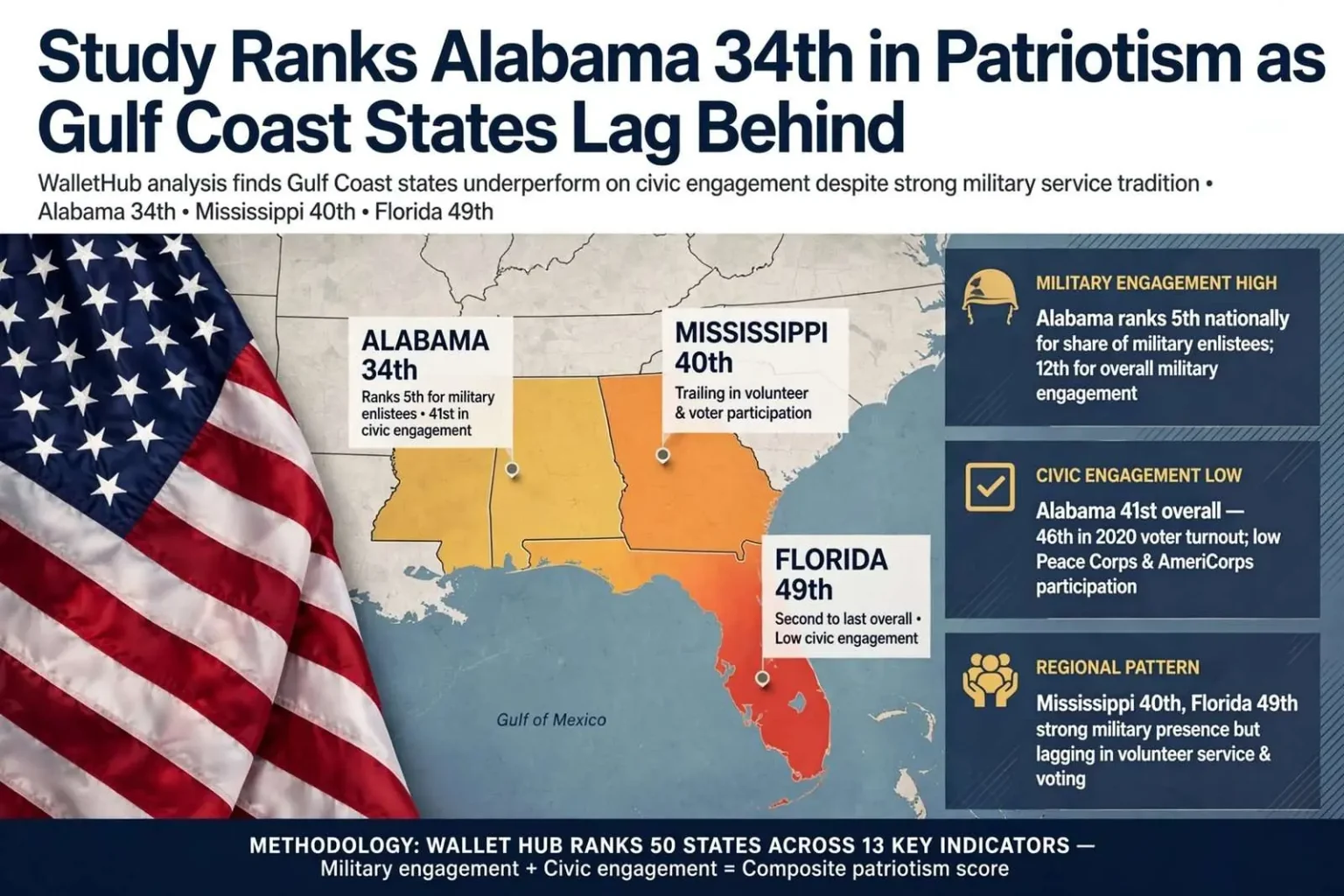
Just ahead of Independence Day, a new analysis ranked Alabama 34th among the 50 states for patriotism — and none of the Gulf Coast states fared especially well. The personal finance website WalletHub compared all 50 states across 13 key indicators of patriotism, including military enlistees per capita, the number of veterans, AmeriCorps volunteers and the percentage of residents who voted in the 2020 presidential election, and Alabama came in at No. 34 overall.
Mississippi ranked 40th, and Florida finished second to last at No. 49. The results landed as a surprise to many residents of a region that markets itself on military heritage, flag displays and deep service traditions — and they illustrated the gap between how a region sees itself and how measurable civic and military participation actually add up when states are compared side by side.
How the Rankings Work
WalletHub’s methodology splits patriotism into two broad dimensions: military engagement and civic engagement. The military side includes measures such as enlistees per capita, the share of the population that are veterans and overall military engagement, while the civic side counts things like AmeriCorps volunteers per capita, Peace Corps volunteers per capita, voter turnout in recent presidential elections and related measures of civic participation. A state’s overall rank is a composite, which means a state can excel dramatically on one dimension and lag badly on the other and still land in the middle of the pack.
That is essentially what happened in Alabama. The state’s overall No. 34 ranking masked a striking split between two very different sets of numbers, one placing Alabama near the top of the country and the other near the bottom.
A Split Personality in the Numbers
The state-by-state numbers revealed a split personality for Alabama. The state ranked fifth nationally for its share of military enlistees and 12th for overall military engagement, reflecting its deep ties to the armed forces. Generations of Alabamians have made careers of military service, and the state’s communities — from its rural counties to its cities — send recruits into the armed forces at rates well above the national average.
But Alabama fell to 41st in civic engagement, ranking 46th for the percentage of residents who voted in the 2020 election and 47th in Peace Corps volunteers per capita. The state’s AmeriCorps participation also lagged, pulling down the civic side of the ledger even as the military side flourished. The result was a composite score that said less about a lack of patriotism than about where Alabama’s tradition of service is concentrated.
The Gulf Coast Picture
Across the Gulf Coast, the study’s findings put the region’s strong military tradition alongside weaker showings on the civic-participation measures that made up the other half of WalletHub’s formula. Mississippi’s 40th-place finish and Florida’s 49th — ahead of only one state — underscored the pattern: a stretch of the country that hosts major military installations and produces enlistees at high rates nonetheless trails on measures of volunteering, national service and voter participation.
The regional context is striking because the Gulf Coast is saturated with the military presence the rankings reward. Pensacola is home to Naval Air Station Pensacola, the cradle of naval aviation; the Mississippi Gulf Coast hosts Keesler Air Force Base in Biloxi; and Mobile’s shipbuilding yards build and support the Navy’s littoral combat fleet. Enlistment and veteran populations across the coastal South consistently rank among the nation’s highest — yet the civic indicators told a different story when the study’s data was tallied.
Alabama’s Deep Military Roots
The state’s fifth-place finish for enlistees per capita did not surprise anyone who follows Alabama’s military footprint. The state hosts a network of major installations — Redstone Arsenal in Huntsville, Maxwell Air Force Base in Montgomery, Fort Rucker in the southeast corner of the state and the Anniston Army Depot among them — and its National Guard and reserve units have deployed repeatedly over the past two decades. Military service runs through Alabama families the way other states run through industries, and recruiters have long found the state’s communities fertile ground.
That tradition extends to the coast. South Alabama’s communities contribute heavily to the state’s enlistment numbers, and the region’s veterans’ organizations — American Legion posts, Veterans of Foreign Wars halls and their auxiliaries — remain among the most active civic institutions in small towns across the state. Those organizations are precisely the kind of engaged, service-oriented community life that patriotism rankings are meant to capture, even if their work does not fit neatly into the metrics WalletHub counts.
The Civic Engagement Gap
The other half of the ledger is where Alabama and its neighbors lost ground. Voter participation ranked 46th in the 2020 election — an election with record national turnout, which made the state’s below-average participation stand out all the more. Peace Corps volunteers per capita ranked 47th, and AmeriCorps service also lagged the national pace, giving the state little cushion on the indicators that reward organized national and community service.
Civic engagement of this kind follows patterns that are hard to reverse quickly. National service programs recruit heavily from college campuses, and states with higher college attainment tend to produce more applicants. Voter turnout, likewise, tracks with education levels, age, income and the competitiveness of elections in a given state. Alabama’s numbers reflect long-running structural realities as much as any measure of civic spirit — a distinction researchers are careful to make but that headline rankings rarely convey.
The report’s release just before Independence Day gave the findings an emotional timing that a mid-winter publication would not have had. Rankings that measure patriotism land differently when they arrive alongside fireworks and flag-waving, and Alabama’s 34th-place finish prompted exactly the conversation such studies are designed to provoke: what does patriotism actually consist of, and how should a state that measures its identity by service respond when the metrics say its civic half is trailing its military half?
What the Rankings Miss — and What They Show
Any single-number patriotism ranking invites pushback, and WalletHub’s formula is no exception. Volunteer work through churches — which in Alabama constitutes a vast share of organized community service — does not appear among the indicators the way AmeriCorps and Peace Corps service do. Care for veterans, blood drives, youth coaching, disaster response after hurricanes: the everyday forms of civic participation that Gulf Coast communities rely on rarely register in the national datasets the rankings draw from.
But the study’s core finding survives those caveats. On the measurable indicators the formula does count — service in national programs, participation in the most consequential act of civic life, the casting of ballots — Alabama and its Gulf Coast neighbors lag, and by wide margins. A state can dispute the weighting of the formula without disputing the raw numbers underneath it, and it is the raw numbers that place Alabama 34th, Mississippi 40th and Florida 49th.
The Voter Turnout Question
The 46th-place showing for 2020 turnout is likely the number that stings most, because it sits at the heart of the civic half of the formula. The 2020 presidential election drew the highest raw turnout in American history, with states across the country posting participation rates not seen in decades — which made any below-average showing more conspicuous. In Alabama, the state’s presidential contests have rarely been competitive in recent cycles, and researchers have long noted that voters in non-competitive states have fewer reasons to believe their ballot will decide the outcome, a dynamic that suppresses turnout regardless of civic feeling.
Alabama’s election officials have worked in recent years on registration and outreach programs aimed at closing that gap, and civic organizations across the state run registration drives each cycle. Whether those efforts move the state up the next edition of such rankings is the practical test of the report’s message — and the metric on which future Independence Day comparisons will turn.
What It Means for the Region
For Alabama and its Gulf Coast neighbors, the study is best read as a diagnosis rather than an insult. The military numbers confirm what the region already knows: its people serve, in numbers few states match, and its communities support that service in ways national metrics can barely capture. The civic numbers point in the other direction, and they identify the specific levers — voting, national service, organized volunteering — where improvement is measurable year to year.
The Fourth of July, the study’s release point, is a fitting moment for that mirror. Patriotism on the Gulf Coast is lived as much as it is measured — in enlistment papers and veteran halls, in hurricane-season mutual aid and small-town parades. WalletHub’s ranking counts only what can be counted, and this year what could be counted put Alabama 34th. Closing the gap between the region’s service tradition and its civic scoreboard is the work the ranking quietly assigns — before the next Independence Day comparison arrives.


