Summer Art Blast 2010: Mobile Kids Turned Paper, Glue and 1,000 Photos Into Animation
Summer Art Blast campers in Mobile turned collage art into stop-motion animations, shooting about 1,000 digital photos per project.
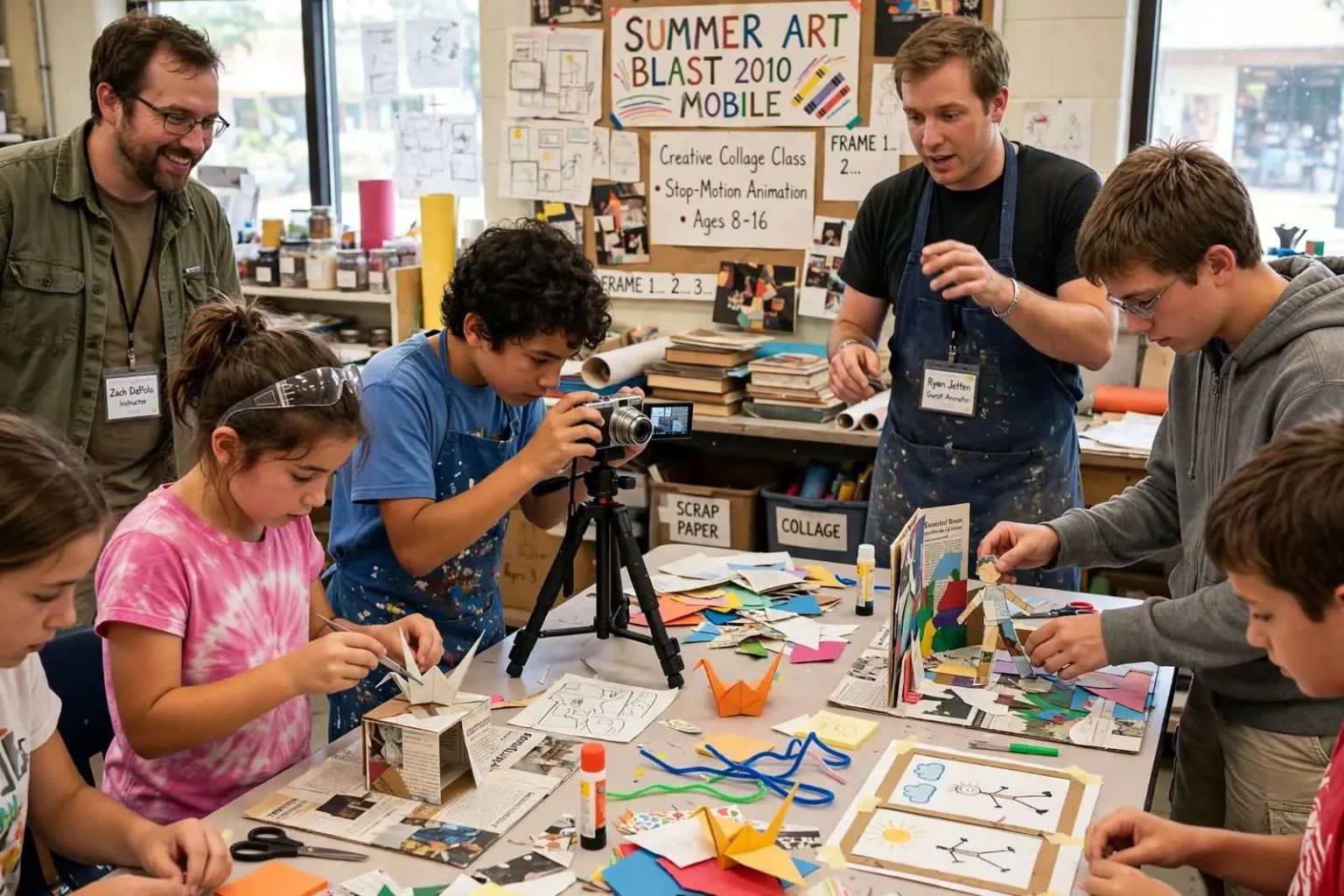
At Summer Art Blast 2010 in Mobile, a Creative Collage class for eight- to sixteen-year-olds ended its session with something more ambitious than refrigerator art: student-made stop-motion animations. The class was led by instructor Zach DePolo with special guest Ryan Jetten.
Campers spent their days altering discarded books, building miniature sets, folding origami and mixing traditional collage techniques with whatever odds and ends and glue they could gather. By the end of the session, the piles of cut paper, salvaged pages and hot-glued constructions had become something their makers never expected at the start: short films.
The Creative Collage class was one strand of the broader Summer Art Blast program, a Mobile summer tradition that has long offered children a week or more of intensive art-making outside the school year. Where a typical camp week might end with paintings and sculptures to carry home, this group of young artists had produced work meant to be watched — a shift that changed how the session felt from the first day.
A Thousand Pictures at a Time
The twist came when students brought their collages to life through stop-motion animation. Working with a simple digital camera — and roughly a thousand frames apiece — each camper or group produced their own animated short built from the artwork they had created.
Stop-motion animation is a technique as old as cinema itself, and its logic is easy to state but punishing to execute: move an object a tiny amount, photograph it, move it again, photograph again, and repeat until the individual stills, played back in sequence, create the illusion of motion. A thousand frames amounts to less than a minute of finished film at standard speed. The young animators in the class learned quickly that a character walking across a table is not a gesture but a long series of minute adjustments, each one photographed, none of them optional.
The class’s materials shaped what was possible on screen. The altered books that campers had spent days carving, painting and collaging became sets and scenery. Origami figures folded earlier in the week turned into characters that could be repositioned a fold at a time. Paper cutouts, pipe cleaners and salvaged odds and ends became everything else. Nothing about the productions was store-bought, which meant every element of every film had passed through the students’ hands first.
For children in the eight-to-sixteen age range, the work demanded an unusual combination of patience and planning. Collage teaches composition and color; animation adds sequencing, storytelling and an almost mathematical discipline about time. Instructors guided the students through storyboarding their ideas before shooting began, so that a week’s worth of photographs would add up to a story rather than a pile of frames.
The People Behind the Class
Instructor Zach DePolo led the Creative Collage session, joined by special guest Ryan Jetten, whose involvement brought additional animation expertise to the room. In a camp setting where each class meets for a compressed stretch of summer days, having a working artist on hand to demonstrate techniques made a visible difference in what students attempted.
The pairing reflected a broader approach behind Summer Art Blast: bring working artists into the studio with children rather than simply supervising craft time. The model gives campers contact with adults who make art as a profession, and it gives the artists an audience of unselfconscious makers — children who have not yet learned to doubt whether an idea will work before trying it.
The wide age range in the class, eight to sixteen, presented its own challenge. Younger campers could fold, cut and glue with enthusiasm while older students handled the technical demands of the animation shoot. Groups formed around projects, with the older students often taking the camera work while younger ones manipulated characters and built sets. The finished films became group accomplishments in the truest sense — no single child could have produced a thousand frames alone in a week.
Arts Education in Mobile in 2010
The project showed how local arts education was stretching beyond drawing and painting in 2010, giving Mobile kids hands-on experience with filmmaking tools most adults were only beginning to explore.
The timing mattered. In 2010, digital cameras had only recently become affordable and commonplace, desktop video editing was newly accessible to households, and YouTube — barely five years old — had turned animation from a studio craft into something anyone with a camera and patience could publish. Most adults in 2010 had never created a frame of animation; the Summer Art Blast campers were doing it before their parents had.
Mobile’s arts community of that era supported a range of programs like it. The city’s museums and art institutions ran education programs through the summer, and camps across the area treated art not as an activity to fill hours but as a discipline worth teaching seriously. Summer Art Blast sat in that tradition, with classes spanning media from painting and ceramics to the collage-and-animation work of DePolo’s session.
The stop-motion angle also connected to a moment when the technique was enjoying a resurgence in popular culture. Feature-length stop-motion films were drawing wide audiences around that era, and children who saw those movies were fascinated to learn the characters had not been drawn or generated but physically moved and photographed, one frame at a time. Holding that power in their own hands — even through a consumer digital camera and a table full of paper — was the spark the class was built to provide.
What the campers carried home in 2010 was not just artwork but a set of skills that crossed disciplines: planning, sequencing, patience, teamwork and the experience of making something that moves. A thousand frames at a time, the Creative Collage class showed Mobile what children’s art education could look like when the definition of art expanded past the page.
How a Stop-Motion Week Actually Works
The daily rhythm of a class like Creative Collage explains how children manage to finish anything at all. Early sessions go to physical craft: altering books by gluing, painting and cutting their pages into new forms; folding origami figures; and building the miniature sets that will later serve as stages. Only after the materials exist does the animation phase begin, with cameras mounted steady — often taped down — so that nothing moves between frames except what the animators intend to move.
The shooting process itself becomes a lesson in attention. One camper moves a character a few millimeters while another frames the shot and a third watches for stray hands, shadows or drifting paper that would spoil the take. A single finished second of film can consume a dozen photographs and several minutes of careful work, which is why the class counted its output in frames — roughly a thousand apiece — rather than minutes of screen time.
Playing the frames back is the payoff that keeps young animators going. When stills that looked unremarkable one at a time suddenly flow together into motion, the effect is a small revelation, and campers who struggled through hours of tedious repositioning get to watch paper figures walk, books open themselves and collages rearrange into stories. That feedback loop — tedious work, instant magic — is the reason stop-motion is such a powerful teaching medium for children who might lose patience with a drawing that stays still no matter how long they work on it.
What Summer Art Blast Meant for Its Campers
Programs like Summer Art Blast fill a specific gap in a child’s summer. School-year art instruction, where it exists, moves in weekly doses constrained by class periods and standardized schedules. A summer intensive inverts that: full days, consecutive days, and time enough to attempt projects that cannot be finished in an hour. The difference shows in the ambition of the work — a stop-motion film is simply not a project that fits into forty-minute segments.
For Mobile families, the camp also represented an affordable entry into arts education at a moment when school budgets for the arts were under pressure nationwide. Classes serving children from eight to sixteen meant siblings could attend together, and the collaborative structure of projects like the animation unit meant age differences became assets rather than divisions. Parents picking up campers at the end of the session saw not just finished films but children who could explain frame rates, storyboards and why a thousand photographs go into less than a minute of movie.
The 2010 session’s Creative Collage class stands as a snapshot of a moment when digital tools were reaching children’s hands and local educators were quick to put them to use. The techniques the campers practiced — collage, altered books, stop-motion — cost little and reward imagination over equipment, which is why they remain staples of arts education. But in Mobile that summer, they produced something genuinely new for most of the participants: their own animated shorts, built entirely out of paper, glue, patience and roughly a thousand pictures each.