Summerdale Church to Host Monthlong Gospel Music Series in August
First Methodist Church of Summerdale will host a series of Monday evening gospel singings throughout August, each paired with a community dessert social.
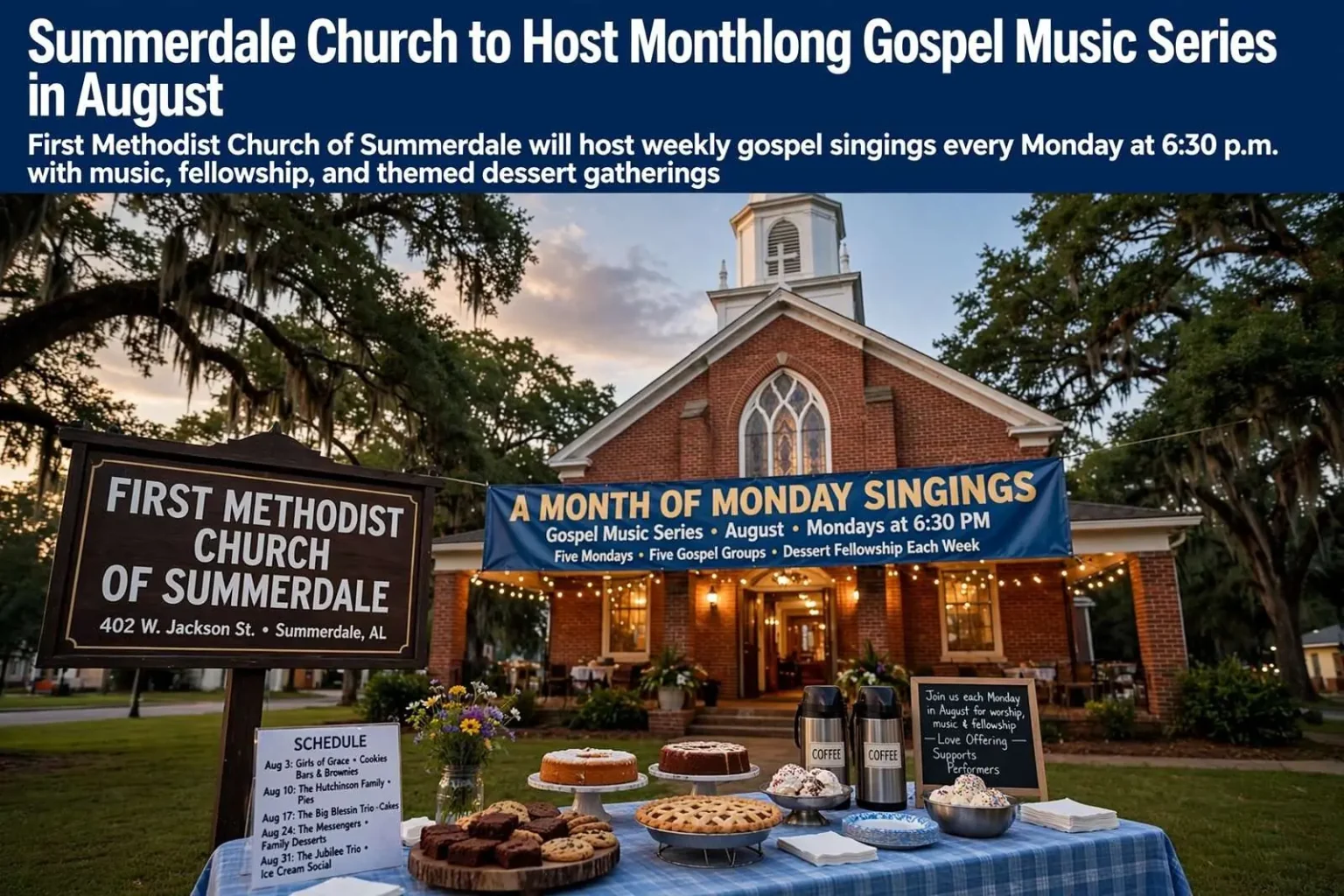
First Methodist Church of Summerdale will fill its Monday evenings through August with gospel music, hosting a monthlong series of weekly singings that pairs a rotating lineup of gospel groups with dessert fellowship gatherings afterward. The “A Month of Monday Singings” series runs each Monday at 6:30 p.m. at the church, located at 402 W. Jackson St. in Summerdale, and every evening ends the same way — with sweets, coffee, and time for the congregation and visitors to linger together.
The schedule spreads five different groups across the month. The series opens Aug. 3 with a performance by Girls of Grace, followed by cookies, bars and brownies. The Hutchinson Family takes the stage Aug. 10, with pies served afterward. The Big Blessin Trio performs Aug. 17 alongside cakes; The Messengers are scheduled for Aug. 24 with family favorite desserts; and the series concludes Aug. 31 with a performance by The Jubilee Trio and an ice cream social to close out the summer.
Church officials said love offerings will be collected during each evening’s event, a longstanding Southern church tradition in which attendees give freely to support the visiting performers rather than the church selling tickets. Organizers designed the series to give the community an opportunity for worship, music and fellowship while showcasing a variety of gospel performers throughout the month — five nights, five groups, and five reasons to be back in the sanctuary each Monday.
A different sound every Monday
The rotating lineup is the heart of the series’ design. Rather than booking one group for a month of services, the church structured August as a sampler of the region’s gospel talent, drawing on the family groups and trios that anchor the Southern gospel tradition. Girls of Grace open the month on Aug. 3, with the women’s vocal style that has long been a staple of church-based gospel singing. The Hutchinson Family follow on Aug. 10, bringing the multi-generational family harmony format that has defined gospel music in the South for generations — fathers, mothers, children, and grandchildren trading verses in tight, rehearsed blend.
Mid-month belongs to the trios. The Big Blessin Trio performs Aug. 17, and The Messengers take the Aug. 24 slot, each representing the three-part harmony style — tenor, lead, and baritone — that remains the workhorse sound of Southern gospel. The month closes Aug. 31 with The Jubilee Trio, whose name carries the celebratory promise of a finale, backed by the series’ most elaborate dessert event: an ice cream social for the whole community.
For audiences, the format means no two Mondays sound alike. Fans of a particular group can circle a single date, while families who attend every week hear the full range of what Gulf Coast and regional gospel offers — from quiet a cappella devotional numbers to full-throated quartet-era standards. The dessert tables give each night a reception feel, and the consistency of time and place — 6:30 p.m. at 402 W. Jackson St. — makes the series easy to build a month around.
Gospel singing as a community institution
The all-day singings and evening gospel conventions of the rural South have been shrinking for decades, but their DNA is visible in events like Summerdale’s. The format — visiting groups, a host church, a love offering passed, and food afterward — descends directly from the singing schools and Saturday-night sings that once drew families across county lines. What has changed is the scale and the calendar: instead of one marathon event, churches now spread the tradition across a month of manageable evenings that working families can attend.
Summerdale, a small Baldwin County community between Foley and Robertsdale along Alabama’s Eastern Shore, has long sustained that tradition. Church music remains one of the area’s strongest cultural bonds, and August — with schools back in session but summer evenings still long — is a natural month for a series that gives neighbors a weekly reason to gather. The church’s location on W. Jackson St. places it in the middle of that community, within easy reach of families across south Baldwin County.
The love offering practice keeps the events accessible. No tickets are sold and no admission is charged; the groups are supported entirely by whatever attendees choose to give, which keeps the door open to everyone and preserves the informal, communal spirit the series is built on. Visitors uncertain about the custom need only know that giving is voluntary and that nobody is turned away.
The dessert fellowship tradition
The food is not an afterthought — it is half the program. Each evening’s dessert table is themed to its group: cookies, bars and brownies on Aug. 3 when Girls of Grace open the series; pies on Aug. 10 with The Hutchinson Family; cakes on Aug. 17 for The Big Blessin Trio; family favorite desserts on Aug. 24 when The Messengers perform; and the ice cream social on Aug. 31 for the finale with The Jubilee Trio. The progression gives the month a rhythm, and regulars quickly learn which Monday brings their favorite table.
Fellowship meals and dessert suppers have served Southern churches as social glue for as long as pews have existed. The practice acknowledges a simple truth: the singing may bring people in, but the hour afterward — plates in hand, children running between tables, visitors introduced by name — is what turns an audience into a congregation. For a series spanning a full month, those weekly dessert hours compound, and by the final ice cream social the room is filled less with strangers than with acquaintances becoming friends.
The format also serves the performers. Gospel groups travel light and often, supporting themselves through love offerings and the merchandise tables they set up in church foyers, and a monthlong engagement like Summerdale’s offers steady, reliable dates in a region that knows and supports the genre. Each group finishes its set, meets the crowd over dessert, and sells recordings to the people who just heard them — the oldest and most effective marketing system in gospel music.
Worship, music and fellowship by design
Church officials were explicit about the series’ purpose: to give the community an opportunity for worship, music and fellowship, and to showcase a variety of gospel performers across the month. That three-part mission shapes every element of the schedule. The music is chosen for its devotional character as much as its entertainment value, the gatherings are open to the whole community rather than the membership alone, and the fellowship time is built into every single evening rather than left to chance.
For First Methodist Church of Summerdale, hosting the series also extends a core function of the rural Methodist tradition: being the community’s gathering place for everything from revivals to homecomings to weeknight programs. A month of Monday singings fits squarely in that lineage, using the sanctuary on a night when it would otherwise sit empty and filling it with exactly the intergenerational crowd the church hopes to reach.
The Monday timing is itself strategic. Midweek services compete with school and work schedules, weekends compete with family plans and, in August, with the start of football season. Monday evening occupies a quieter slot — the weekend is over, the week has barely begun, and a 6:30 p.m. start allows time for supper-adjacent desserts without running late into the night. By the time each evening closes with its love offering and last serving of dessert, attendees are home well before ten.
Five Mondays, one close
The series closes Aug. 31 with The Jubilee Trio and the ice cream social, a finale designed to leave the community on a high note. Ice cream socials carry their own nostalgia — the church-basement institution of another century, revived for an August evening in Baldwin County — and pairing one with the final singing gives families a reason to bring neighbors who have not yet attended a single night of the series.
By then, the month will have traced the full arc the organizers intended: five groups, five styles of gospel singing, five themed dessert tables, and a love offering each week to carry the performers to their next stop. Whether attendees came for one favorite group or every Monday, the series delivered what its planners promised — worship, music and fellowship, served weekly at 6:30 p.m. at 402 W. Jackson St., one singing and one dessert at a time.
Planning a month around the singings
For families weighing the series, the practical details favor attendance. Every performance falls on the same night at the same time and place, eliminating the scheduling puzzles that keep members away from one-off church events. A family in Summerdale, Foley, Robertsdale, or the surrounding communities can commit to Monday evenings for a month with a single decision, and the 6:30 p.m. start leaves the whole day’s work and school routine untouched.
The dessert assignments double as an easy participation point. Congregations typically staff tables like these with volunteer bakers, and a month of themed nights gives members a concrete way to contribute — a batch of brownies for the opener, a pie for the Hutchinson Family night, a cake for the Big Blessin Trio, and so on through the finale’s ice cream. Contributions need not be elaborate; the tradition depends on abundance and variety rather than showmanship, and every table looks better with one more dish on it.
First-time visitors will find the etiquette forgiving. Attendees arrive when they can, sit where they like, and give to the love offering only as they choose. Groups typically perform a 45-minute to hourlong set, after which the crowd moves toward the fellowship area for dessert. Nobody needs to know anyone to be welcomed, and the series’ community-wide framing — worship, music and fellowship for everyone, not members only — is the church’s explicit invitation to the whole town.
The groups that carry the tradition
The five acts on the schedule represent the ecosystem that keeps Southern gospel alive across the Gulf Coast region. Family groups like The Hutchinson Family pass the music between generations, learning harmony parts at kitchen tables long before they rehearse them in sanctuaries. Vocal ensembles like Girls of Grace showcase the women’s voices that have led gospel singing since its earliest days. Trios — The Big Blessin Trio, The Messengers, and The Jubilee Trio — preserve the classic three-part sound that carried gospel radio through the twentieth century and still fills church fellowship halls today.
These groups sustain themselves on the circuit of churches, homecomings, and benefit singings that stretches across south Alabama and the Florida panhandle, and a church that commits a full month to the genre is providing exactly the steady, supportive dates the circuit needs. The love offering model keeps the economics honest and local: money raised in the Summerdale sanctuary goes directly to the singers who performed there, with no promoter or ticketing in between.
For the audience, the month offers something streaming cannot replicate. Gospel singing is a participatory art — audiences know the songs, respond to the verses, and often sing along on the choruses — and the give-and-take between stage and pew is the genre’s living heart. Five Mondays of that exchange, capped each night by dessert and conversation, is the “A Month of Monday Singings” series in miniature: old traditions, faithfully kept, offered freely to a Baldwin County community every week of August at First Methodist Church of Summerdale.