Summerdale Nonprofit Director Beth Biggs Helps Baldwin County Families Move From Crisis to a Home
Beth Biggs directs Family Promise of Baldwin County from Summerdale, connecting homeless working families with churches, volunteers and permanent housing.
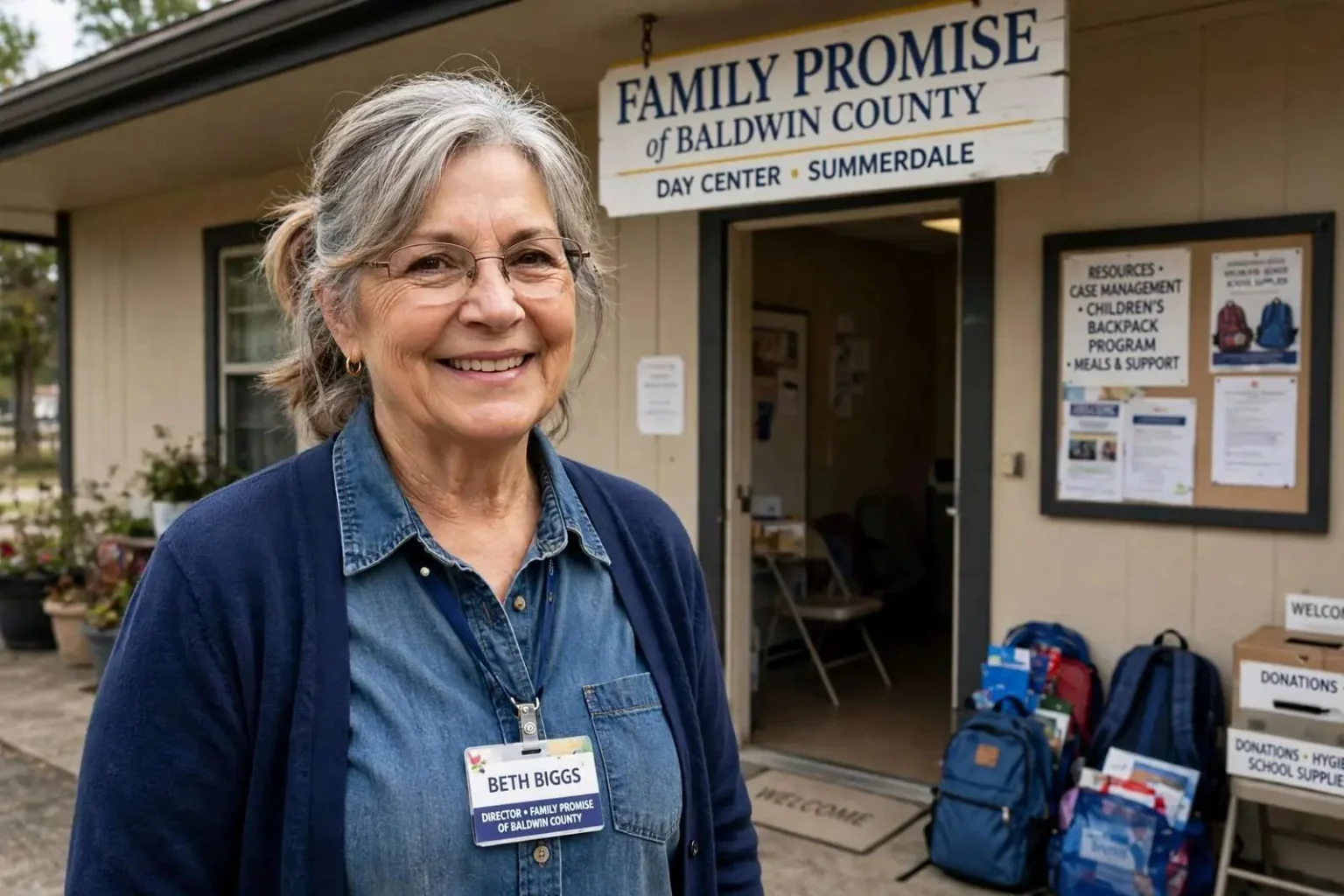
For more than three decades, Beth Biggs has built a career around getting people back on their feet. As director of Family Promise of Baldwin County, she now spends her days connecting homeless working families with children to churches, volunteers and, eventually, homes of their own. The work rarely makes headlines, but it is the kind of steady, personal effort that determines whether a family in crisis loses its footing for good or finds its way back to stability.
Biggs works out of the program’s Day Center in Summerdale, which functions as the hub of the operation. Families sometimes stay at the center, but it mainly serves as a place to keep their belongings and get support during the day while they sleep overnight in participating churches. The arrangement is the backbone of the Family Promise model, a national program built on the idea that houses of worship — not large institutional shelters — can provide the shelter a family needs while caseworkers help address the underlying causes of the crisis.
“I love people,” Biggs said. “I love helping not just the people we serve in Family Promise but serving our volunteers, giving them the opportunity to live out their faith mission of serving others less fortunate. It’s kind of like doing mission work right here in your own hometown, in your own home church. So that’s been a real blessing.”
The families Biggs serves are a particular slice of homelessness that often goes unseen in coastal Alabama. These are working parents with children — people who hold jobs, get their kids to school and try to keep life as normal as possible, but who have lost stable housing because of a job loss, an illness or some other financial shock. In a county where rental housing has grown scarcer and more expensive as the population has boomed, a single lost paycheck can put a family with six children in a hotel room, and a hotel room can give way to a campground. The Day Center in Summerdale gives those families a daytime address, a place to store what they own and a staff member whose job is to help them plan the next step.
From a hotel room to a house
Rodney Merrell knows the program from the inside. He lost his job during the COVID-19 pandemic, and he, his wife and their six children ended up living in a hotel and then a campground until Biggs helped the family find a home. For a family of eight, the fall from a household of their own to a series of temporary beds was quick and disorienting, and the path back was not one they could have walked alone.
“She helps you regain your respect for yourself, treats you just like she would her own family, you know, makes you feel like a person again,” Merrell said. “I gratefully appreciate all the hard work that she put forth to help our family out.”
Merrell said that before his family fell on hard times, he and his wife had been donors to the program — a turn of events that illustrates how thin the line can be between the people who give to a charity and the people it serves. Today, his connection to Family Promise has come full circle. He now volunteers with the organization and serves on its board, bringing to the table the perspective of someone who once sat on the other side of the intake paperwork.
How the church network works
The Family Promise approach, which began nationally in the late 1980s as the Interfaith Hospitality Network, pairs professional casework with a rotating network of host congregations. In Baldwin County, participating churches take turns providing overnight space for guest families, typically for a week at a time, while volunteers furnish meals, conversation and a safe place for children to do their homework. Because the congregations already exist in every corner of the county, the network can operate without the heavy overhead of a residential shelter, and the money it does raise goes largely into services for families rather than buildings.
For the families, the routine is demanding but structured. Mornings are spent at the Day Center in Summerdale or at work and school; late afternoons bring the family back to whichever church is hosting that week for dinner and the night. Children in the program continue attending their own schools, which spares them the upheaval of changing classrooms in the middle of an already unstable stretch of life. That stability, advocates of the model say, is one of its most important products, because a child who stays in the same school keeps the same teachers, friends and routines even when everything else at home has been turned upside down.
The volunteer experience is also central to what Biggs does. Congregation members who host families are not simply providing cots and casseroles; they are forming relationships with people they might otherwise never have met. Biggs has made cultivating that volunteer corps a core part of her job, treating the churches’ involvement not as charity handed down but as a partnership in which both sides are changed.
A career built on case work
Biggs’ background spans social work, group home management and case management, and she holds leadership roles with several homeless coalitions. That résumé reflects a career spent at the point where institutions meet individual need — running group homes, managing cases, and coordinating with the agencies and coalitions that shape how a region responds to homelessness. In 2020 she took part in a discussion on homelessness with Ben Carson, then the U.S. secretary of housing and urban development, an invitation that reflected the respect her work has earned well beyond Baldwin County’s borders.
“I love helping people move from that point of crisis to a point of stability, and I’ll be honest with you, it’s really about the kids,” she said.
That focus on children is not abstract for Biggs. The instinct showed up early. At 16, while working at a camp for children with special needs, Biggs brought home a five-year-old boy named Jimmy who was about to be returned to the foster system. She asked her parents whether the family could keep him, and they adopted him. Her brother is now in his 40s and lives in Foley with their parents — a living reminder, in the town where she works, of what one intervention at the right moment can mean for a child’s whole life.
How the program stays funded
Family Promise of Baldwin County is a United Way agency and depends on contributions and fundraisers in addition to the grants Biggs writes herself. The funding mix is typical of small nonprofits across Baldwin County, where a handful of staff members often wear several hats at once — director, grant writer, caseworker and community ambassador all in the same week. Writing her own grants means Biggs knows every line of the budget and every promise attached to every dollar, but it also means that when she is filling out applications, no one else is answering the phone at the Day Center.
The volunteer network of local congregations supplies the overnight shelter space that makes the model work, which stretches each contribution further. A donated Sunday school wing or fellowship hall for one week out of the rotation is space the organization does not have to lease, insure and maintain year-round. The trade-off is a constant need to recruit and coordinate: each host congregation requires volunteers to prepare meals, stay overnight, launder linens and pack the family’s belongings for the move to the next church when the week ends.
The needs the program addresses are growing along with the county. Baldwin County’s population surge has brought new schools, new subdivisions and new commercial corridors, but it has also pushed housing costs upward faster than many working wages have risen. For a family living paycheck to paycheck, that squeeze leaves little margin: a car repair or a missed week of work can spiral into an eviction, and an eviction with school-age children in the household is exactly the kind of crisis Family Promise is built to interrupt.
Biggs frames the work in simple terms. A family that arrives at the Day Center frightened and exhausted is not treated as a case number but as neighbors temporarily in need, surrounded by a community that has decided their children’s stability matters. The goal is always the same — a home of their own, with the adults employed and the children settled in school — and the program measures its success one family at a time.
Faith, family and the long view
Biggs, a grandmother, said her faith and her family are what keep her going, and that her husband volunteers alongside her. After three decades in a field where burnout is common and the emotional weight is heavy, she has built a life in which the work and the household support each other rather than compete.
“I’m not gonna not help. It’s who I am. It’s what I love to do,” she said. “I have a wonderful life partner in my spouse who supports me in everything I do. He’s a wonderful volunteer. He enjoys helping people and we make a team of it. I can’t just sit at home and watch TV.”
That team approach extends through the whole operation. The staff member at the Day Center, the congregation volunteers who serve supper, the board member who once lived in a campground with his six children and the donors who fund the next grant match all occupy different positions in the same effort. For Biggs, three decades into a career of helping people move from crisis to stability, the reward is watching a family walk out of the program with keys to a place of their own — and, in cases like the Merrells’, watching them turn around and reach back for the next family still waiting for that moment.