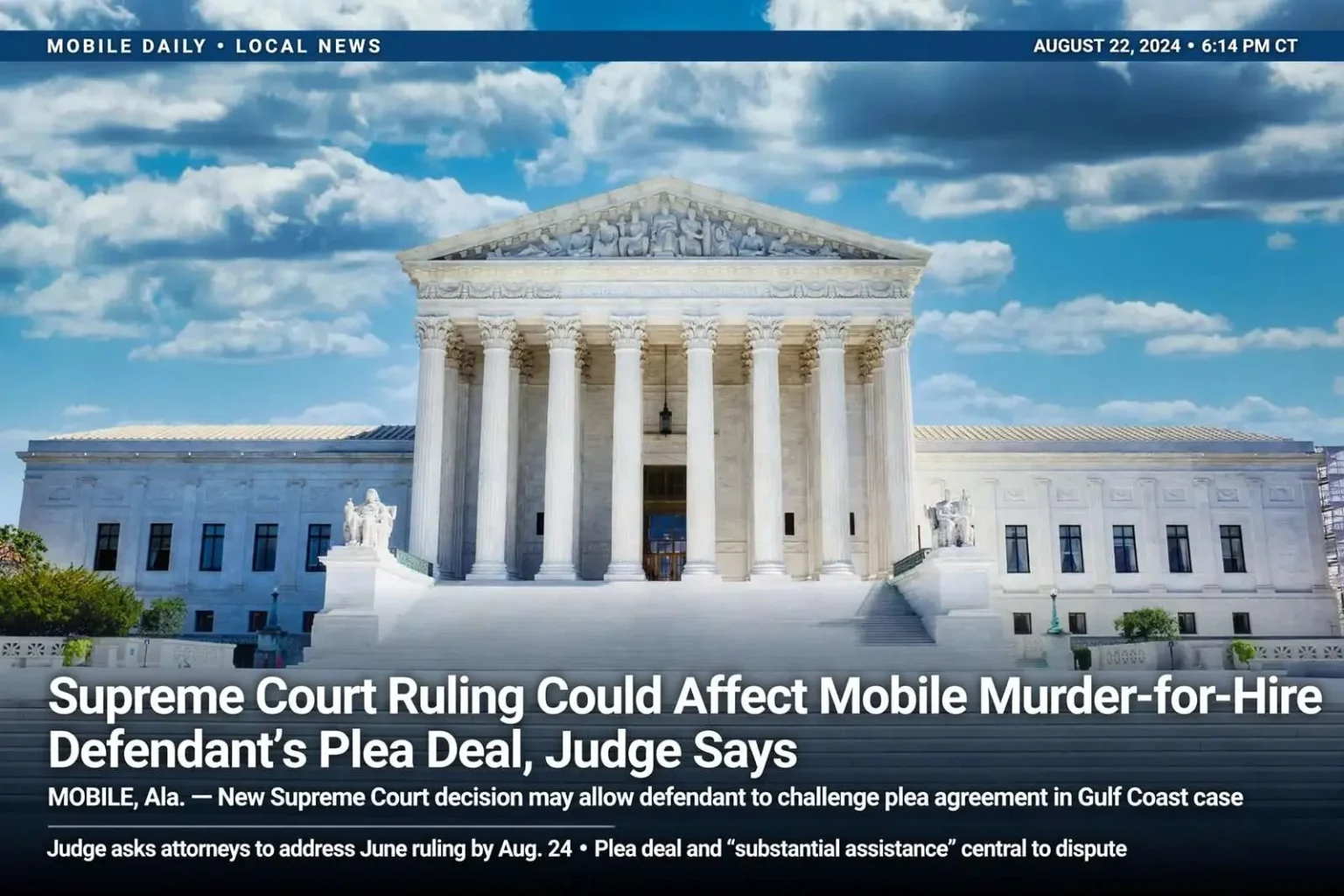
MOBILE, Ala. — A U.S. Supreme Court ruling handed down this year could affect a Mobile man’s bid to revisit his guilty plea in a murder-for-hire case that spanned two states along the Gulf Coast, a federal judge suggested this week.
Jimaurice Pierce pleaded guilty in 2024 to conspiracy to commit murder for hire, admitting that he and two co-defendants went to a Walmart Supercenter on the Interstate 65 Service Road in December 2022 in search of a magnetic tracking device to attach to the vehicle of the plot’s target. Prosecutors say the plot led to two nightclub shootings in Mobile and one in Mississippi.
Facing an automatic life sentence, Pierce asked U.S. District Judge Terry Moorer to either enforce what he says was a promise from prosecutors to recommend a lighter sentence, or let him withdraw his plea and go to trial. This week, the judge asked prosecutors and defense attorneys to submit written arguments on how a June Supreme Court ruling might apply to Pierce’s case.
That decision, involving defendant Munson Hunter III, adopted a “miscarriage of justice” exception allowing defendants to challenge plea agreements’ appeal waivers in certain circumstances. Hunter had pleaded guilty to aiding and abetting wire fraud and objected not to his 51-month sentence but to a supervised-release requirement that he undergo mental health treatment and take prescribed medication; the 5th U.S. Circuit Court of Appeals rejected his appeal, citing the plea’s waiver, but the Supreme Court reversed that ruling 8-1. “We principally hold that an agreement not to appeal a sentence is unenforceable when it would result in a miscarriage of justice,” the majority opinion states.
Pierce’s case hasn’t yet reached the appeal stage. The judge gave attorneys until Aug. 24 to lay out their positions and asked the defense to clarify whether Pierce’s priority is enforcing the plea deal as he understood it or withdrawing the plea entirely.
His attorneys maintain Pierce relied on assurances that a guilty plea, combined with “substantial assistance” to investigators, would avoid a life sentence — assurances they say prosecutors never honored. The U.S. Attorney’s Office counters that it was Pierce who failed to hold up his end of the agreement by not cooperating.
How Substantial Assistance Works
In federal court, a defendant’s cooperation can lead to a sentence below a mandatory minimum only if prosecutors file a “substantial assistance” motion; judges cannot grant that reduction on their own. Whether the government has promised to file such a motion, and whether the defendant held up his side of the bargain, is often at the center of disputes like Pierce’s. Once a judge accepts a guilty plea, a defendant can withdraw it before sentencing only by showing a “fair and just reason” under the federal rules of criminal procedure.