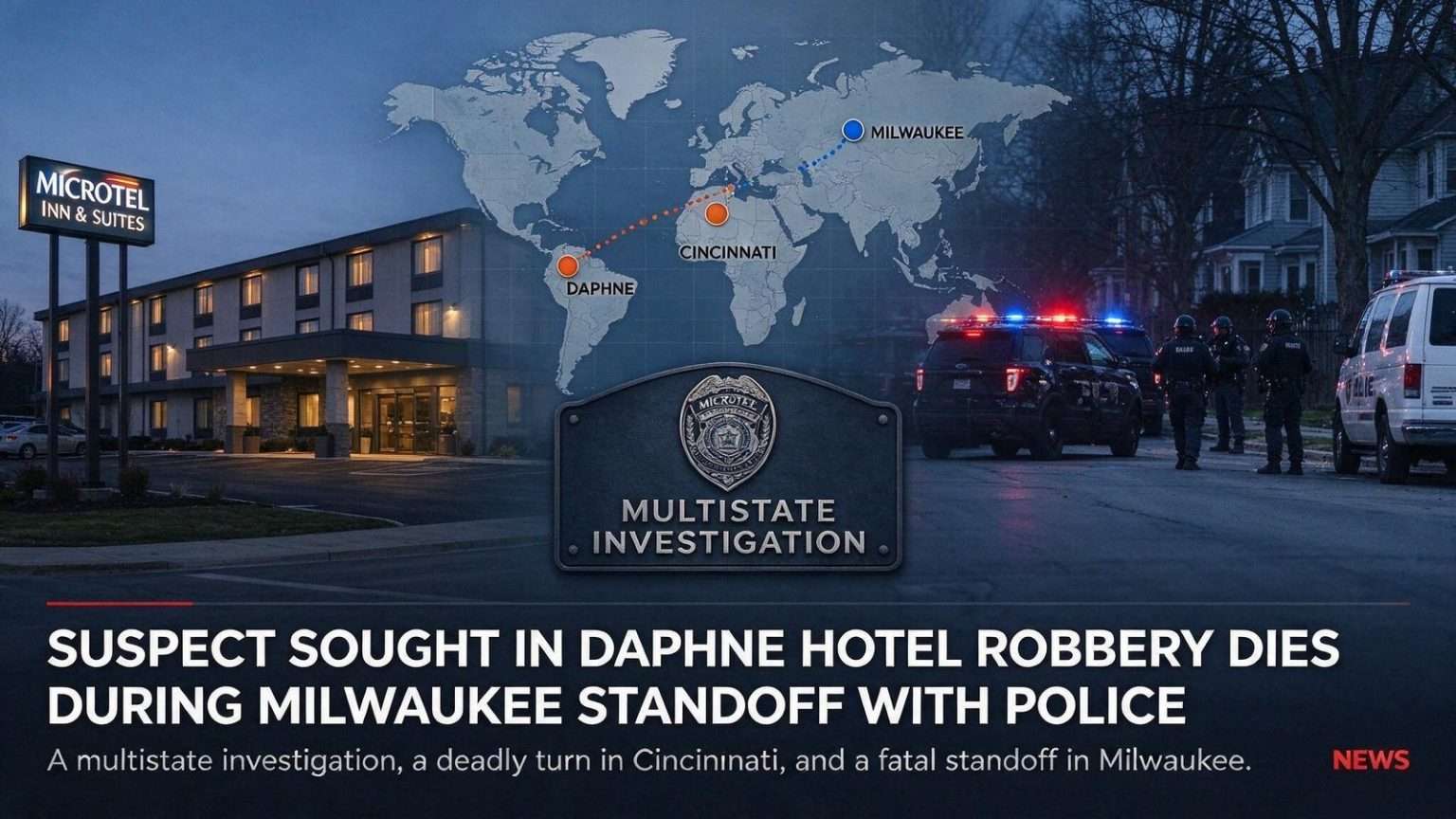
Suspect Sought in Daphne Hotel Robbery Dies During Milwaukee Standoff With Police
Gary Eubanks, wanted in a Daphne Microtel Inn robbery and linked to a dead accomplice in Ohio, died during a Milwaukee police standoff.
A man wanted in connection with an armed robbery at a Daphne hotel — and sought in Ohio after his alleged accomplice turned up dead — died during a standoff with police in Milwaukee, according to authorities. Daphne police identified the man as Gary Eubanks, 25. He was suspected in the Oct. 21 robbery of a Microtel Inn in Daphne, an incident caught on surveillance video.
The case had stretched across more than a thousand miles and three states by the time it ended in Wisconsin. What began as a hotel robbery in a quiet Baldwin County suburb became a multistate criminal investigation after one suspect turned up dead in Cincinnati, and it concluded in Milwaukee with a barricaded suspect, a police SWAT team and a fatal ending that investigators described as an apparently self-inflicted gunshot wound.
Daphne sits across Mobile Bay from Mobile, a city of about 25,000 along the eastern shore whose hotel corridor along US 98 and I-10 serves travelers moving between the beaches, the port and the interstate. A hotel robbery there — committed, police said, by someone captured on the property’s own cameras — generated the initial investigative file that would eventually be shared with police departments across the country as the suspects moved north.
The Daphne robbery
The Microtel Inn robbery on Oct. 21 set the case in motion. Surveillance video captured the incident, giving Daphne investigators images of the suspects from the outset — an advantage not every armed robbery investigation enjoys, and one that shaped the case’s subsequent course. Armed robbery of a hotel places employees and guests at risk in a location that cannot be hardened the way a bank is, and Alabama charges the offense as a felony with penalties that can run to decades in prison.
With the images in hand and the suspects identified as Eubanks and 18-year-old Baylee Wall, Daphne police sought warrants and began coordinating with other agencies as it became clear the two had left the area. Hotel robbery suspects frequently cross state lines quickly on the interstate corridors that run through the Mobile area — I-10 east toward Florida, I-65 north toward Montgomery and beyond — and once a suspect’s location spreads across multiple jurisdictions, the case becomes a patchwork of local departments, state agencies and federal partners.
The case took a darker turn two days after the robbery, when Wall — Eubanks’ alleged accomplice — was found dead in Cincinnati. Police there investigated her death as a homicide. The discovery converted a robbery manhunt into something more serious: investigators in two states now had a dead 18-year-old with a connection to a Daphne robbery, a surviving suspect who had been traveling with her, and an open question about where he was and what he would do next.
The trail to Milwaukee
According to Daphne police, Eubanks was located at a Milwaukee residence at about 4 p.m. Wednesday. How investigators found him followed the standard playbook for multistate fugitive work: coordinate with the local police department, verify the location, and contain the address before approaching. Milwaukee is roughly 750 miles from Daphne by road, a distance a fugitive can cover in a single day’s drive on the interstates that connect the Gulf Coast to the upper Midwest.
He barricaded himself inside, touching off roughly four-hour standoff involving the Milwaukee SWAT team. Standoffs of that length are typically managed with containment, negotiation and patience — officers secure the perimeter, evacuate nearby residents, and attempt to talk the subject out rather than force an entry that risks officers’ lives and any occupants inside. A four-hour timeline suggests the negotiators were working the situation actively through the afternoon and evening before the decision was made to enter.
When officers entered the home around 9 p.m., they found Eubanks dead from what investigators described as an apparently self-inflicted gunshot wound, citing reports from Cincinnati media. The finding closed the manhunt but opened the standard review that follows any death during a police operation: Milwaukee authorities investigate officer-involved deaths, and the autopsy and scene work will establish the precise circumstances. For Daphne investigators, the resolution of the fugitive phase left their own case — the robbery itself — still open.
What remains for Daphne investigators
The Daphne hotel robbery remains an active investigation, with detectives still working to identify a third person seen on the hotel’s surveillance video. That detail — a third individual captured on camera — means the Oct. 21 robbery may have involved more participants than the two suspects already identified, and with Eubanks dead and Wall dead, the video itself has become the primary lead. Detectives will continue reviewing the footage, canvassing the area and pursuing tips as they work to identify and locate the remaining figure.
The case also leaves questions that only the Cincinnati investigation can answer. Police there treated Wall’s death as a homicide, and investigators have not publicly described the circumstances or named a suspect. Until that investigation produces findings, the connection between her death and the robbery — and between her death and Eubanks’ flight north — remains unexplained in the public record. Multistate cases like this one typically involve information-sharing among the involved departments, with each agency responsible for its own piece: Daphne for the robbery, Cincinnati for the death investigation, Milwaukee for the standoff review.
For Baldwin County residents, the episode’s ending brought an unresolved kind of closure. The man suspected of robbing a Daphne hotel will never face an Alabama courtroom, and with him died the answers a trial might have produced about who did what on Oct. 21. What remains is the investigative record — surveillance video, witness statements and the multistate paper trail of a case that started at a hotel on the Alabama coast and ended, four hours of standoff later, in a Milwaukee residence where officers entered to find the suspect already gone.
The multistate fugitive machine
Cases like this one expose how modern fugitive investigations actually work. When Eubanks and Wall left Baldwin County, the Daphne robbery file did not simply sit in one agency’s drawer. Warrants were entered into national databases, alerts went to departments along likely travel routes, and once the suspects surfaced in Ohio, Cincinnati police became part of the case in real time. The same infrastructure later produced the Milwaukee location — a reminder that a suspect fleeing one small-city robbery is, in practice, fleeing a network of departments that share records daily.
Extradition is the legal backdrop that makes such pursuits matter. A suspect arrested in Wisconsin on Alabama robbery warrants would face a governor’s warrant and a transport back to Baldwin County to answer the charges, a process that typically takes weeks once the suspect declines to waive extradition. That machinery exists so that geography does not erase accountability, and it is why investigators in Daphne kept building their case even while the suspect was a thousand miles away — the file that supports the warrant is the file that will eventually support the prosecution.
The standoff’s fatal conclusion short-circuited all of it. Deaths during police standoffs trigger the standard reviews — an autopsy to confirm the cause and manner of death, an investigation of the tactical operation, and coordination among the involved agencies to reconcile their separate records. Only after those processes conclude do the involved departments usually release detailed findings, which is why the public account of the standoff’s final minutes rests, for now, on the preliminary description: an apparently self-inflicted gunshot wound found when officers entered around 9 p.m.
The human ledger of a two-week case
Stripped to its dates, the case moved with terrible speed: a robbery on Oct. 21, an 18-year-old found dead two days later in Cincinnati, a suspect located and dead in Milwaukee by the following Wednesday. Two young people connected to an Alabama robbery were dead within roughly a week of the crime, and a third person from the surveillance video remained unidentified. Each of those outcomes generated its own investigation, its own file and its own unresolved questions.
For the Daphne community, armed robbery of a hotel is a jarring crime — the kind of offense that shatters the sense of safety in a city where violent crime rates are low by regional standards. Baldwin County has grown rapidly for decades, and its police departments have scaled up accordingly, but cases that end in other states, with suspects dead in other cities, test the limits of what any local agency can resolve on its own. The video from the Microtel remains the case’s central evidence, and the unidentified third person on it remains its central question.
Daphne police have asked anyone with information about the robbery or the third individual seen on the surveillance footage to come forward, and the investigation’s outcome now depends on exactly the kind of public assistance that solved the initial identification. The multistate chapter of the case is closed with Eubanks’ death. The Alabama chapter — who robbed the Microtel Inn on Oct. 21, and who else was with them — remains open.