Teen recovering after possible shark bite at Orange Beach
A 15-year-old boy was recovering after a possible shark bite at Orange Beach, with witnesses helping stop the bleeding until medics arrived.
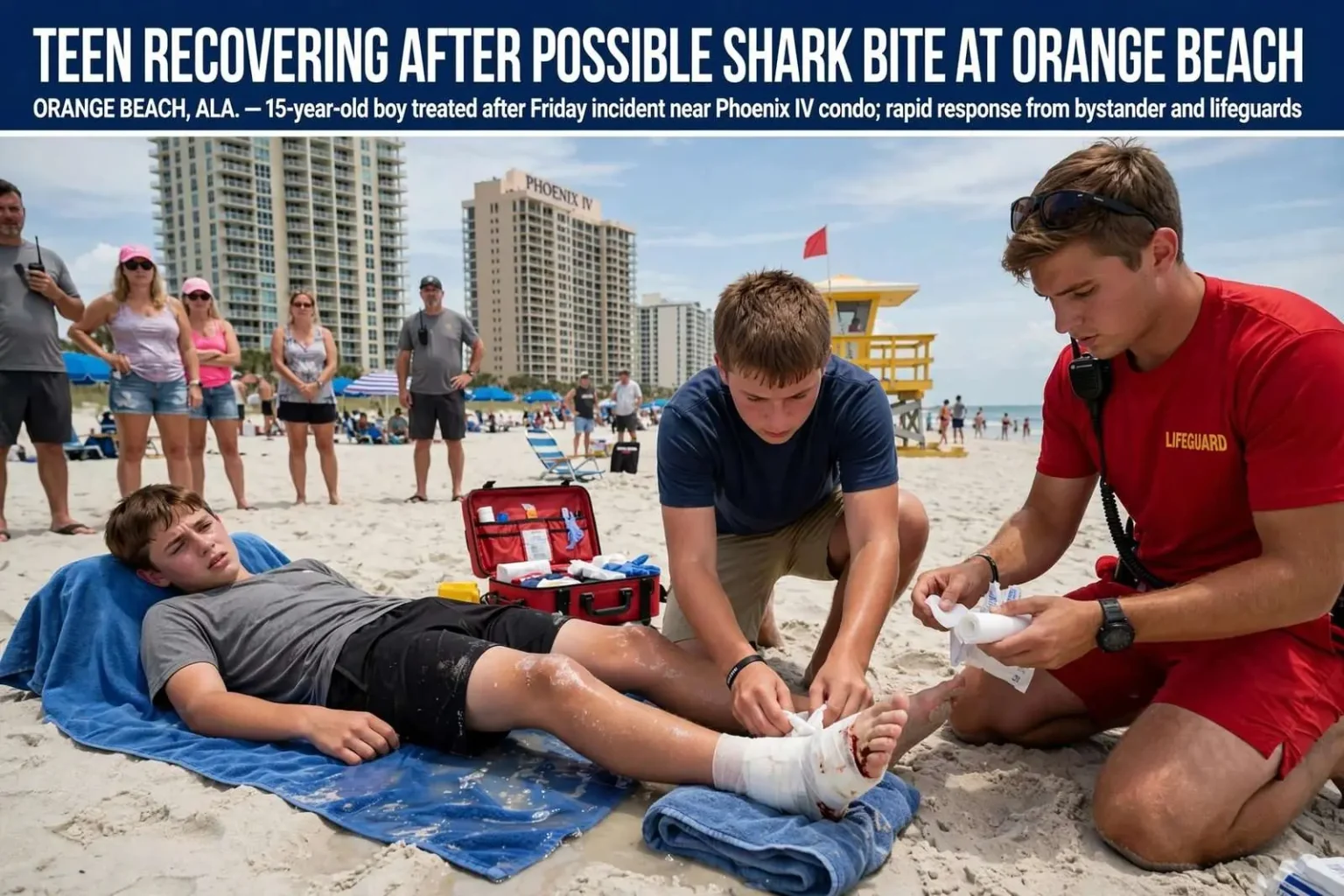
ORANGE BEACH, Ala. — A 15-year-old boy is recovering after a possible shark bite at Orange Beach, an incident that unfolded Friday afternoon in the water near the Phoenix IV condominium and left onlookers rushing to his aid. A 14-year-old witness who helped the boy said the injury was unmistakable once he got close.
Gavin Green, 14, said he walked over to help the boy near Phoenix IV around 1:30 p.m. Friday, thinking at first the teenager had suffered a stingray sting — a common assumption on the Gulf Coast, where stingray injuries send beachgoers to first aid stations all summer. What he found was far more serious. “I walk over there and a chunk of his foot is missing,” Green said.
The boy’s father had reported seeing a lot of fish in the area, but neither he nor his son saw a shark, according to the account from those who assisted. Despite that, the nature of the wound — a significant piece of the boy’s foot missing — pointed authorities and witnesses toward a shark as the likely source, and the case is being treated as a possible shark bite pending further review.
Green and several other beachgoers worked with lifeguards to stop the bleeding, wrapping the boy’s foot and keeping him stable until he could be taken to a hospital for treatment. The boy is expected to be OK, and his recovery was progressing after the Friday incident.
A rapid response on a crowded beach
The response to the injury showed how fast a beach crowd can mobilize. Green said he and several others went to the boy immediately after realizing the severity of the wound, and lifeguards joined the effort to control the bleeding. Severe injuries to a foot can involve heavy blood loss, and stopping it quickly — with pressure, elevation and whatever dressings were at hand — was the priority until the boy reached definitive care.
Orange Beach’s beach safety program staffs lifeguard towers along the city’s publicly guarded beach areas during the summer, and lifeguards are trained in first aid for everything from jellyfish stings and stingray injuries to lacerations and drownings. Friday’s response put that training to work in real time, with guards and civilians cooperating until the boy could be transported to a hospital.
The timing and location matter, too. Phoenix IV sits along the stretch of Orange Beach fronted by high-rise condominiums, one of the busiest parts of Alabama’s Gulf shoreline on a summer Friday. An injury in that area draws immediate attention, and word of a possible shark bite spreads quickly along the sand — prompting questions from parents and visitors about the water and what happened.
Sharks, stingrays and the Gulf Coast summer
The initial assumption that the injury was a stingray sting reflects how the Gulf Coast’s everyday hazards work. Stingrays rest on the sandy bottom in the shallow surf, and swimmers who step on one can take a barb to the foot — painful, occasionally serious, but rarely the stuff of emergency surgery. The standard advice is the “stingray shuffle”: sliding the feet through the sand rather than stepping, which gives the rays warning to move. Most beach visitors who limp out of the surf on a Gulf Coast afternoon are dealing with a stingray, a jellyfish or a shell cut, not a shark.
Shark bites, by contrast, are genuinely rare along Alabama’s beaches — uncommon enough that each one makes news across the region. When they do occur, they often follow the pattern experts describe: murky nearshore water, an abundance of bait fish close to shore, and a shark that mistakes a hand or foot for prey in low visibility. The boy’s father’s report of a lot of fish in the area fits that picture. Bait fish attract feeding sharks, and swimmers in the middle of a bait school face more risk than those in clear, quiet water, though the absolute risk remains small.
Marine biologists note that the Gulf’s most common nearshore sharks — species like blacktips and spinner sharks — feed on small fish and are generally not a threat to people, but any shark in turbid water chasing bait can bite mistakenly. Bites typically involve a single strike to a limb rather than repeated attacks, which matches the profile of the Orange Beach incident: one injury, to a foot, with no shark seen by the victim or his father.
What beachgoers can do to reduce risk
Safety officials along the Alabama coast repeat a short list of precautions every summer. Swim near lifeguards, as the boy’s rescuers were able to do near the guarded beach areas. Avoid swimming at dawn, dusk and night, when sharks feed and visibility is poor. Stay out of the water where birds are diving or fish are jumping — signs that bait fish are concentrated — and leave the water if fish behave erratically or large fish are seen. Avoid wearing shiny jewelry, which can flash like fish scales, and don’t swim near fishing piers or where people are casting for bait.
Orange Beach’s lifeguards also fly warning flags that communicate surf conditions each day, and guards move swimmers out of the water when hazards develop. Visitors are encouraged to check the flags, ask guards about conditions and keep children within sight. None of these measures eliminates risk — the Gulf is a wild ecosystem — but they address the conditions most often associated with the rare bite, and they put trained responders close at hand when something goes wrong.
Recovery and the aftermath for the boy
The 15-year-old’s injuries, while severe, are expected to heal, and officials and witnesses alike have expressed relief that the outcome was not worse. Foot injuries from a possible shark bite often require surgery, and recovery can involve months of care depending on the tissue damage involved. What witnesses described — a piece of the boy’s foot missing, heavy bleeding, a rapid response — suggests a wound treated as a medical emergency from the first moments, which is exactly what the people around him provided.
The hospital’s treatment of such wounds typically focuses on cleaning the injury thoroughly — mouth bacteria from any bite, shark or human, makes infection a real concern — repairing tissue, and preserving function. Orthopedic and reconstructive specialists become involved when bone or tendon is damaged. The boy’s family has not spoken publicly, and authorities have not released his name because he is a minor.
For Gavin Green, the 14-year-old who walked toward what he thought was a stingray sting and found something far worse, the afternoon was a lesson in what bystanders can do. Along with the lifeguards and the others who helped, he kept his head, applied pressure, and stayed with the boy until the situation was under control. Bystander response of that kind is a recurring factor in the survival stories that follow water emergencies along the coast.
The rare-but-real nature of shark bites on the Alabama coast
Incidents like Friday’s are worth keeping in perspective. Millions of people swim along Alabama’s Gulf beaches every summer, and confirmed shark bites in the state are rare enough to be counted individually. Worldwide, unprovoked shark bites number in the dozens each year, and fatal ones are rarer still — a measure of how seldom sharks and swimmers actually collide, and of how few species pose any danger to people.
Still, the Gulf is home to sharks year-round, and summer brings both peak crowds and peak shark activity close to shore as bait fish school in the warm, murky water. The Orange Beach incident — a possible bite near Phoenix IV on a Friday afternoon, witnessed by a 14-year-old vacationer’s quick action and a lifeguard response that stopped the bleeding — ends as well as such events can: a boy recovering, expected to be OK, and a beach community reminded of both the sea’s rare hazards and the value of people who know what to do when one of them surfaces.
Orange Beach and its beach safety infrastructure
Orange Beach draws its summer crowds to a shoreline lined with condominium towers, rental houses and the public beach access points the city maintains along Perdido Pass and the Gulf State Park boundary. The city’s beach safety division operates during the peak season, staffing guarded areas and patrolling the sand with vehicles and personal watercraft. Lifeguards handle everything from missing children and rip-current rescues to the medical calls that come with a beach full of swimmers, and coordination with fire and EMS agencies is routine.
The stretch near Phoenix IV, where Friday’s injury happened, is among the most heavily used parts of the beach, fronted by vacation rentals that fill with families throughout the summer. Around 1:30 p.m. on a Friday, the water and sand are at their most crowded, and the proximity of bystanders and lifeguards in that environment is part of what made the rapid response possible. In more isolated stretches of the coast, an identical injury could wait far longer for help.
Local officials have long paired that infrastructure with public education — flag systems, rip-current awareness campaigns and guidance about marine life — and the city’s approach mirrors what beaches across the Florida panhandle and the rest of the Alabama coast do. The goal is simple: keep the Gulf’s rare dangers rare, and make sure that when one does occur, the people closest to it are ready.
The takeaway from a Friday on the sand
For the families visiting Orange Beach, Friday’s events will fade into the background as the summer goes on, and the beach will stay busy. The boy who was bitten is expected to be OK, thanks to a chain of quick decisions by a 14-year-old witness, other beachgoers and professional lifeguards. The possible shark bite remains a reminder that the Gulf is a living system — bait fish, rays and sharks all share the same water swimmers do — and that the smartest response is neither panic nor neglect, but simple awareness: swim guarded, watch the flags, heed the bait fish, and know that the people around you, like Gavin Green, may be the first responders who matter most.