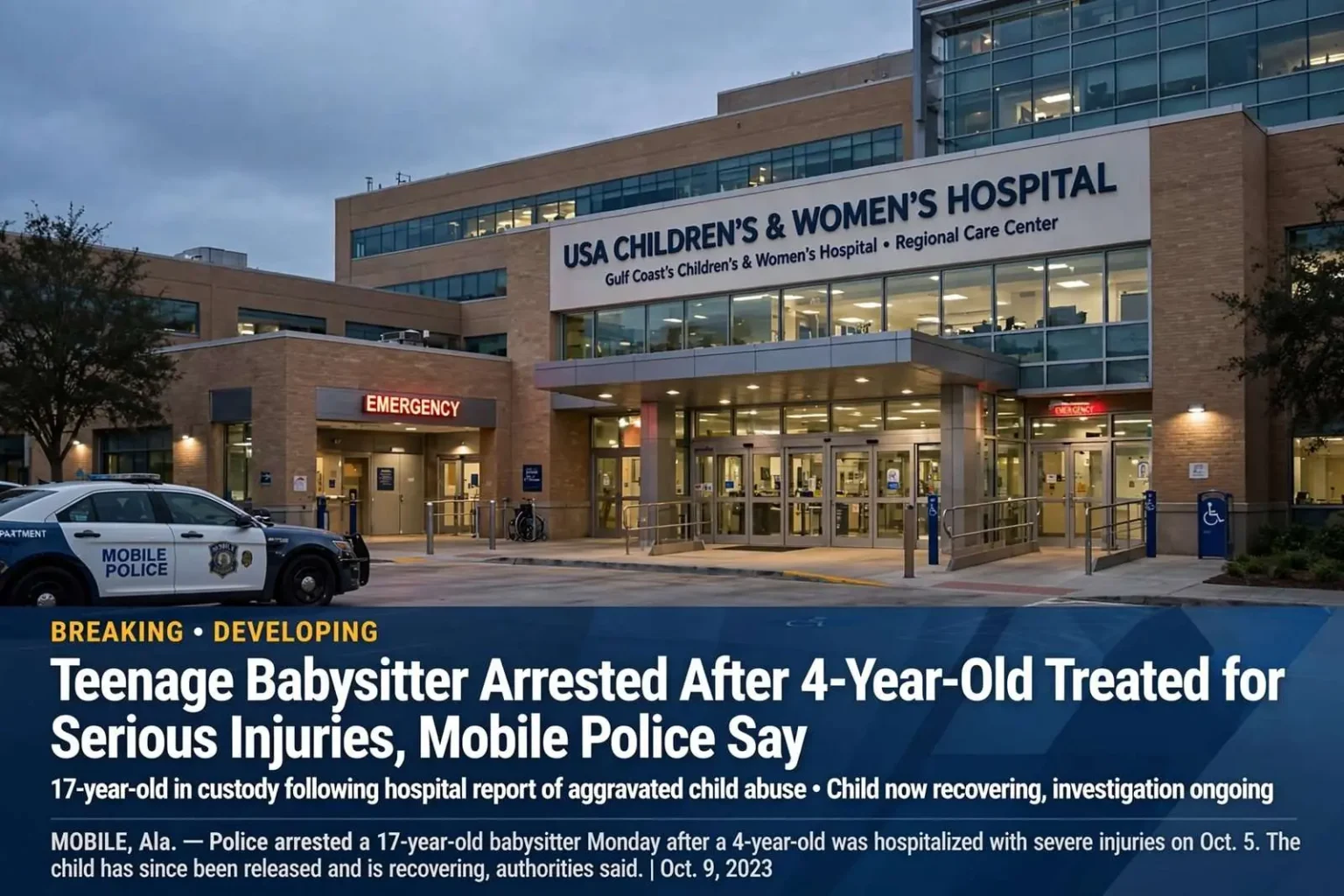
MOBILE, Ala. — A 17-year-old babysitter has been arrested in connection with the suspected abuse of a 4-year-old child he was watching, according to the Mobile Police Department, in a case that investigators have classified as aggravated child abuse. Officers were called to USA Children’s and Women’s Hospital on Thursday, Oct. 5, at around 9 p.m. after hospital staff reported treating a severely injured 4-year-old, and the arrest came days later after detectives identified the teenage caregiver as a suspect.
According to police, the child had multiple injuries and extensive bruising and tested positive for drugs — findings that transformed what began as a hospital report into a criminal investigation. The department said the child has since been released from the hospital and is recovering, though authorities have not detailed the long-term outlook. The severity of the injuries and the positive drug test formed the basis for classifying the case under Alabama’s aggravated child abuse statute, which applies to abuse resulting in serious harm to a child.
On Monday afternoon, investigators identified the teenage babysitter as a suspect and took him into custody. Because he is a juvenile, authorities have not released his name, and formal charges had not been detailed publicly in the days following the arrest. The investigation into the circumstances of the child’s injuries remains ongoing, with detectives continuing to piece together the timeline of who was caring for the child and when the abuse occurred.
The Hospital Where the Case Began
USA Children’s and Women’s Hospital occupies a central place in cases like this one. The hospital is the Gulf Coast’s dedicated children’s and women’s medical facility, serving as the regional referral center for injured and abused children across southwest Alabama, and its staff are trained to recognize the signs of abuse that a general emergency room might miss. When medical staff there identify injuries inconsistent with an explanation offered, state law requires a report to law enforcement and child protective authorities — the mechanism that brought Mobile police to the hospital that Thursday night.
The hospital’s role does not end with the report. Pediatric medical teams document injuries in the detail that investigators and prosecutors require, coordinate with social workers, and manage the child’s recovery — work that continues after police make an arrest. In this case, the child’s release from the hospital marked a medical milestone, but the child’s care and safety going forward remained in the hands of the agencies now involved.
The call to police came at around 9 p.m. on Oct. 5, a timing that reflects how these cases emerge: not through a 911 call from the scene, but through medical professionals evaluating a child whose injuries tell a story no one else has told. Detectives from the police department’s family crimes and child abuse investigators took over from there, working to establish who had access to the child and when the injuries were most likely inflicted.
How the Case Moved From Report to Arrest
Identifying a suspect took days rather than hours. Between the hospital report on Thursday night and the Monday afternoon arrest, detectives worked through the child’s caretaking arrangements — the questions at the center of every child abuse case involving a caregiver. The investigation settled on the 17-year-old babysitter who had been watching the child, and officers took the teenager into custody without incident, according to the information police released.
The suspect’s age shapes how the case proceeds. As a juvenile, the 17-year-old’s name cannot be released, and his case moves through the juvenile justice system rather than adult court — at least initially. Alabama prosecutors can seek to transfer serious juvenile cases to adult court, but that decision comes later in the process, after formal petitions are filed and hearings held. Police have not detailed the formal charges, a gap that reflects both the juvenile confidentiality rules and the ongoing investigation.
The classification of the case as aggravated child abuse signals the severity the allegations carry. Under Alabama law, the aggravated form of the offense involves serious physical harm to a child and carries substantial penalties, and the charge structure prosecutors ultimately pursue will depend on the medical evidence documented at the hospital and the findings of the police investigation.
DHR’s Role Going Forward
The Alabama Department of Human Resources has been notified of the incident, and police said DHR is working alongside investigators to help ensure the child’s safety going forward. That involvement is standard in abuse cases and takes on central importance once a child leaves the hospital: DHR assesses the home environment, determines who can safely care for the child, and coordinates with the courts on protective measures while the criminal case proceeds on a separate track.
The dual-track structure — criminal prosecution and child protection — runs in parallel in cases like this one. Police and prosecutors pursue accountability for the abuse; DHR’s child welfare staff work to ensure the child’s living situation supports recovery and safety. The two efforts share information, but they operate under different rules, different timelines and different standards, and both remained active after the teenager’s arrest.
The child’s positive drug test raised questions investigators have not answered publicly — including how the child was exposed and what substance was involved. Police have not said whether additional suspects or charges are possible, noting only that the investigation remains ongoing. In abuse cases involving young children, the initial arrest frequently is not the end of the inquiry, as detectives continue to establish the full sequence of events and whether others had knowledge or involvement.
A Community Marker of a Larger Problem
The case arrived in Mobile amid the steady drumbeat of child abuse cases that children’s hospitals across Alabama see each year. Medical professionals and child welfare workers have long emphasized that abuse cases are identified most often through hospitals, schools and daycare centers — the places where children’s injuries become visible to adults outside the home. Mandatory reporting requirements in Alabama place the obligation on professionals in those settings, and the Oct. 5 report from the hospital staff followed exactly that pattern.
For the recovering 4-year-old, the path forward involves medical follow-up, child welfare oversight and, eventually, the resolution of the criminal case against the teenager arrested in connection with the injuries. The police department’s announcement of the arrest closed one phase of the case but left the larger questions — the child’s long-term recovery, the final charges, and the outcome of the juvenile proceedings — to be answered as the investigation and the courts move forward. Authorities have committed to continuing the investigation, and additional details will emerge only through that process.
The Timeline Police Described
The sequence the Mobile Police Department laid out was brief but specific. At around 9 p.m. on Thursday, Oct. 5, officers were called to USA Children’s and Women’s Hospital, where staff reported that a 4-year-old was being treated for severe injuries. The child presented with multiple injuries and extensive bruising and had tested positive for drugs, and detectives classified the case as aggravated child abuse — the formal category that set the investigation’s course.
Over the following days, detectives worked to identify who had been caring for the child. By Monday afternoon, they had identified the teenage babysitter as the suspect, and officers took the 17-year-old into custody. The arrest, coming four days after the hospital report, reflected the pace of an investigation that had to account for the child’s caretaking history before naming anyone.
What police have not done is fill in the surrounding story. They have not said how long the teenager had been babysitting the child, where the abuse was believed to have occurred, what injuries specifically were documented, or what drug the child tested positive for. Those details, if they become public, would surface through charging documents or court proceedings in the juvenile system, where confidentiality limits what officials can release.
Aggravated Child Abuse Under Alabama Law
The aggravated child abuse classification carries the state’s most serious framework for abuse short of a child’s death. Alabama’s statute reaches abuse that causes serious physical harm, and it applies to caregivers responsible for a child’s welfare — a category that includes babysitters as well as parents. A person accused of the offense faces felony-level exposure, and the classification prosecutors settle on will reflect the medical evidence the hospital documented and the investigative file detectives assembled.
The juvenile suspect’s age adds a procedural layer. Seventeen-year-olds charged in Alabama’s juvenile system face detention hearings, formal petitions and adjudication hearings rather than the public courtroom process adults see, and the records remain sealed. In cases involving injuries this severe, the district attorney’s office can seek a transfer hearing to move the case to adult court, a decision that would make the proceedings and records far more public. Whether that step happens in this case has not been indicated.
Police have also not detailed the formal charges, noting only that they had not been publicly itemized in the days after the arrest. In juvenile cases, the formal charging document — the petition — is filed with the juvenile court rather than announced at a press conference, which explains the gap between the arrest announcement and the specifics of what the teenager is accused of doing.
Where the Case Stands
As of the department’s announcement, the child had been released from the hospital and was recovering, and the Alabama Department of Human Resources had joined the effort to secure the child’s future safety. The juvenile suspect remained in custody, and the police investigation remained open — a status that leaves room for additional findings, additional charges or a fuller public account as the case develops.
The case now moves along the two tracks that every serious abuse case in Alabama follows: the juvenile court’s handling of the 17-year-old suspect, and the child welfare system’s oversight of the 4-year-old victim’s care. Both will unfold largely outside public view, constrained by the confidentiality rules that govern juvenile proceedings and child protective cases alike. What the public knows today is what investigators chose to release — the hospital report, the injuries, the arrest — and the rest will emerge, if it emerges at all, through the courts.