Temporal City Festival 2013 Invites Artists to Reimagine Downtown Mobile’s Abandoned Spaces
The Rumor Union sought ten artists for the 2013 Temporal City Festival, transforming abandoned downtown Mobile buildings into art spaces.
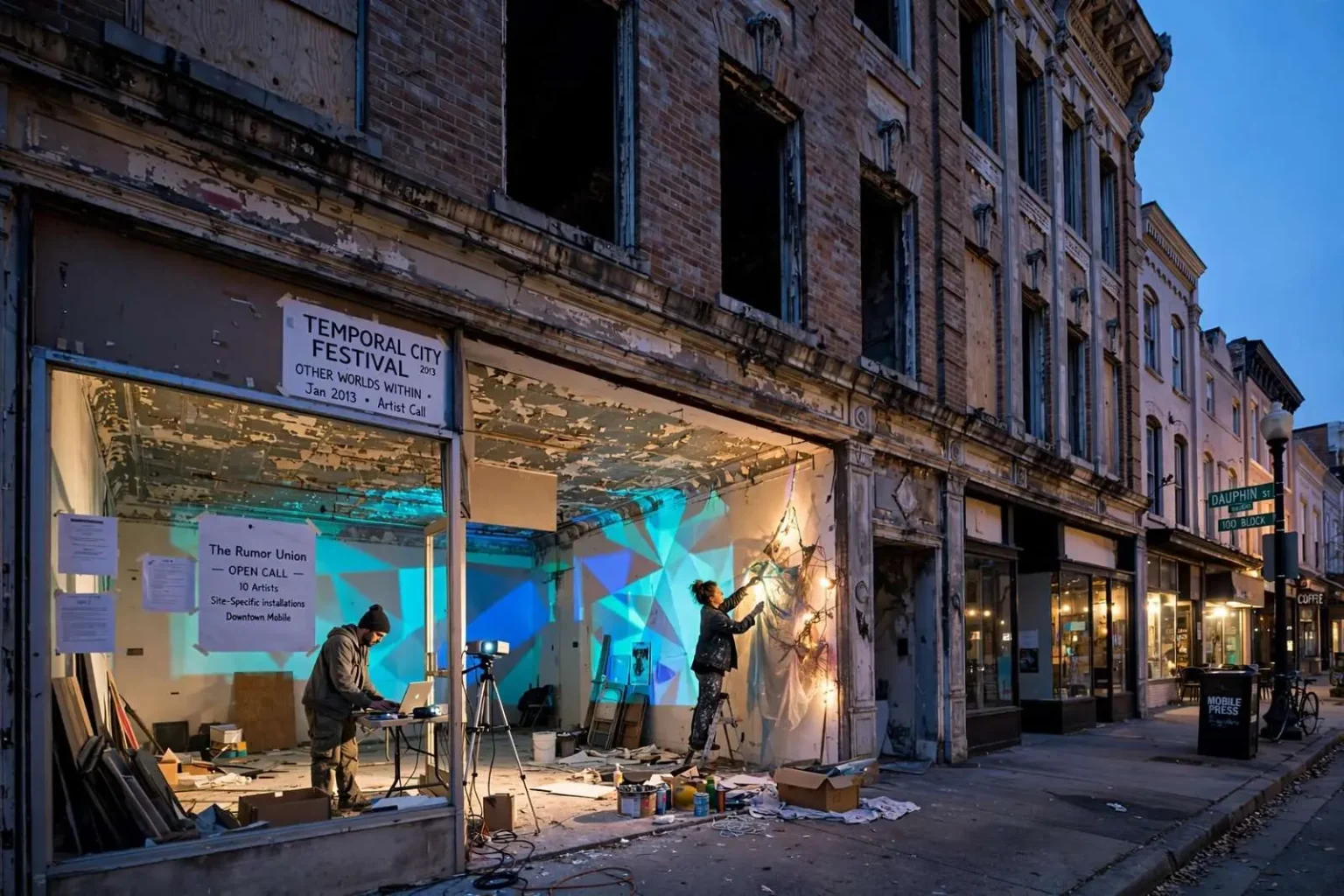
The Rumor Union, a Mobile-based arts collective, announced in January 2013 that it was seeking artists to participate in the third iteration of the Temporal City Festival, an event dedicated to transforming unused and abandoned buildings in downtown Mobile into temporary venues for art and performance. The call arrived at a moment when downtown’s vacant structures were a defining feature of its landscape — upper floors empty above active storefronts, whole buildings standing dark between restored neighbors — and when a growing community of artists was arguing that those spaces were assets rather than eyesores.
A Call for Creative Intervention
The festival’s organizers invited up to ten artists to stage temporary interventions in vacant downtown structures, using performance, installation, and new media as vehicles for reimagining the city’s built environment. Site-specific projects that presented alternative visions of place were especially encouraged, though all media and art forms were welcome as long as they engaged with the festival’s central theme of reinventing urban space. The cap on participants was a curatorial choice rather than a limitation on ambition: with ten artists, the festival could support each project individually and assemble a coherent route for audiences moving between sites.
Temporary intervention, as a form, occupies a deliberate middle ground between a gallery show and permanent public art. Artists work with the grain of the building they are given — its dust, its decay, its leftover details — and what they create disappears when the festival ends. That impermanence is the point. The Temporal City format lets a community test what a space could be without anyone committing to what it will be, and it generates the photographs, conversations and press attention that sometimes push a permanent redevelopment forward.
The 2013 edition carried the subtitle “Other Worlds Within,” a nod to the untapped creative potential that organizers saw in the shells of empty storefronts and disused buildings scattered across Mobile’s downtown core. The title invited audiences to read each vacant structure not as a void but as a container — a set of rooms, proportions and histories that could hold something new for a night or a weekend. Artists selected for the festival were expected to respond to the specific character of their assigned space rather than drop in generic work.
Art in a City in Transition
Mobile had weathered a particularly turbulent stretch in the years leading up to the festival, dealing with the aftermath of devastating storms while simultaneously celebrating cultural and economic wins. The storms that raked the Gulf Coast in the 2000s left their marks on the city’s building stock and its budgets, while the same period brought downtown revitalization wins — new restaurants and entertainment venues along Dauphin Street, the continued growth of the cruise terminal, and a steadily building reputation for the city’s historic Mardi Gras celebrations. The festival positioned itself as part of a broader conversation about the future of the city, one shaped by both the challenges of recent storm damage and the promise of emerging economic opportunities.
Festival organizers framed the event as a chance for the community to engage in what they called “unfettered dreaming” about the city’s future, using art as a tool for civic imagination. The phrase captured the organizers’ belief that a city’s self-image is a creative act — that before Mobile could decide what its downtown should become, its residents needed places to practice imagining it. A vacant building turned into an art venue for a night gives exactly that: a low-stakes rehearsal of a different future.
Built on the Arts Alive Foundation
The Temporal City Festival, which first launched during the Arts Alive season in 2011, had already established itself as one of downtown Mobile’s more ambitious arts programming efforts by the time of the 2013 call. Arts Alive, the annual celebration coordinated through Mobile’s arts community each spring, gathers galleries, performance groups and creative businesses for a concentrated stretch of events centered on the LoDa arts district, and the festival’s debut rode that existing audience to a strong start. Its second edition confirmed that the vacant-building concept could draw crowds year after year.
By the 2013 cycle, the festival had become one of the more distinctive entries in Mobile’s arts calendar precisely because it used the city itself as the venue. Where a gallery show asks audiences to come to the art, the Temporal City Festival asked them to walk past the familiar and see it differently — to enter buildings they had passed a hundred times without a second thought and find them occupied by performance, projection and installation.
By temporarily activating neglected spaces, the festival sought to draw attention to the potential locked inside buildings that most residents walked past without a second glance. That argument had practical weight in downtown Mobile, where vacant upper stories and underused commercial blocks sat in the middle of a district that was otherwise gaining residents, restaurants and nightlife. Every intervention demonstrated that the structures had sound bones, usable space and atmosphere that no new construction could replicate.
The Role of the Rumor Union
The Rumor Union, the collective behind the festival, represents a strain of artist-run organizing that has shaped Mobile’s cultural scene alongside its longer-established institutions. Collectives of this kind typically operate on volunteer energy, small grants and in-kind support from property owners willing to lend a vacant building for a weekend, and they succeed by being nimble in ways that formal institutions cannot. The collective’s willingness to broker between artists and building owners — two groups with very different risk tolerances — is what makes a vacant-building festival legally and logistically possible.
The festival’s model also depends on timing and trust. Owners of vacant downtown buildings face insurance, liability and security concerns that make them cautious about opening their properties, and the festival’s track record over its first two editions was the evidence that reassured new owners to participate. Each successful event made the next round of building access easier to arrange, which is why the third iteration’s call for artists could promise more sites and bigger audiences than the first.
For the artists, the appeal is equally practical. Emerging performers and installation artists rarely get access to raw, character-filled space — most exhibition venues are white boxes — and a downtown Mobile storefront with its original tin ceiling and aged plaster is the kind of canvas that shapes a project rather than merely housing it. The festival’s invitation asked artists to treat the buildings as collaborators, and the best-remembered works from past editions took that instruction seriously.
What the Festival Asks of Artists and Audiences
For artists considering the call, the requirements followed the festival’s established pattern: proposals that named the kind of space they needed, media that could function in an unconditioned building without standard gallery infrastructure, and work that engaged the theme of reinventing urban space rather than simply using a vacant building as a backdrop. Performance, installation and new media were named explicitly, which signaled that organizers wanted projects that activated the space in time — sound, motion, light — rather than static exhibitions that could hang anywhere.
For audiences, the festival format turns attendance into a kind of urban exploration. Visitors move between sites, often finding buildings they never knew existed, and the experience of standing in a dark ballroom or an empty retail floor lit by an artist’s projection rewrites their mental map of the block. That rewiring is the festival’s real product. A resident who has seen the inside of a “vacant” building is far more likely to support its redevelopment, buy into its reuse, or invest downtown at all.
Vacant Buildings as a Downtown Question
The festival’s premise sits inside a debate playing out in mid-sized cities across the Gulf South: what to do with the commercial buildings that predate the suburban era and resist easy reuse. Downtown Mobile’s historic fabric — blocks of early twentieth-century masonry commercial buildings along Dauphin, Royal and Bienville — represents both the city’s greatest design asset and its most persistent challenge, because upper floors built for offices and lodging in 1910 do not convert to modern uses without money and imagination.
Arts-led vacancy interventions have become a recognized strategy in that debate nationwide. Cities from smaller Gulf Coast towns to major metros have used temporary arts tenancy to market hard-to-lease buildings, gather community feedback on potential reuses, and give preservation advocates concrete evidence that the structures are worth saving. Mobile’s Temporal City Festival belongs squarely in that movement, and its subtitle in 2013 — “Other Worlds Within” — made the underlying claim explicit: the value is already inside the buildings, waiting to be shown.
The January 2013 announcement positioned the festival for its spring presentation, with artists expected to develop their proposals through the winter and build their interventions in the weeks before the event. For a city still working out the fate of its empty spaces, the third edition offered the same proposition as the first two: that the fastest way to see downtown Mobile’s future is to spend an evening walking through its past, reimagined by ten artists with the doors unlocked.