
Temporal City Festival Returns to Downtown Mobile for Its Fourth and Final Year
Temporal City Festival returns to downtown Mobile for its fourth and final year April 10-12, 2014, with site-specific art inside a historic building.
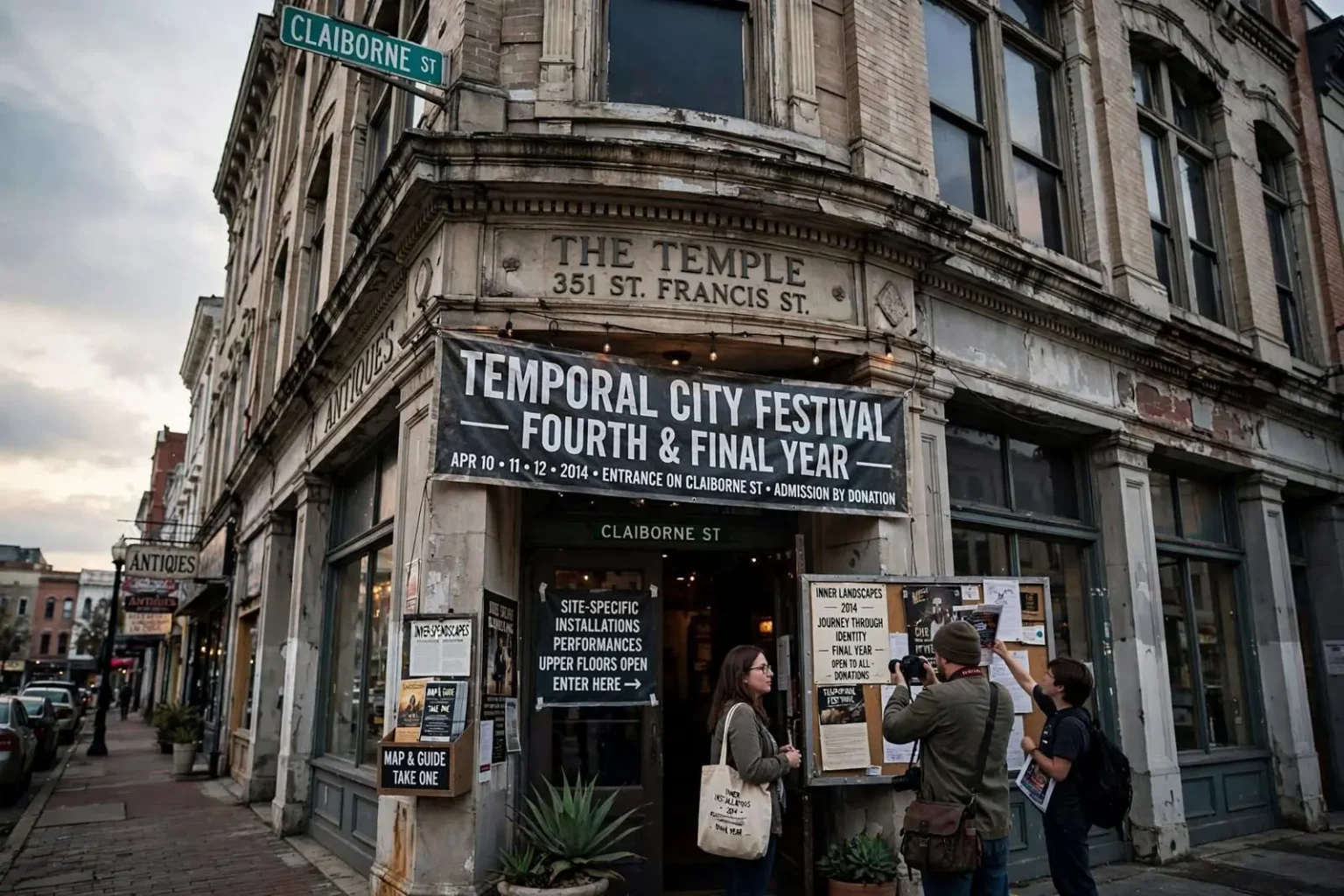
The Rumor Union has announced the 2014 edition of Temporal City, the downtown Mobile arts festival that transforms the upper floors of a historic building into a temporary world of site-specific installation and performance. This year’s festival runs Thursday, April 10 through Saturday, April 12, with entrance on Claiborne Street near the Temple at 351 St. Francis Street. Admission is by donation, and organizers say visitors may arrive at any point during the three-day run and move through the space at their own pace.
Now in its fourth and final year, Temporal City has long invited artists to reimagine neglected downtown spaces, taking over upper floors that most passersby have never seen and filling them with work created for those rooms alone. The 2014 theme turns inward, exploring personal identity and the inner landscapes that shape how people see the world around them. Organizers describe the experience as a journey through varied performances of identity, one that can lead either to deeper clarity or complete oblivion.
A Festival Built on Forgotten Spaces
Temporal City takes its name from the idea that a city is never finished, that blocks and buildings carry layers of use and abandonment that can be briefly reopened for public imagination. Since its first edition, the festival has set itself apart from gallery shows and street fairs by choosing buildings rather than venues. Instead of white walls and track lighting, artists have worked with plaster dust, old floorboards, sealed windows, and the natural light that finds its way through upper-story windows along St. Francis and Claiborne streets.
That approach has made the festival a recurring showcase for the kind of site-specific work that rarely gets made in the Gulf Coast region. Painters, sculptors, dancers, actors, musicians, and video artists have all contributed in past years, each asked to respond to the architecture rather than simply hang work inside it. A room with a broken transom window might become a sound chamber; a long hallway might host a slow procession performed a few feet from the audience. Visitors never quite know what the next door will hold, and organizers have long treated that uncertainty as the point.
The Rumor Union, the collective behind the festival, has been part of a small but persistent wave of independent arts organizing in downtown Mobile. Alongside the city’s established museums and the monthly art walk along Dauphin Street, groups like the Rumor Union have pushed for temporary uses of vacant and underused property, arguing that empty upper floors are among the most expressive spaces a city owns. Temporal City has been the clearest expression of that argument, giving artists a building and a deadline and letting the public see the result.
Downtown Mobile as a Canvas
The choice of location matters. The Temple at 351 St. Francis Street sits in the heart of downtown’s historic commercial district, blocks from Dauphin Street’s restaurants and bars and within walking distance of Bienville Square and the RSA towers. The Claiborne Street entrance puts visitors on a corridor that has seen waves of investment and decline over the decades, and the building’s upper floors hold the kind of quiet, layered interior that festival organizers have consistently sought out: large rooms, old finishes, and little evidence of recent renovation.
For festival-goers, the setting does part of the artistic work. Climbing from street level into the upper floors is itself a transition, a move out of the working daytime city and into a space that has been temporarily claimed for something else. Organizers encourage visitors to wander the catacomb-like rooms of the building’s upper floors, to double back, to sit with a piece that confuses them, and to treat the layout less like an exhibition path and more like a maze worth getting lost in.
This Year’s Theme: The Inner Landscape
Each edition of Temporal City has carried a guiding theme, and the 2014 edition may be the most intimate yet. Where earlier festivals looked outward at the city, its forgotten rooms and its public stories, this year’s theme turns the lens on the self. Artists were asked to explore personal identity and the inner landscapes that shape perception, the private terrain of memory, habit, fear, and hope that each person carries into every room they enter.
Organizers describe the 2014 experience as a journey through varied performances of identity. That framing suggests work in many registers: some pieces may be theatrical and overt, others quiet and observational, and still others abstract enough that visitors will bring their own meaning to them. The phrase organizers use to describe the possible outcomes, from deeper clarity to complete oblivion, captures the festival’s willingness to leave visitors unsettled. This is not programming designed to resolve neatly; it is programming designed to be walked through and argued with afterward.
The theme also suits the building. Upper floors invite introspection in a way that street level does not. Above the noise of Claiborne and St. Francis streets, with traffic reduced to a distant hum, the rooms lend themselves to work about what happens inside a person when the outside world quiets down. Festival artists across all four years have used that contrast deliberately, and visitors to this final edition can expect the same interplay between the physical space and the ideas staged inside it.
How the Festival Works
The practical details are simple. The festival opens the evening of Thursday, April 10, continues Friday, and closes Saturday, April 12. The entrance on Claiborne Street near the Temple at 351 St. Francis Street is the single point of access, so first-time visitors should plan to find street or garage parking nearby and walk in. Admission is by donation, which has been a consistent feature of the festival and reflects the Rumor Union’s aim of keeping contemporary art accessible to anyone curious enough to climb the stairs.
Once inside, visitors are encouraged to take their time. Because the installations occupy a web of rooms across the upper floors, there is no single correct route, and different visitors will encounter the pieces in different orders. That variability has always been part of the festival’s character: two people can attend the same evening and describe two entirely different festivals when they leave. Comfortable shoes and a willingness to explore are the only requirements.
The donation model also reflects the realities of independent arts organizing on the Gulf Coast. Without a major institutional sponsor, the festival depends on the community it serves, and the money collected at the door goes toward the raw costs of transforming a building: lighting, materials, safety preparations, and the labor of the artists themselves. For attendees, a donation at the Claiborne Street entrance is a direct investment in the kind of experimental work that has no other regular home in the region.
A Final Chapter
The most significant change this year is that it is the last. Organizers have confirmed that 2014 is Temporal City’s fourth and final year, which gives the run the feel of a closing statement rather than another experiment. Longtime attendees will have the chance to see how the festival has matured since its first edition, while newcomers can experience the event without the assumption that there will be another one next spring.
Ending a successful festival on purpose is a decision with its own logic. Site-specific work of this kind is demanding: it requires a building, a burst of volunteer labor, and an audience willing to take a chance on something unclassifiable. By closing the festival at four years, the Rumor Union avoids letting the format become routine, and the final edition stands as a record of what a small group of artists can do with a neglected piece of downtown Mobile.
Why It Matters for Mobile
Temporal City’s departure leaves a question the city will have to answer without it: what happens to the empty spaces it briefly filled? Downtown Mobile has spent years working through the challenges of its historic building stock, where upper floors often sit vacant above active ground-floor businesses. The festival offered one answer, showing that those floors can hold public life, at least temporarily, and that residents will climb unfamiliar staircases when something worth seeing waits at the top.
The festival also helped stitch together the different threads of Mobile’s arts community. University programs, established institutions, and independent artists all have a stake in the city’s cultural life, but they rarely share a stage. A festival built on collaboration and shared space gave them a reason to work side by side, and the habit of working together outlasts any single event.
For visitors, the practical takeaway is straightforward: the 2014 festival runs April 10 through 12, entrance is on Claiborne Street near the Temple at 351 St. Francis Street, and admission is by donation. More information is available through the Rumor Union and the occupywithart hashtag, which organizers have used to share details and updates in the lead-up to the opening.
Whether this truly is goodbye or simply a pause, the fourth edition gives Mobile one more chance to walk the catacomb-like rooms above St. Francis Street and see its own city, and itself, from a different angle. The journey through varied performances of identity that organizers promise may end in clarity or in oblivion, but either way it ends in a building most of the city has never entered, which has always been the festival’s quiet lesson about the places people overlook.
Those who attended earlier years will remember the sense of discovery that came with each unmarked door; those arriving for the first time will get to feel it without expectations. Either way, the final Temporal City closes out four years of proving that downtown Mobile’s forgotten upper floors are not dead space but unfinished canvas, and that the city’s imagination is one of its most renewable resources.


