

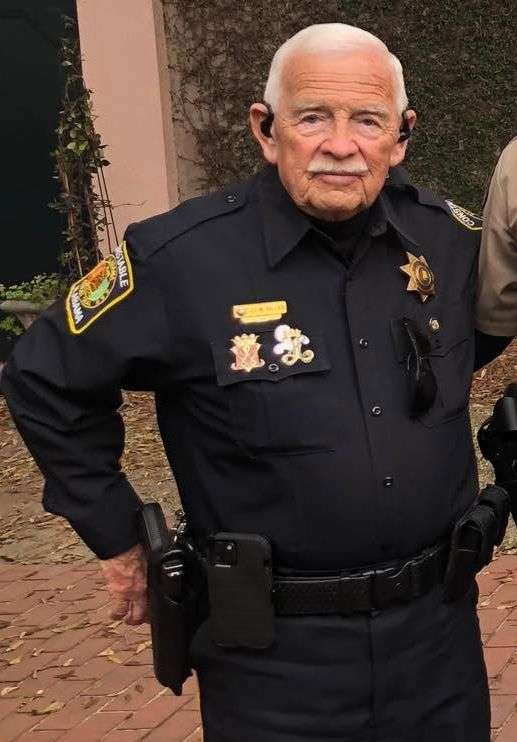
For four decades, Leo Bullock III has been a fixture in Mobile County law enforcement. First elected as constable in 1984, he has outlasted presidents, heavyweight champions, and even Freddy Krueger. He has positioned himself as the elder statesman of the constable corps, serving as head of the Mobile County Constable Association and as a director of the National Constables and Marshals Association. But behind the folksy public persona—the man who says he “loves meeting people” and enjoys serving his community—lies a calculating operator who has made a career out of tearing down his fellow constables, publicly humiliating them, and actively working to eliminate their livelihoods.

A Pattern of Public Humiliation
Bullock’s modus operandi is unmistakable: whenever a constable gets into legal trouble, Leo Bullock is there, microphone in hand, ready to pile on. He has become the go-to source for journalists covering constable misconduct, and he never misses an opportunity to throw his colleagues under the bus.
When Constable Jeffrey Morris was arrested for domestic violence in 2017—accused of assaulting two different girlfriends in a matter of hours—Bullock was quick to declare it “scary and embarrassing.” “It hurts all of us in the law enforcement community,” he said. “We don’t need people like this.” Never mind that Morris was a write-in candidate who had only been serving since December. Bullock’s response wasn’t to defend a fellow officer or call for due process; it was to publicly disown him.
When Morris was arrested again in 2018—this time for impersonating a peace officer and unlawful imprisonment—Bullock was once again front and center. “I’m disturbed about it because it’s a clear indication that he doesn’t know what he can do,” Bullock said, adding that Morris “never attended any of the training they hold and obviously doesn’t understand the office he holds.” “It’s guys like this causing our office some serious trouble and embarrassment.” Morris was later exonerated of all charges.
When a constable was caught on camera driving nearly 100 miles per hour on I-10 without lights or sirens, Bullock was there to express his “embarrassment.” “That alarms me greatly in the interest of public safety,” he said. “It’s embarrassing to me and I think it’s embarrassing to the professional constables here in Alabama as well as across the country.”
When five constables got into legal trouble within two years, Bullock was there to express his outrage. “We’re extremely upset with it,” he said. “It goes against the trust that we’re given by the people of the community.”
When Constable John Arnold was arrested for robbery, Bullock was there to call for a crackdown. “It’s embarrassing,” he said, adding that he’s had people walk up to him and ask, “Who is getting robbed today? How many do drugs?”
When Constable Larry Sheffield was charged with murder, Bullock was there to distance himself and the office from the accused. “We don’t have any constables that I know of that carry guns to night clubs,” Bullock said. “This was certainly not an incident involving any duty, him on duty, or carrying out any duty as a constable. This was an individual act of himself.”
Notice the pattern? Bullock has positioned himself as the moral arbiter of the constable corps, the one righteous man standing amid a sea of corruption. He never misses a chance to remind the public—and the media—that he is the good one, while his colleagues are the “bad apples.”
The Puppet Master Behind the Arrests

But Bullock’s role in the downfall of his fellow constables goes far beyond merely commenting on their misfortunes. There is mounting evidence that he has been actively involved in identifying, targeting, and setting up other constables for arrest and prosecution.
In 2015, Bullock was instrumental in exposing that Constable John Arnold was living outside the precinct where he was elected. Bullock told the press that Arnold’s address was “outside of the precinct where Arnold was elected as constable” and declared that “under state law, moving out of your precinct, you’ve vacated the office you were elected to.” This information was fed to Assistant District Attorney Keith Blackwood, who was investigating dozens of constable cases. Bullock wasn’t just a concerned citizen—he was acting as an informant, feeding intelligence to prosecutors about his fellow constables. Blackwood would later file close to 100 court petitions to remove every constable from office because the county had simply renumbered their voting precincts. He reportedly spend tens of thousands of taxpayer dollars on the effort, only to be defeated in court with Circuit Court Judge Ben Brooks throwing out all of the petitions.
Bullock has publicly referred to some of his colleagues as “jerks” who simply “walk into the polls and writing their names down.” He has called for legislation that would reduce the number of constables in Mobile County from 80 to just 10 or 11. He has supported bills that would slash constable positions by two-thirds. He has actively worked to limit who can become a constable and how many can serve.
This raises a troubling question:
Why is Leo Bullock so determined to eliminate his fellow constables?
The Monopoly Game
The answer, quite simply, is money.
Mobile County constables receive no salary. They are paid entirely through fees for serving papers, directing traffic, escorting funerals, and other services. It is a competitive, fee-based system where every constable is essentially a small business owner competing for the same limited pool of work.
Bullock has been at this for over 40 years. He has built a reputation, a client base, and a steady stream of income from constable work. He serves warrants and court orders, assists with traffic control, and has worked with one of the largest schools in Mobile for 30 years. He has a monopoly on certain contracts and relationships.
Every other constable who gets arrested, disgraced, or removed from office is one less competitor for Bullock. Every constable who is exposed as living outside their precinct, charged with a crime, or driven out by scandal opens up more work for the remaining constables—especially the one who has been there the longest and has the most connections.
Bullock has been leading the charge to reduce the number of constables from 80 to 27 or even 10. He has framed this as a reform effort, a way to ensure quality and accountability. But the practical effect would be to eliminate the vast majority of his competitors, leaving a small, elite corps of constables—with Leo Bullock at the top. He would have first pick of the best assignments, the most lucrative contracts, and the most desirable traffic control details.
Is it any wonder that Bullock is so eager to see his colleagues arrested, exposed, and removed from office? Every scandal he publicizes, every arrest he comments on, every investigation he feeds information to, brings him one step closer to a monopoly on constable work in Mobile County.
The Pot Calling the Kettle Black

Perhaps the most damning indictment of Leo Bullock is his own record. For all his grandstanding about “standards, training and accountability”, Bullock himself has not been immune from legal trouble.
In 2007, Bullock was charged with harassment after allegedly threatening a mother and her teenage son with a gun while in uniform as a constable. According to court documents, Bullock used his weapon to harass and threaten the victims in a dispute between neighbors. The victim testified that Bullock used his weapon to harass and threaten her teenage son while in uniform.
Let that sink in:
The man who has made a career out of denouncing other constables for their misconduct was himself arrested for threatening civilians with a firearm while on duty.
Bullock has called for background checks for constables, yet he was charged with harassment—a crime that would likely disqualify someone from holding office under the very standards he advocates. He has called for training requirements, yet he was allegedly threatening families while in uniform. He has called for accountability, yet he has faced accountability himself.
The hypocrisy is staggering. Bullock wants to impose standards on everyone else while exempting himself from the same scrutiny.
The Real Agenda
Bullock has been a constable since 1984. He has served for more than 40 years. He has been the head of the Mobile County Constable Association. He has been a director of the National Constables and Marshals Association. He has received awards from the National Constable Association. He has been quoted in countless news articles, always presenting himself as the voice of reason, the reformer, the good guy.
But the evidence paints a different picture. Bullock is not a reformer—he is a consolidator. He is not interested in improving the constable system; he is interested in controlling it. He wants fewer constables so that he can have more work. He wants higher standards so that he can eliminate his competitors. He wants accountability—for everyone except himself.
Every time a constable is arrested, Bullock is there to denounce them. Every time a constable is exposed for wrongdoing, Bullock is there to distance himself. Every time a bill is proposed to reduce the number of constables, Bullock is there to support it. He is not cleaning house—he is clearing the competition.
The Deputy Hypocrite
Perhaps the most glaring example of Leo Bullock’s hypocrisy lies in his vehement public opposition to constables appointing deputies—a position he has used to attack and undermine his fellow constables—while simultaneously maintaining deputies of his own.
For years, Bullock has pointed to a 1995 Alabama Supreme Court ruling as proof that constables have no authority to deputize anyone. The case, Mobile County Constables Ass’n v. Alabama Department of Public Safety, was filed in 1993 and decided by the Mobile County Circuit Court, with the Alabama Supreme Court ultimately affirming the lower court’s ruling in 1995. The lawsuit specifically sought a judgment declaring that “persons elected to the office of constable in Mobile County have no authority to … deputize any person as ‘deputy constable,’ and that all prior deputizations are null, void, and without force and effect”. The trial court found that “there is no statute that authorizes a Mobile County constable to appoint a deputy or to deputize a person as a ‘deputy constable'”.
Bullock has wielded this ruling like a cudgel against his colleagues. Whenever a constable has been accused of misconduct involving deputies or unauthorized personnel, Bullock has been quick to cite the 1995 decision, positioning himself as a defender of the law and a critic of those who overstep their authority. He has publicly denounced constables who “don’t know what they can do” and has called for legislation to reduce the number of constables and impose stricter standards. He presents himself as the righteous enforcer of the rules, the one constable who understands the limits of the office and respects the law.
But Bullock’s public piety crumbles under the weight of his own actions.
The Burch Connection
According to sources, Constable Leo Bullock did exactly what he publicly condemned: he deputized Charles “Charlie” Burch as his own deputy constable. Bullock took it upon himself to appoint Burch—a man who would later go on to become an elected constable in his own right.

Charles Burch has held the office of constable in Mobile County, winning election as a Republican nominee in 2012 and again in 2016, when his precinct was renumbered to Precinct 67. He operates the Mobile County Constable Office PCT 67 and has actively engaged with his community through platforms like Nextdoor, introducing himself as “Charlie Burch” and welcoming neighbors to his office.
The timeline is damning: Bullock, who has made a career out of denouncing other constables for operating outside the law, personally appointed Burch as his deputy. He gave Burch authority, legitimacy, and a foothold in the constable system. And then, having been trained and empowered by Bullock himself, Burch ran for office and became a constable in his own precinct—a direct competitor for the same fees, the same traffic control details, the same process-serving work that Bullock has spent decades monopolizing.
This is the ultimate act of hypocrisy. Bullock publicly argues that constables cannot have deputies, yet he had one. He publicly calls for the elimination of constable positions, yet he personally created a deputy who would go on to fill one of those positions. He publicly denounces “bad apples” and unqualified constables, yet he trained and empowered a man who would become his direct competitor.
The Real Motive
Why would Bullock secretly appoint a deputy while publicly arguing that no constable should have one? The answer is as transparent as it is cynical.
Bullock has been a constable for over 40 years. He has built a lucrative business serving papers, directing traffic, and performing other constable duties. He has a monopoly on certain contracts—including a 30-year relationship with one of Mobile’s largest schools for traffic control. Every new constable who enters the system is a threat to that monopoly. Every deputy who gains experience and runs for office is a potential competitor.
By publicly arguing against deputies, Bullock sought to prevent other constables from building their own networks, training their own successors, and expanding their own operations. He wanted to keep the constable system small, exclusive, and under his control. But he wasn’t willing to apply those same rules to himself. He appointed Burch because it served his interests—perhaps to have an ally, perhaps to expand his own reach, perhaps simply because the rules, in his mind, have never applied to Leo Bullock.
The Burch Payoff
And what happened to Burch? He ran for office and won. He became an elected constable in his own precinct. He became one of the very competitors Bullock has spent decades trying to eliminate. The man Bullock deputized—the man he trained and empowered—is now out there serving papers, directing traffic, and collecting fees that could have gone to Bullock.
It is a delicious irony, but also a damning indictment. Bullock’s entire public campaign against deputies was never about the law, never about accountability, and never about protecting the public. It was about eliminating competition. It was about keeping the constable system small enough for him to control. It was about preventing others from doing what he himself had done.
And when one of his own deputies turned around and became a competitor, Bullock got exactly what he deserved: a rival he created with his own hands.
The Pattern of Deception
This is not an isolated incident. It is part of a broader pattern of deception and self-dealing that defines Leo Bullock’s career. He calls for training requirements, yet he was arrested for threatening a family with a gun. He calls for accountability, yet he has faced accountability himself. He calls for reducing the number of constables, yet he personally created a deputy who would become one. He calls for following the law, yet he violated the very law he cites to attack his colleagues.
The 1995 Alabama Supreme Court ruling was clear: Mobile County constables have no authority to appoint deputies. Bullock knows this. He has cited it publicly. He has used it to destroy the careers of his fellow constables. And yet he flagrantly violated it himself, appointing Charles Burch as his deputy and setting him on a path to becoming an elected constable.
This is the measure of the man: a rule for thee, but not for me. A standard for everyone else, but an exemption for Leo Bullock. A public campaign against deputies, conducted in secret while he maintained one of his own.
Mobile County deserves better than a constable who preaches one thing and practices another. It deserves better than a man who uses the law as a weapon against his rivals while ignoring it when it suits him. And it certainly deserves better than a constable who would create his own competitors, only to spend years trying to destroy everyone else’s careers.
Leo Bullock has been in office for over 40 years. He has built a career on hypocrisy, deception, and self-dealing. The people of Mobile County should ask themselves: if he cannot even follow the law he cites against others, how can he be trusted to enforce it?
Conclusion
Leo Bullock has built a career on the misfortunes of others. He has positioned himself as the moral compass of Mobile County’s constable corps while actively working to destroy the careers of his colleagues. He has fed information to prosecutors, publicly humiliated fellow constables, and advocated for legislation that would eliminate most of the constable positions in the county—all while collecting fees and building his own monopoly on constable work.
The public should be wary of Leo Bullock’s self-righteous posturing. Behind the smile and the uniform is a man who has made a living by tearing others down. He does not want reform—he wants a monopoly. He does not want accountability—he wants to eliminate the competition. And he does not want justice—he wants to be the last constable standing.

Mobile County deserves better than a constable who sees his colleagues as enemies to be destroyed rather than partners in law enforcement. The people of Mobile County deserve constables who work together to serve the community, not compete to tear each other apart. And they certainly deserve a constable who is not himself facing charges for threatening families with a gun.
Leo Bullock has been in office for over 40 years. Perhaps it is time for the people of Mobile County to ask themselves: Is he serving the community, or is he serving himself?
BONUS:
Leo Bullock was actually sued in the early 1990s for arresting a fellow deputy constable! The charges were fully dismissed and the victim sued.