The Gulf, Orange Beach’s Shipping-Container Restaurant at Perdido Pass, Plots a Bigger Footprint
The Gulf opened on the Orange Beach waterfront with shipping-container construction, outdoor couches, vinyl records and expansion plans down the beach.
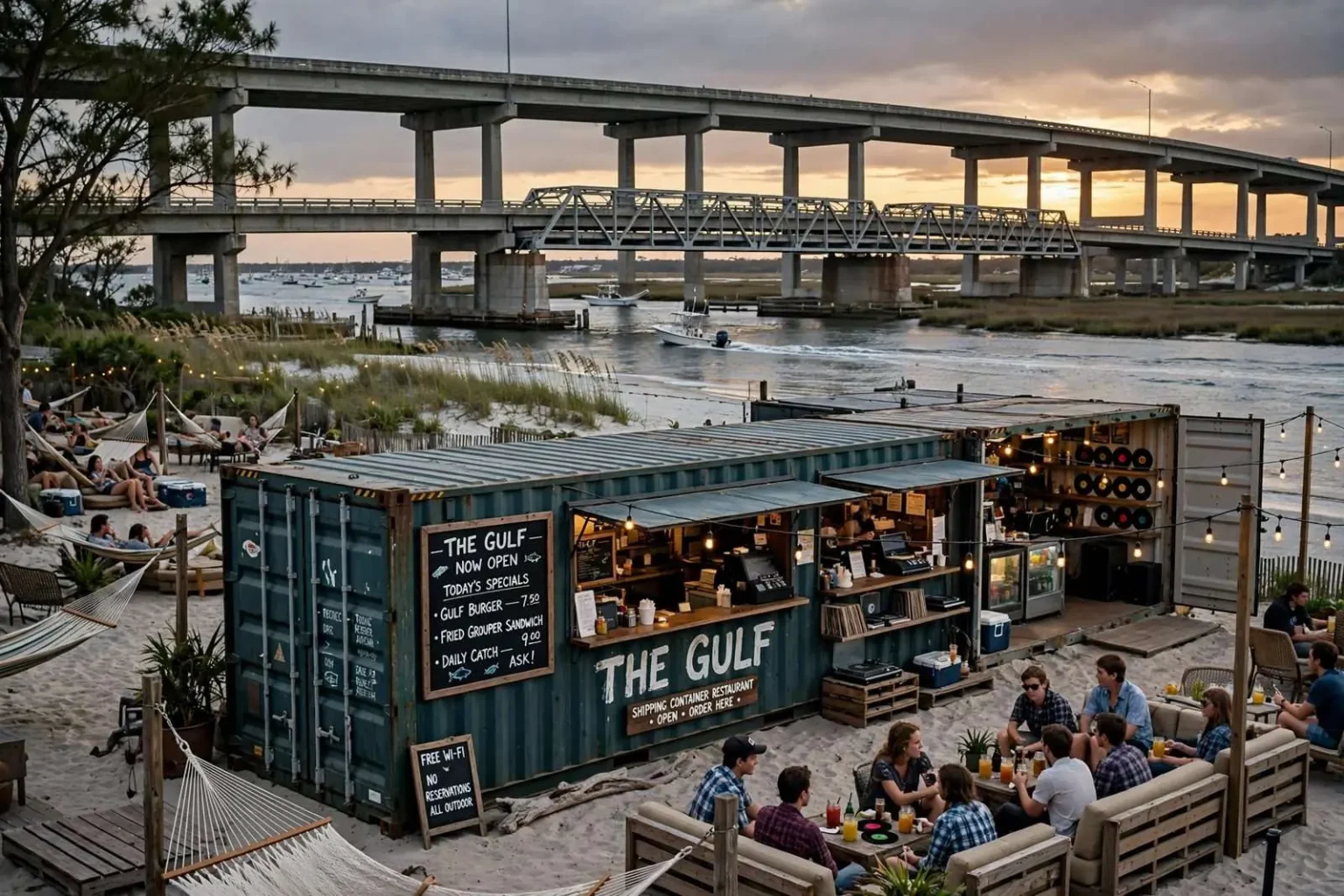
A bold new dining concept opened its doors on the Orange Beach waterfront in early November 2012: The Gulf, an open-air restaurant built from recycled shipping containers and set directly beneath the Perdido Pass Bridge with sweeping views of the water it is named for.
The location alone sets The Gulf apart. Perdido Pass is the narrow channel where the Gulf of Mexico meets the eastern end of Orange Beach’s waterfront — the pass through which the area’s fishing fleet moves between the inland waters and the open Gulf — and the bridge that carries State Route 182 across it has one of the most recognizable silhouettes on the Alabama coast. Building a restaurant in the shadow of that bridge, on a strip of sand and fill at the water’s edge, is the kind of coastal real estate that almost never comes available for a new venture.
The building method is equally distinctive. Rather than conventional construction, the restaurant was assembled from recycled shipping containers, the steel boxes that move cargo around the world and have increasingly found second lives as architectural building blocks. The containers give the place an industrial, modernist edge that stands apart from the coastal pastel palette that dominates Orange Beach’s restaurant row, and their modular nature is central to the expansion plans the owners have laid out for the site.
Shipping Containers, Hammocks and Chalkboard Menus
The restaurant does away with much of the conventional beach-restaurant playbook. Paper menus are replaced by chalkboard specials that spotlight items like the house “Gulf Burger” and a fried grouper sandwich. Ordering happens concession-style at the window rather than at tables, and all of the dining is outdoors — a wooden deck gives way to a sod seating area and then to a broad stretch of sand dotted with hammocks, oversized chairs and couches overlooking the pass.
The effect is closer to a beach gathering spot than a restaurant. Guests order at the window, take a drink, and settle wherever suits them — a lounge chair on the sand, a hammock strung near the dune line, or a couch facing the pass to watch boats run the channel at sunset. There is no dress code, no reservations and no host stand, a deliberate stripping away of the formalities that separate most waterfront dining from the beach itself.
The menu follows the same stripped-down logic. The chalkboard approach lets the kitchen shift with the day’s catch and the evening’s specials, and the early lineup centers on the house Gulf Burger and the fried grouper sandwich — dishes simple enough for the concession model but built to draw a following. Grouper holds a special place on the Alabama coast’s menus, and a well-fried grouper sandwich is a benchmark by which local seafood spots are judged.
Co-owners Shaul Zislin, the entrepreneur behind Gulf Shores’ Hangout, and Johnny Fisher stocked the spot with moody evening lighting, vinyl records spinning behind the bar, and free Wi-Fi for guests.
Zislin’s involvement gives the project a pedigree. He is the force behind the Hangout, the massive Gulf Shores entertainment complex that opened in 2010 and quickly became one of the Alabama coast’s signature attractions, combining dining, live music and a festival ground that now hosts a nationally known spring music festival. Fisher, his partner in The Gulf, brings the operating experience of a longtime restaurateur to the day-to-day.
The design choices — records behind the bar, low evening light, hammocks instead of tables — signal who the place is for. Where the Hangout aims at families and crowds, The Gulf is pitched at a younger, looser crowd: couples at sunset, surfers coming off the beach, college students, and the growing slice of travelers who want a beach bar that feels discovered rather than marketed. The vinyl collection and the concession counter are aesthetic statements as much as operating decisions.
Free Wi-Fi, meanwhile, acknowledges a practical reality of the modern beach day: guests work from their phones and laptops even on the sand, and a spot that lets someone answer email in a hammock with a view of the pass converts an afternoon visit into a full day. It is a small amenity, but one that fits the venue’s blend of laid-back atmosphere and modern sensibility.
Expansion Plans Down the Beach
Fisher said the Perdido Pass location is only the beginning. Plans call for The Gulf to extend further down the beach and add an amphitheater, positioning the venue as a hub for live music alongside its kitchen — The Banditos played the grand opening.
The amphitheater plan points toward what the owners evidently see as the long game: a venue that draws crowds not just for dinner but for shows, building the same kind of destination draw the Hangout achieved in Gulf Shores. Live music and waterfront sunsets are a proven combination on the Alabama coast, and the open-sand format gives The Gulf room to grow crowds in a way a conventional restaurant footprint never could.
The Banditos’ grand-opening slot fit the venue’s sensibility. The band, with roots in the Southeast and a rootsy blend of Southern rock, country and soul, is the kind of act that plays to a younger crowd without needing an arena draw — exactly the level of act a beachfront stage can build around in its early days.
The modular construction gives the expansion flexibility that conventional buildings lack. Shipping containers can be added, stacked and rearranged as the site grows, letting the kitchen, bar and service areas expand down the beach in phases rather than in one disruptive construction project. It is the same logic driving container architecture from pop-up retail to small commercial districts, applied to a stretch of Alabama beachfront with unusually high visibility.
A New Counterpart on the Coast
The concept aims to give the Alabama beach communities a younger, more eclectic counterpart to the larger Hangout entertainment complex just down the road.
That positioning matters in the context of how the Alabama coast has developed. Orange Beach and Gulf Shores spent decades growing their reputations as family beach destinations, with a hospitality strip built around large restaurants, amusement attractions and condominium towers. The success of those venues created the audience — and the traffic on Highway 182 and the Perdido Pass bridge — that a smaller, style-driven concept like The Gulf can now tap into.
The timing also reflects a coast rebuilding its confidence. The Gulf Coast tourism economy spent 2010 and much of 2011 working through the aftermath of the Deepwater Horizon oil spill, which blanketed the region’s beaches in uncertainty even where oil never came ashore. New investment on the waterfront in late 2012 — particularly an investment as visually distinctive as a shipping-container restaurant under the pass bridge — read as a statement that Orange Beach’s momentum was back.
For locals and repeat visitors, The Gulf adds a missing piece to the beach calendar: a sunset spot that is neither a fine-dining room nor a t-shirt-and-funnel-cake boardwalk, where dinner and live music share the same stretch of sand. If the amphitheater plans come to pass, the venue under the Perdido Pass bridge could become one of the defining music-and-food destinations on the Alabama coast — built, fittingly, out of boxes that have already traveled the world and washed up, in a sense, exactly where the owners wanted them.
The expansion talk also underscores how quickly the Perdido Pass area has become a destination in its own right. The pass sits at the boundary between Orange Beach and Gulf Shores, close to the public beach accesses and marinas that draw anglers, dolphin cruises and parasail operators through the channel every summer day. A restaurant that anchors the western approach to the bridge captures traffic from both cities at once — visitors heading to the pass for a fishing charter in the morning and the same stretch of sand at sunset.
For now, the draw is the basics done with unusual style: a burger or a grouper sandwich, a drink from the bar, a hammock, a record spinning behind the counter and the sun going down over the pass. It is a formula that took shape in early November 2012, and by every sign from its co-owners, it is only the first installment of something larger taking shape on the sand beneath the bridge.
The model also mirrors a broader shift in coastal dining nationwide. Travelers increasingly seek out places that feel authentic to their setting — food trucks, beach shacks, container parks — over the polished chain restaurants that line the main drags. By leaning into that aesthetic on one of the most visible parcels on the Alabama coast, the owners are betting that the same instinct will translate to the white-sand audience that fills Orange Beach each season, and that a younger crowd will trade table service for atmosphere without a second thought.