
The Hidden Risks of Tar Sands Pipelines, Oil Trains, and Storage Tanks in Mobile
A look at the environmental and safety risks posed by tar sands pipelines, oil trains, and storage tanks in Mobile, including past spill disasters.
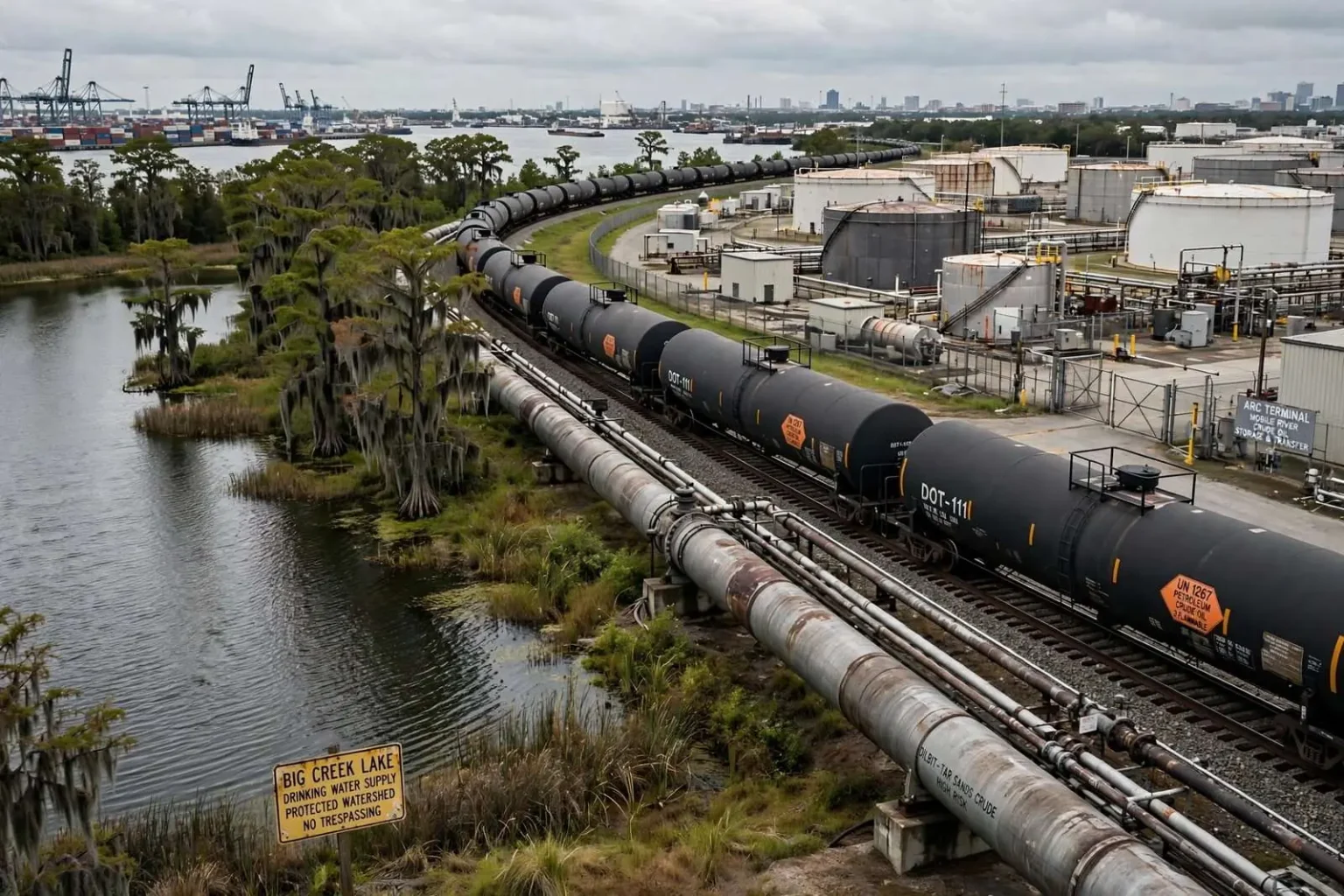
The Hidden Risks of Tar Sands Pipelines, Oil Trains, and Storage Tanks in Mobile
As energy companies expanded oil infrastructure across Mobile in 2013, the potential dangers of transporting tar sands crude and shale oil through the city demanded serious public scrutiny. From pipeline ruptures to rail explosions to storage tank failures, the risks associated with these projects carried consequences that could linger for generations.
Pipeline Spill History Raises Alarms
The track record of major pipeline operators offered little reassurance. In 2010, an Enbridge pipeline ruptured and spilled 877,000 gallons of diluted bitumen (dilbit) into Michigan’s Kalamazoo River. Company operators at Enbridge headquarters misread the alarm signals, and the leak was not discovered for 18 hours. The spill closed 35 miles of the river to water traffic for two years, and cleanup costs exceeded $800 million as of 2013.
In March 2013, an ExxonMobil pipeline carrying Canadian tar sands crude ruptured in Mayflower, Arkansas, sending between 5,000 and 7,000 barrels of crude oil flooding through a residential neighborhood. The Mayflower rupture — in a suburban street rather than a remote right-of-way — demonstrated the risk pipelines pose when they cross populated areas, and it became a reference point for communities weighing new pipeline proposals.
Plains All American Pipelines, the company proposing to build a pipeline across Mobile’s Big Creek Lake watershed, had its own troubled history. The company agreed to a settlement with the U.S. Environmental Protection Agency over repeated Clean Water Act violations involving the discharge of nearly 7,000 barrels of oil across Texas, Louisiana, and Oklahoma between 2004 and 2007. That settlement included $3.25 million in civil penalties and $41 million in required pipeline upgrades.
In May 2012, the U.S. Pipeline and Hazardous Materials Safety Administration (PHMSA) issued three additional uncontested safety violations against the company. Taken together, the enforcement record gave Mobile residents and officials a concrete basis for evaluating the proposal — not abstract fear, but the operator’s own regulatory file.
A key concern specific to tar sands crude was that dilbit, unlike conventional light crude oil, sinks in water rather than floating on the surface. This characteristic made spills into waterways like Big Creek Lake potentially far more difficult and costly to clean up. The Kalamazoo River spill illustrated the problem at scale: bitumen that sinks fouls the riverbed, requiring dredging and years of recovery work that conventional skimming cannot address.
Big Creek Lake and the Region’s Water Supply
Big Creek Lake serves as a primary drinking water source for the Mobile area, which is what made the proposed pipeline crossing of its watershed a matter of immediate public concern rather than a distant environmental debate. A spill anywhere along a pipeline route through the watershed would threaten the reservoir that supplies the city’s water system, and the sinking behavior of dilbit in a reservoir environment would compound the difficulty of any response.
The watershed crosses land that has seen steady development pressure from the region’s growth, and the proposal arrived as Mobile’s economy — anchored by the port, aerospace and manufacturing — was diversifying its industrial base. The question facing the city was whether adding hydrocarbon transport infrastructure to the water supply’s protective zone was a trade worth making.
Oil-by-Rail: The Explosion Factor
The devastating July 2013 rail disaster in Lac-Megantic, Quebec, where a runaway oil train exploded and destroyed roughly a kilometer of the town’s downtown, cast a stark light on oil-by-rail hazards. An explosion of similar scale near the Arc Terminal along the Mobile River could paralyze commerce and daily life across the city.
Industry experts noted that Bakken crude oil from North Dakota contained 30 to 40 percent volatile chemicals, making it far more combustible than conventional crude. The U.S. Federal Railroad Administration was also investigating whether chemicals used in hydraulic fracturing were corroding the DOT-111 tank cars commonly used to transport oil by rail.
The National Transportation Safety Board had recommended modifications to all DOT-111 cars, but the rail industry resisted the proposed retrofit, citing costs of up to $1 billion. The DOT-111 fleet — the workhorse tank car of the North American rail system — became the focal point of the safety debate, with regulators pressing for stronger shells, better venting and improved braking while the industry weighed the price of the retrofit.
A string of derailments in early 2013 underscored the urgency: a train carrying tar sands dilbit derailed in Minnesota in March, spilling an estimated 30,000 gallons; a Canadian Pacific train derailed in northern Ontario in April, spilling 17,000 gallons; and another Canadian Pacific derailment in Saskatchewan in May released 575 barrels of crude.
Mobile’s Own History of Oil Disasters
Mobile had already experienced the consequences of oil infrastructure failures firsthand. In 1976, Chevron spilled more than four million gallons of crude oil from storage tanks on Blakeley Island. The spill left parts of the island knee-deep in oil, with crude draining directly into Mobile Bay. The contamination was never fully cleaned up, and legal disputes over residual pollution continued for decades afterward.
More recently, in 2011, Gulf Coast Asphalt Company spilled tens of thousands of gallons of oil into the Mobile River after employees overfilled a large storage tank and failed to close a valve that federal law required to remain shut. The incident — a matter of two human errors at a single facility on the river — showed how quickly the city’s own waterfront infrastructure could fail without any pipeline rupture or train derailment involved.
Together, the 1976 and 2011 incidents formed the local case history that residents and officials cited in 2013: a city that had already absorbed a multi-million-gallon storage tank spill on Blakeley Island and a river spill from a failed valve had grounds for skepticism about proposals that would expand the same kinds of infrastructure.
Weighing Benefits Against Long-Term Risk
The debate over whether pipelines or rail posed greater danger remained unresolved. According to the Association of American Railroads, pipeline spills averaged 266 barrels per incident compared to 65 barrels for rail, but the Lac-Megantic disaster demonstrated that rail incidents could be catastrophically more destructive and deadly.
The comparison illustrated the difficulty of ranking two imperfect options: pipelines spill more on average but rarely kill; trains spill less per incident but, when they fail in a populated place, can destroy a downtown. Mobile faced both risks at once — the proposed pipeline through the Big Creek Lake watershed and increasing volumes of volatile Bakken crude moving by rail to terminals along the Mobile River.
Critics of the expansion argued that the economic benefits of energy infrastructure projects tended to flow to a small segment of the community, primarily lawyers, engineers, and landowners, and generated relatively few permanent jobs. The risks, however, would persist indefinitely. While the probability of a major spill or explosion in any given year might be small, those odds compounded over the 50- to 100-year lifespan of such infrastructure.
Mobile’s energy infrastructure remained modest compared to communities farther west along the Gulf Coast, but the economic forces driving expansion in 2013 could easily have led to a dramatic increase. Community leaders faced a fundamental choice: maintain careful limits on industrial growth or accept additional expansion and the environmental and safety liabilities that came with it.
An oil spill into the Mobile River or Big Creek Lake, or an explosion in downtown Mobile, would represent what risk analysts call a “black swan” event, low in probability but devastating in consequence.
What the Arc Terminal Meant for the Riverfront
The Arc Terminal along the Mobile River sat at the center of the rail risk discussion because it represented the point where growing crude-by-rail volumes would concentrate in the city. Terminals of this kind receive unit trains of tank cars, transfer crude into storage and onto vessels, and sit within the working waterfront that also carries the port’s container traffic, the shipbuilding corridor and downtown’s western edge.
A catastrophic event at such a facility would not remain an industrial accident. The Mobile River’s banks hold the Alabama State Docks, heavy manufacturing, and infrastructure that the entire region’s economy depends on, and downtown Mobile’s convention district and historic core stand within sight of the terminals. The Lac-Megantic comparison — a kilometer of a town’s downtown destroyed — mapped directly onto that geography.
The Regulatory Landscape in 2013
The enforcement actions against Plains All American — the EPA settlement covering 2004 to 2007 violations, the $3.25 million in civil penalties, the $41 million in mandated upgrades, and the three PHMSA violations of May 2012 — showed how federal oversight actually worked against major operators: violations were documented, penalties negotiated, and upgrades ordered, but the pattern of spills continued across a decade.
On the rail side, the FRA’s corrosion investigation and the NTSB’s recommendation on DOT-111 cars framed the regulatory debate that would eventually produce tank car standards, but in 2013 the industry’s $1 billion retrofit estimate kept the recommendations from becoming requirements. Mobile’s officials were therefore weighing proposals against a regulatory environment still catching up to the crude-by-rail boom that had transformed North American oil logistics in only a few years.


