Theodore Burglary Caught on Camera: Neighbors Hope Footage Leads to Arrest
Surveillance video captured a burglar stealing tools from two neighboring Theodore homes on Rester Road. Victims hope it leads to an arrest.
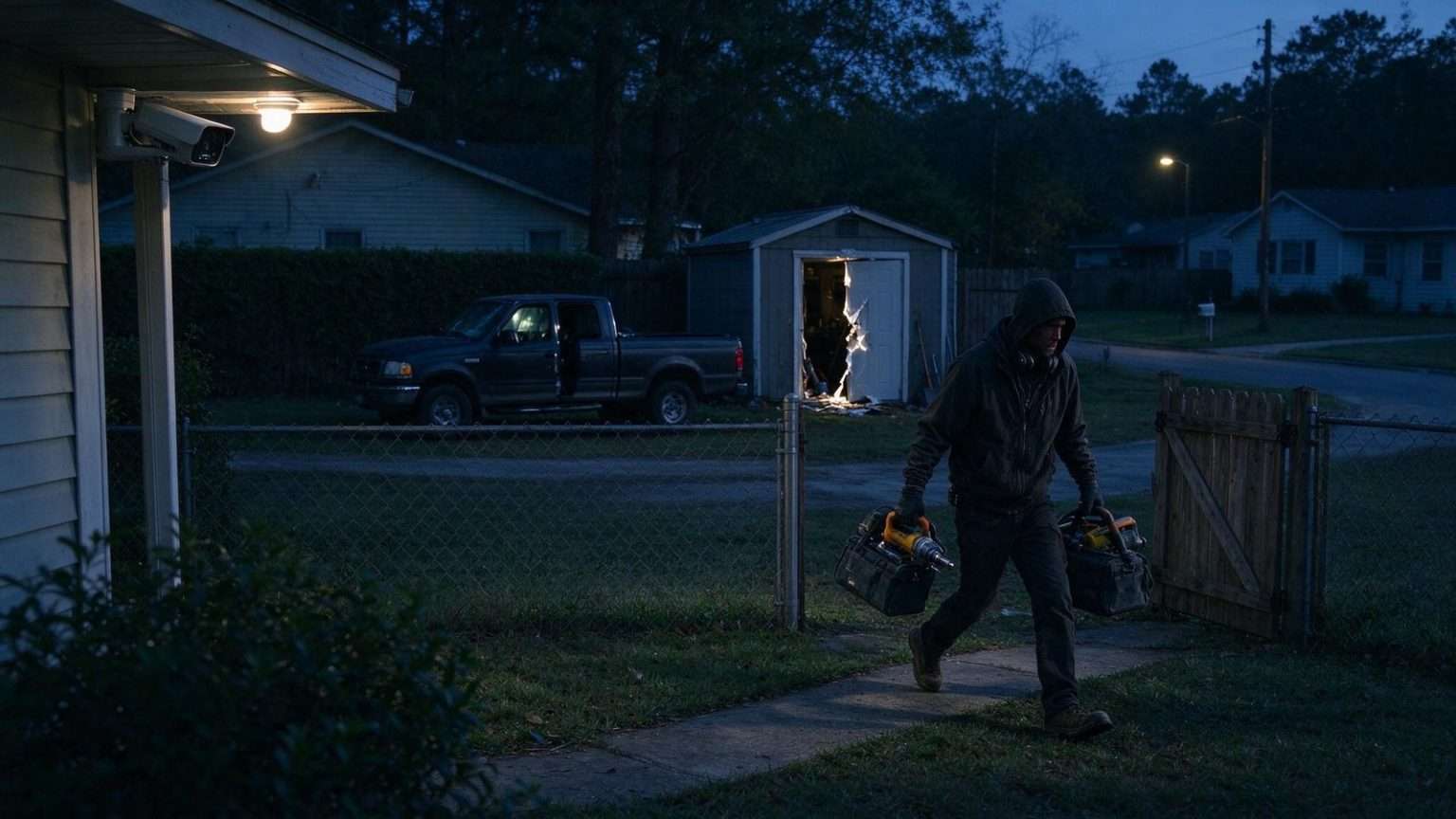
A burglar who hit two neighboring Theodore homes in one early-morning spree didn’t know one of them was watching. Now the victims are hoping surveillance footage from the scene will help Mobile police identify him and put an end to a run of break-ins that has rattled the quiet neighborhood off Rester Road.
According to the residents’ account, the break-ins happened before dawn, the hours when sleeping households and dark streets give intruders their best cover. By the time the sun came up, one family was missing a truckload of belongings and another had lost tools from a backyard shop — and both had something most burglary victims never get: a camera that caught the suspect in the act.
One Truck Gutted, a Backyard Shop Hit Next
The first stop of the spree was a truck parked at one of the homes. The homeowner said his son’s truck was completely gutted, its stereo and a stash of tools stolen — more than a thousand dollars worth of equipment gone from that stop alone. The loss hit the family twice: once in the value of what was taken, and again in the sense that a vehicle sitting in its own driveway was no longer safe overnight.
But the thief wasn’t done. In a detail that has stood out to everyone who has seen the footage, the homeowner described watching the intruder jump his fence, cross his backyard, and get into another shop on the property before hauling everything out toward the road and hopping the neighbor’s fence. The route suggested someone familiar with moving quickly through residential lots, pausing only long enough to carry the loot over each obstacle between him and the street.
For the family, watching the sequence play out has been jarring. The backyard shop and the fenced yard were supposed to be the secure part of the property, the place where tools and equipment stayed protected. Instead, the fences that were meant to keep people out ended up doing nothing more than slowing the burglar down for a few seconds at a time.
Cameras Catch the Second Stop
That fence-hop put the burglar squarely in view of the next door neighbor’s surveillance cameras. The footage shows what appears to be the same man circling a truck — headphones from his earlier theft still around his neck — before breaking in and stealing more tools. The image of the intruder still wearing the first victim’s property while working on the second is exactly the kind of identifying detail investigators look for, tying two scenes together in a single continuous timeline.
The second victim said he’d been targeted twice before, and this time the thief finally got in. For that family, the break-in was the culmination of a pattern rather than a one-time event, a repetition that has convinced neighbors the same person may be responsible for a string of property crimes in the area rather than a single opportunistic night.
Neither family has reported an arrest; both are counting on the video to give investigators the lead they need. Until someone is taken into custody, residents on Rester Road and the surrounding streets are doing what homeowners across Theodore have been doing all along — locking up, checking their own cameras, and comparing notes about who has been seen where.
How Surveillance Footage Becomes a Case
Residential camera footage has become one of the most important tools in property crime investigations across Mobile County. When a burglary is reported, investigators routinely ask victims whether any cameras recorded the suspect, the vehicle, or the surrounding street. Clear video showing a person’s face, build, clothing, or distinctive behavior can be the difference between a case that stalls and one that produces a warrant.
The Theodore footage offers several of those threads at once. It connects two crime scenes into one continuous account of the spree, it shows the suspect handling and wearing items stolen from the first home, and it captures his movements across the two properties in enough detail to describe how he worked. Investigators can compare the images against other unsolved break-ins in the area, check whether the method matches earlier reports, and circulate still frames in hopes that someone recognizes the man.
Detectives typically supplement video with canvassing — knocking on nearby doors, asking about suspicious vehicles or people seen in the days before, and checking whether other neighbors have cameras that captured the suspect arriving or leaving. In a close-knit community like the Rester Road area, residents’ own observations often fill in the timeline that cameras miss.
What Neighbors Can Do
Law enforcement agencies consistently offer the same guidance to neighborhoods dealing with break-ins, and it applies directly here. Residents are encouraged to report suspicious activity as it happens rather than after the fact, to record serial numbers and mark tools and equipment so stolen items can be identified if recovered, and to keep exterior lights and cameras maintained and aimed at driveways, vehicles, and side yards.
They also advise making it harder to move through a property unseen. Trimmed hedges, locked gates, secured sheds and outbuildings, and motion-activated lighting all lengthen the amount of time and noise a burglar must spend on a single property — and in a case like this one, where the suspect jumped multiple fences carrying stolen goods, every extra obstacle increases the chance of detection.
The most valuable step, though, is simply paying attention. In this case, one homeowner’s willingness to watch and describe what he saw — the fence crossings, the backyard route, the haul out to the road — gave investigators a narrative that no police report alone could provide.
Theodore and the Wider Pattern of Property Crime
Theodore, an unincorporated community south of Mobile served by the Mobile County Sheriff’s Office and the Mobile Police Department depending on jurisdiction, has seen the same pressures on residential property crime as the rest of the county. Neighborhoods of modest homes, fenced yards, detached garages, and driveway-parked trucks present consistent targets: tools, electronics, and vehicle parts that are easy to carry, quick to sell, and difficult to trace once they leave the neighborhood.
That is what makes footage like the kind captured on Rester Road so valuable. Stolen tools and stereo equipment rarely surface in ways that point investigators back to a specific theft, unless the theft itself was documented. A camera that records the crime as it happens converts an anonymous loss into a searchable, shareable record that can be matched against other cases and against known suspects.
Community groups in the area have increasingly turned to shared camera networks and neighborhood messaging threads, where homeowners post clips and alerts so that a break-in on one street is known on the next block within hours. Investigators have repeatedly said that this kind of coordinated awareness shortens investigations, because pattern information gathered by residents helps police anticipate where a repeat offender will strike next.
The Case Remains Open
For now, the two families on Rester Road are left to tally their losses and wait. More than a thousand dollars in tools and equipment from the first home, additional tools from the second, a gutted truck, and the lingering unease of knowing someone moved freely through both backyards before dawn — those are the concrete costs of a single early-morning spree.
The upside, if it can be called that, is evidence. The neighbors’ cameras documented a suspect’s appearance, method, and route in a way few burglary cases ever manage, and the detail of the headphones taken from one victim and worn while burglarizing the next gives investigators a memorable, human link between the two scenes.
Anyone with information about the break-ins, or who recognizes the man in the footage, is encouraged to contact the Mobile Police Department or leave an anonymous tip through the department’s tip lines. Until an arrest is made, Rester Road’s residents say they’ll keep watching — and keep recording.
When Victims Become Witnesses
There is a particular frustration in property crime that victims of other offenses rarely describe: the knowledge that somewhere out there, someone has their belongings and there is almost nothing to do but wait. The Rester Road families have short-circuited part of that waiting by turning themselves into witnesses. One documented the intruder’s route through his own yard in real time; the other’s cameras preserved the second stop frame by frame.
Their account now forms the backbone of the report: a spree that began with a truck gutted for its stereo and tools, continued across a fence into a backyard shop, and ended with a second theft captured on video. Every element — the timing before dawn, the fence crossings, the headphones worn around the suspect’s neck — gives investigators texture that a list of missing items never could.
It also gives the neighborhood a shared story. Break-ins feel random until one is described in detail, and a detailed account lets neighbors recognize patterns in what they’ve seen themselves: a person they noticed walking where no one walks, a vehicle idling where no one idles, a stranger testing a gate. Those small observations, pooled, are often what close a case like this one.
Protecting Tools, Trucks, and Shops
For homeowners across South Alabama with trucks in the driveway and shops behind the house, the case is a checklist waiting to happen. Investigators and crime-prevention officers suggest engraving or marking tools with a driver’s license number so recovered items can be traced, photographing valuable equipment, and keeping an inventory — serial numbers included — updated before anything is stolen, not after.
Trucks warrant special attention, since stereos and tools left visible in a cab are among the most commonly targeted items in residential thefts. Anything of value should go inside the house overnight, and the truck itself should be locked even for a few hours. Detached shops and storage buildings deserve the same treatment as the main house: solid locks on the doors, secured windows, and lighting that removes the shadows an early-morning intruder depends on.
Cameras close the loop. The footage on Rester Road worked because it covered a fence line and a truck — the two routes the suspect actually used. Positioning cameras so they view approach paths, not just doorways, is the difference between recording an empty yard and recording a case.
Waiting on an Arrest
Until police announce an arrest, the neighbors’ footage remains the case’s most important asset, and they remain its most vocal advocates. They have shared it, described it, and made clear they intend to keep pressing for identification, hopeful that someone who knows the man in the video will recognize him — the build, the clothes, the headphones — and come forward.