
Theodore Firefighter’s Truck-Fire Video a Warning as Dry Conditions Persist
Theodore-Dawes Volunteer Fire Department video shows firefighter Jarvis Lewis battling a pickup truck fire amid dry fall weather.
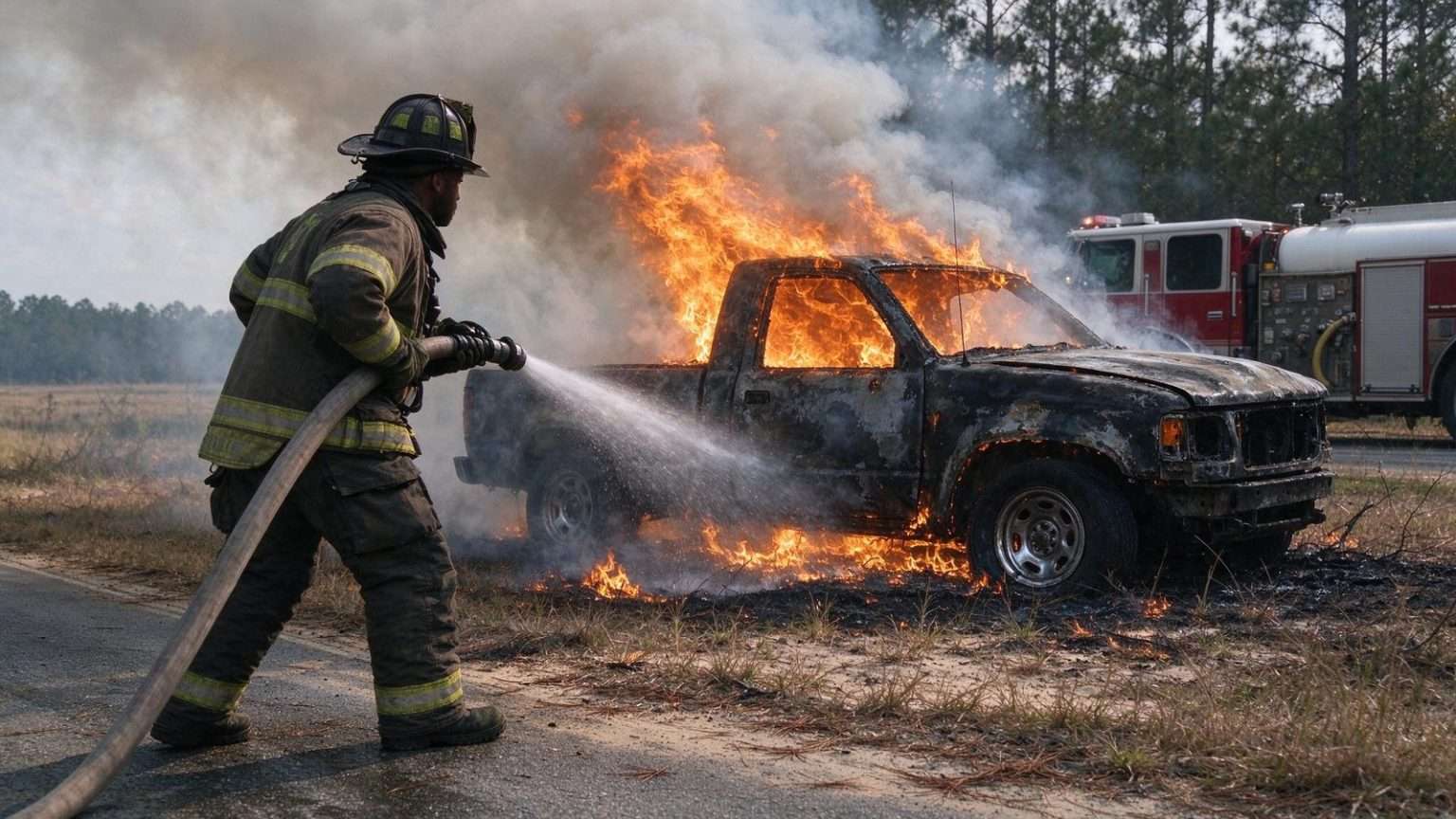
A video posted by the Theodore-Dawes Volunteer Fire Department offered a vivid reminder of how quickly a vehicle can become fully engulfed — and why the region’s dry stretch was worrying first responders. The footage, posted Saturday, shows firefighter Jarvis Lewis battling a fully involved vehicle fire Friday morning, working a hose line as flames consume the cab of what appears to be a pickup truck. No injuries were reported in the blaze.
The department shared the clip at a moment when Mobile County sat under heightened fire danger after weeks of dry conditions. During such stretches, fire officials warn that anything from a tossed cigarette to a hot exhaust pipe parked over roadside grass can ignite a blaze, and the Theodore-Dawes crew’s video made the stakes concrete: a truck that would ordinarily be parked harmlessly at the roadside became a tower of flame in minutes, with toxic smoke rolling off burning upholstery, tires, and fuel lines.
What the video showed
The footage captured a scene that vehicle fire veterans know well. A fully involved vehicle fire produces intense heat in a small footprint, with the passenger compartment acting as an oven of burning plastics, foam, and wiring. Firefighters attacking it with a hose line face not only the flames but the constant risk of components exploding — struts, tires, shock absorbers, and gas-filled lift supports all fail violently under heat — and of fuel tank rupture. The Friday morning blaze showed the cab fully consumed as Lewis worked the line, dousing the vehicle methodically until the fire was knocked down.
Vehicle fires in south Alabama typically draw a volunteer company, an engine or pumper, and often a second unit for water supply, since rural hydrant coverage is uneven across the county. Fires of this kind burn hot enough to melt aluminum wheels and reduce a truck’s cab to its frame within the time it takes a passerby to call 911 and a crew to arrive, which is why departments document them: the video serves as a training record, a recruitment tool, and a public warning all at once.
Why the dry stretch raised the stakes
Weeks without significant rain change the calculus of every fire response. Grass, pine straw, and underbrush that would stay damp through a normal Gulf Coast summer instead cure into tinder, and fires that would smolder and die spread quickly through dry vegetation. Mobile County’s fire services — a patchwork of volunteer departments covering the unincorporated areas, supplemented by municipal departments in the cities — see call volumes climb during such periods, with brush fires igniting along roadways and threatening homes and outbuildings.
The ignition sources are as mundane as they are numerous. A cigarette tossed from a window lands in dry grass beside the road. A vehicle parks with its catalytic converter and exhaust components hanging over dead vegetation, and the heat does the rest. Chains dragging from trailers throw sparks. Debris burning that gets out of hand, equipment operating in dry fields, and lightning from storms that bring wind but no rain all add to the count. Fire officials spend dry weeks repeating the same appeals: don’t toss burning material from vehicles, be careful with any outdoor flame, and keep vehicles off dry grass.
The Theodore-Dawes department
The Theodore-Dawes Volunteer Fire Department serves a broad swath of southern Mobile County around the communities of Theodore and Dawes, responding to structure fires, vehicle fires, brush fires, wrecks, and medical calls alongside its neighboring volunteer companies. Like most volunteer departments in Alabama, it operates on a mix of public funding, fees, and community support, with members who train regularly and respond from their homes and jobs at all hours. Departments like this one are the front line of fire protection for the majority of Mobile County’s land area, where municipal fire coverage ends.
Sharing videos of recent fires has become standard practice for such departments, part public education and part acknowledgment of the members who did the work. The clip of Lewis on the hose line offered the community a rare look at what its volunteer firefighters actually face on an ordinary Friday morning — and, coming in the middle of a dry spell, a timely demonstration of why the department was asking residents to be careful with anything that burns.
Vehicle fires: what drivers should know
Safety guidance around vehicle fires is consistent across fire services. Drivers who notice smoke, a burning smell, or flames should pull over away from buildings and other vehicles, shut off the engine, and get everyone out and upwind — not attempt to fight the fire themselves with an extinguisher while the vehicle burns around them. Fire officials note that the contents of a modern vehicle burn hot and fast and produce toxic fumes, and that a fire which appears small can reignite or flare as fuel lines and plastics fail. A 911 call from a safe distance brings a crew with the water supply and protective gear to do the job properly.
Prevention, meanwhile, starts with maintenance. Leaking fuel or fluid lines, frayed wiring, and piles of grease-soaked rags or paper left in an engine bay are common ignition points, and worn batteries and after-market electrical accessories add risk. During dry spells, drivers are reminded not to park over tall dead grass, where a hot exhaust system can touch off a fire that climbs from the vegetation into the vehicle itself — the scenario fire officials had in mind when they emphasized the roadside ignition danger during Mobile County’s dry stretch.
Fire danger across the Gulf Coast
The Gulf Coast’s reputation for humidity hides the fact that the region experiences real fire seasons. Long stretches without rain — most often in fall, but possible in any season — dry out the pine straw and palmetto that blanket south Alabama’s landscape, and the same terrain that makes the area green year-round gives fires plenty of fuel when conditions line up. The Alabama Forestry Commission tracks burn conditions statewide, issues fire alerts when danger rises, and restricts permitted burning during dry periods, while local fire departments shoulder the responses when warnings go unheeded.
For residents, the practical guidance during heightened fire danger is simple. Obey burn bans and think twice before burning anything outdoors, even where it is technically permitted. Keep lawns and gutters clear of dry debris near structures, keep garden hoses connected and accessible, and report smoke early — a brush fire caught in its first minutes is a small incident, while one reported late can grow into a threat to homes. Smokers should treat every cigarette as a potential wildfire starter, because in dry conditions it is one.
After the flames
Once a vehicle fire is knocked down, the work continues. Crews check for reignition, overhaul the wreckage to expose hidden fire in compartments and under the vehicle, and make sure the scene is safe before clearing. Burned vehicles leak fuel, oil, and coolant, creating environmental hazards that firefighters contain as best they can, and the remains must be removed by a recovery service. The roadway reopens only after all of that, which is why a vehicle fire often closes a road far longer than bystanders expect.
For the vehicle’s owner, the aftermath is costly even when insurance covers the loss: a burned truck is rarely salvageable beyond its frame, and personal items inside are gone. Fire departments use such outcomes in their public messaging, and the Theodore-Dawes video — flames pouring from a pickup’s cab on an ordinary Friday morning, extinguished by one of the community’s own volunteers — did exactly what the department intended. It showed the speed of the fire, the skill it takes to fight it, and the wisdom of the precautions the county was being asked to take while the dry weather held.
Volunteer firefighting in Mobile County
The work on display in the video represents a system that much of south Alabama depends on. Outside the limits of Mobile, Prichard, and the county’s other municipalities, fire protection rests almost entirely on volunteer fire departments — community organizations staffed by residents who complete training, attend drills, and answer alarms around their work and family schedules. These departments handle thousands of calls a year across the county, from chimney and kitchen fires to interstate wrecks, brush fires, and medical assists, and their members are the neighbors of the people they help.
Volunteer departments operate under persistent pressures that the public rarely sees: aging equipment, rising costs, and the constant challenge of recruiting members in an era when few people live and work in the same community all day. Fund drives, membership fees, and county support keep the trucks rolling, and departments like Theodore-Dawes welcome community involvement, whether through donations, joining the auxiliary, or signing up for training. The men and women on those hose lines are volunteers in the fullest sense, and videos like the one posted Saturday let the community see exactly what their support funds.
The Friday morning truck fire ended without injuries, which is the outcome every department hopes to report. The vehicle was lost, the roadside where it burned will grow back with the next rain, and the crew that fought it went on to the next call. But the video remains as the department intended it — a warning delivered at the right moment, from firefighters who know better than anyone how fast a spark in dry grass becomes a fire that consumes everything it touches.


