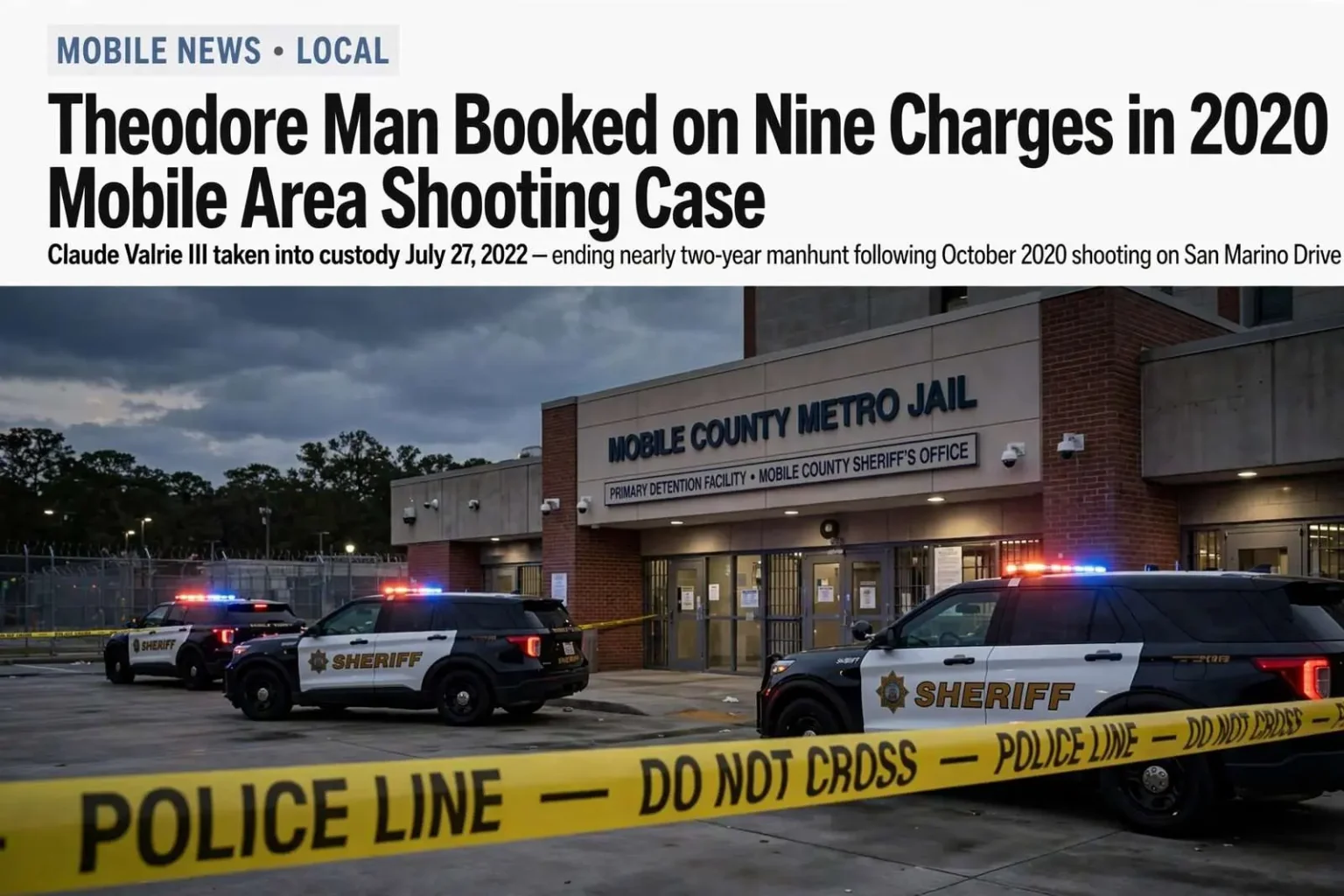
MOBILE, Ala. — A Theodore man wanted for nearly two years in connection with a 2020 shooting is now behind bars. Claude Valrie III was booked into Mobile County Metro Jail on July 27, 2022, after Mobile police linked him to a shooting that left at least four people diving for cover inside their vehicles, closing a chapter in a case that detectives had kept active long after the gunfire stopped.
The arrest ended a search that began in the fall of 2020 and stretched across two years, a span during which investigators continued working the case while the suspect remained out of reach. Cases like this one — where the violence is over in seconds but the investigation stretches on — are a familiar rhythm for Mobile police, who pursue warrants that can remain open for months or years before an arrest brings the accused before a judge.
Valrie’s booking at the Metro Jail, the primary detention facility serving Mobile County, set in motion the court process that will determine how the case is resolved. The nine charges he faced at booking carry serious potential penalties under Alabama law, and the road from booking to trial will move through the Mobile County court system in the months ahead.
What Happened in October 2020
According to investigators, the victims told police they drove to a home off San Marino Drive on October 16, 2020, when someone opened fire on their vehicles. The confrontation unfolded quickly — the victims had just arrived at the location when the shots began, leaving them no option but to take cover inside their cars while bullets struck around them.
Two cars were struck by gunfire, though no one was injured. The outcome could easily have been different; rounds that penetrate occupied vehicles in a residential area endanger not only the intended targets but anyone nearby. Police said one of the victims pulled out his own gun and returned fire before the shooter fled the scene, an exchange of gunfire that added to the danger in the neighborhood that evening.
The area off San Marino Drive, in the western part of Mobile County near Theodore, is a residential corridor where incidents of this kind draw immediate attention from neighbors and concern from the surrounding community. Shots fired into occupied vehicles on a residential street are among the most serious calls police respond to, precisely because the bullets do not discriminate between targets and bystanders.
Police said the victims’ accounts, the physical evidence from the two struck vehicles, and the follow-up work by detectives together built the case in the days and weeks after the shooting. Detectives continued working the case after the initial response, a sustained effort that ultimately produced the identification of a suspect and the warrant that led to Valrie’s arrest.
From Warrant to Booking
A warrant was issued for Valrie’s arrest in 2020, turning the investigation’s findings into formal charges and adding his name to the list of wanted individuals sought by Mobile police. The charges included four counts of reckless endangerment and two counts of discharging a firearm into an occupied vehicle, according to police — counts that map directly onto the events of that October evening, with the four reckless endangerment counts corresponding to the people who took cover during the gunfire.
Under Alabama law, reckless endangerment applies when a person engages in conduct that creates a substantial risk of serious physical injury to another person, and it can be charged as a misdemeanor or a felony depending on the circumstances. Discharging a firearm into an occupied vehicle is a separate and more specific offense, reflecting the legislature’s determination that shooting into cars where people are sitting carries a level of danger the law must address on its own terms.
Valrie, a Theodore resident, was taken into custody without further incident reported and booked on a total of nine charges. The additional counts beyond the six described in the warrant paperwork are part of the charging documents filed at the time of booking, which will be laid out as the case proceeds. Booking at the Metro Jail records the charges, takes fingerprints and photographs, and holds the arrested person pending an initial court appearance.
The nearly two-year gap between the shooting and the arrest is not unusual for cases in which a suspect is not immediately located. Wanted individuals who avoid capture may move between addresses, leave the jurisdiction, or simply remain unidentified to the public, while detectives balance the case against their other active investigations. Warrants do not expire, however, and an arrest on a two-year-old warrant means the case picks up exactly where the paperwork left off.
His case now moves through the Mobile County court system, where prosecutors will review the evidence, present the charges, and ultimately take the case toward trial or resolution by plea. The defendants in such cases face an initial appearance before a judge, bond determinations and a series of pretrial proceedings before any trial date is set. For the victims who dove for cover on San Marino Drive two years ago, the arrest is the first step in seeing the case answered in court.
How These Cases Work Through the Courts
The path from booking to resolution in Mobile County runs through the district and circuit courts. After an arrest on felony-eligible charges, the case typically begins with a initial appearance where the charges are read, counsel is addressed and bond is set. From there, prosecutors in the Mobile County District Attorney’s office review the file, decide how to proceed on each count, and carry the case through preliminary hearings or grand jury review before any trial.
Charges filed at the time of an arrest are not fixed permanently; prosecutors can add or reduce counts as the evidence is fully evaluated. The nine charges Valrie was booked on represent the case as presented when he was taken into custody, and the final set of charges the court actually considers will be determined as the case moves forward. That flexibility is standard in the justice system, but the underlying events — a burst of gunfire aimed at occupied vehicles on a residential street — form the fixed center of the case.
Gunfire cases occupy a priority position for prosecutors and police alike. Alabama law provides specific felony penalties for firing into occupied vehicles and buildings because such shootings carry a high risk of lethal outcome, and Mobile County has seen the consequences of indiscriminate gun violence in its residential neighborhoods. Each arrest in a case of this kind is also a message to the community that old cases do not simply disappear.
The Long Reach of Old Warrants
The arrest illustrates how warrants function as open commitments for law enforcement. A warrant issued in 2020 remained active through every shift change, every reassignment and every other case that competed for detective time, until the combination of investigative work and circumstance put Valrie in custody. Police departments across Alabama maintain warrant lists and conduct periodic fugitive operations precisely because clearing outstanding warrants is one of the most direct ways to address unresolved violence.
For the neighborhood where the shooting occurred, the arrest brings a measure of closure to an incident that began with the sound of gunfire on an October evening in 2020. Residents who heard the shots, saw the police response and waited for news of an arrest have had two years to wonder whether anyone would be held accountable. The booking of a suspect answers that question, even as the legal process itself has yet to play out.
The arrest also reflects the persistence that defines how Mobile police handle shooting cases that do not resolve quickly. Detectives carry active files forward through personnel changes and shifting caseloads, revisiting evidence and following up on any new information that surfaces. Warrants such as the one issued in this case remain ready for execution whenever the suspect is located, whether that takes two months or, as here, two years.
The case also underscores the role that victims play in keeping cases alive. The accounts the four individuals gave police — where they were driving, what they saw, who returned fire — formed the foundation of the investigation. Without witnesses willing to describe what happened and cooperate through a process that can take years, cases like this one rarely produce arrests, and the police said the victims’ statements were central to building the file that led to the warrant.
Valrie remains in the custody of the Mobile County Metro Jail as his case proceeds, and the next milestones will come in the courts rather than on the streets: an initial appearance, bond proceedings, and the schedule of hearings that will move the case toward its conclusion. Nearly two years after the shooting on San Marino Drive, the case has moved from an open investigation to a formal prosecution, and the outcome now rests with the Mobile County court system.