Pedestrian Killed in Theodore Crash in 2008
A Theodore woman was killed after being struck by a vehicle near Highway 90 and Bellingrath Road in July 2008, according to Alabama State Troopers.
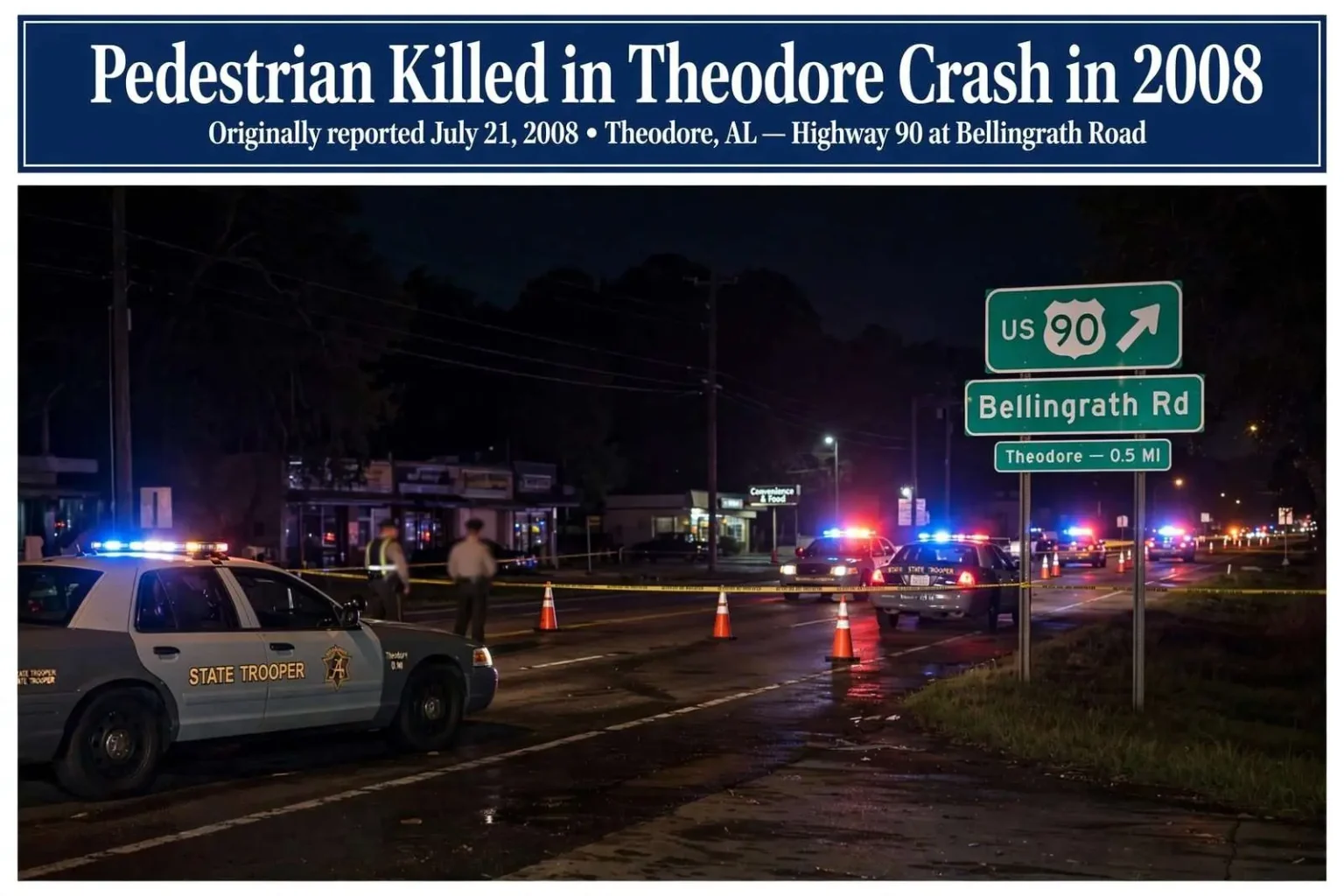
Originally reported July 21, 2008.
A Theodore woman was killed after being struck by a vehicle near Highway 90 and Bellingrath Road in July 2008, according to an archived local news report. State troopers said the crash occurred about 10 p.m. on a Sunday, in one of south Mobile County’s busiest commercial corridors.
In a later update, troopers identified the victim as a 46-year-old Theodore resident and said a 21-year-old Coden woman had been driving the vehicle. Troopers were investigating the crash, and no findings about its cause had been released at the time of the original report.
The intersection area where the crash occurred sits along U.S. Highway 90 in Theodore, the main commercial artery running south from Mobile toward the coastal communities of Coden and Bayou La Batre. Bellingrath Road branches off the highway and leads toward Bellingrath Gardens and Home, one of the region’s best-known attractions, carrying a steady mix of local and visitor traffic.
Pedestrian crashes along that stretch of Highway 90 have been a recurring concern over the years. The corridor combines high travel speeds, numerous driveways and commercial entrances, and stretches with limited lighting and few marked crossings — conditions that traffic safety officials have long identified as hazardous for people on foot, particularly after dark.
How Such Crashes Are Investigated
In 2008, crash investigations on state highways in Mobile County fell to the Alabama Department of Public Safety’s state troopers, who handled rural and state-route crashes while municipal police covered their own city limits. Troopers responding to a fatal pedestrian crash typically closed the roadway for hours while documenting the scene.
A standard investigation of that kind involves measuring and photographing the scene, locating the point of impact, examining the vehicle for damage, and gathering witness statements. Investigators work to establish where the pedestrian was in the roadway, the vehicle’s speed and direction, and the lighting conditions at the time — factors that determine whether any charges ultimately follow.
Identification of the victim and the driver, as happened in the later update troopers provided, is a routine step once next of kin have been notified. Names released in such reports were typically accompanied by an age and hometown, as was the case with both the 46-year-old victim from Theodore and the 21-year-old driver from Coden.
Under Alabama law at the time, a pedestrian death did not automatically result in criminal charges. Prosecutors considered impairment, speed, recklessness, and other evidence before deciding whether a driver’s conduct warranted citations or criminal prosecution, and many fatal pedestrian crashes were closed without charges when investigators found no violation.
Theodore and the Highway 90 Corridor
Theodore in 2008 was an unincorporated community of roughly 7,000 residents along Highway 90, anchored by its schools, churches, and the commercial strip that serves travelers and locals alike. Like other south Mobile County communities, it sat outside any city limits, meaning county services and state troopers handled much of its public safety needs.
The community grew up along the highway itself — the old Spanish Trail — which for decades was the primary route between Mobile and the bay communities before Interstate 10 drew through traffic away. What remained was a corridor dense with businesses that depend on highway visibility, and the turning movements that come with them.
Bellingrath Road, which meets Highway 90 near the crash site, funnels traffic to Bellingrath Gardens and Home, the 65-acre estate garden opened to the public in 1932 by Walter and Bessie Bellingrath. On summer evenings the road also serves residents of the Coden and Bayou La Batre areas heading north toward Mobile, adding to the traffic mix near the junction.
That combination — highway speeds, turning traffic, and pedestrians along the shoulder — has made the Highway 90 corridor through Theodore and neighboring communities a focus of periodic safety attention. Residents and officials have discussed improved lighting, sidewalks, and enforcement details over the years, though the corridor’s basic layout has changed little since 2008.
Pedestrian Safety After Dark
The crash occurred about 10 p.m. on a Sunday, a time when visibility along the corridor is limited to what headlights and sparse streetlights provide. National crash data from that era consistently showed that a disproportionate share of pedestrian fatalities occurred after dark, on roadways without marked crossings, and involved pedestrians walking along or near the travel lane.
Traffic safety experts have long urged both drivers and pedestrians to take extra care on corridors like Highway 90 at night — drivers by reducing speed and watching for people near the roadway, pedestrians by carrying lights, wearing reflective gear when possible, and walking facing traffic where no sidewalk exists.
South Mobile County’s layout complicates those efforts. Many residents live along highway frontage roads or side streets with no continuous sidewalk network, and daily life — walking to work, to a store, or to a relative’s house — often means sharing the roadside with fast-moving traffic. The risk is compounded in stretches where bus stops, convenience stores, and residences sit across the highway from one another.
Troopers’ investigations in such cases served a dual purpose: determining fault in a specific crash and documenting conditions that sometimes fed into later safety improvements along the corridor.
A Sensitive Report
This historical article, like the original report it summarizes, avoids graphic detail about the crash. The original coverage was straightforward and restrained — the location, the time, the identities as confirmed by troopers, and the status of the investigation — consistent with how Alabama outlets typically handled fatal crash reports of the era.
The article also does not state later investigative findings or court outcomes, because the archived report did not include them. What remains on the record is the essential account: a 46-year-old Theodore woman was struck and killed near Highway 90 and Bellingrath Road on a Sunday night in July 2008, a 21-year-old Coden woman was driving the vehicle, and state troopers investigated the crash.
For the families involved, such reports marked only the beginning of a long process — investigations, insurance matters, and grief that extends far beyond any news cycle. Communities along the corridor have continued to wrestle with the roadway conditions that make such tragedies possible, a conversation that was as current in 2008 as it remains today.
Traffic Fatalities in South Mobile County, Then and Now
The stretch of Highway 90 through Theodore has seen its share of serious crashes over the decades. Long before the interstate took most through traffic, the Spanish Trail corridor was among the busiest roads in south Alabama, and its legacy of high volumes and commercial density has persisted even as traffic patterns shifted.
State and county safety records from the period showed rural highways like U.S. 90 accounting for a significant share of Alabama’s roadway deaths, with pedestrian fatalities among the hardest to prevent. Unlike occupant protections — seat belts, air bags, crash-tested vehicles — little separates a person on foot from a moving vehicle, which is why speed and visibility matter so much in these cases.
In the years since 2008, engineering responses to such crashes have included better lighting at key intersections, added turn lanes, and periodic enforcement waves targeting speed and impairment along the corridor. Advocates continue to press for more pedestrian infrastructure — sidewalks and marked crossings — in south Mobile County, where most roads were built before pedestrian traffic was a design consideration.
For local readers searching archives for accounts of that July 2008 night, the essentials are preserved in this summary: the Sunday-night timing near 10 p.m., the Highway 90 and Bellingrath Road location, the victim identified as a 46-year-old Theodore woman, the driver identified as a 21-year-old from Coden, and the state troopers’ continuing investigation as of the original report date of July 21, 2008.
Beyond those documented facts, the record is silent — and this account deliberately leaves it so, honoring both the original report’s restraint and the privacy of the families involved in a tragedy that the south Mobile County community of Theodore has not forgotten.
Remembering the Victims of Roadway Crashes
Fatal crash reports, brief as they are, represent a permanent change for two families — the family of the person killed and the family of the driver. In crashes like the one near Highway 90 and Bellingrath Road, both households in the Theodore and Coden communities faced grief, questions, and public attention at once.
Victim advocates and clergy in south Mobile County have long played a role in supporting families after such losses, from navigating the investigation process to organizing memorial services. Rural and suburban communities often lean on those informal networks because formal grief services were, and remain, limited outside the city of Mobile.
Roadway memorials — flowers, crosses, and markers placed near crash sites — became a familiar sight along Alabama highways, and the Highway 90 corridor has carried its share over the years. State rules about roadside memorials have evolved, but the practice endures as a way for families and neighbors to mark the spot where a life was lost.
Safety organizations have used stories like this one in their outreach, reminding drivers that a moment of inattention or speed on a dark corridor can end a life, and reminding pedestrians that visibility can be the difference between a close call and a tragedy. Those messages were as relevant to Theodore residents in 2008 as they are to commuters on Highway 90 today.
The archived report of July 21, 2008 closes with troopers continuing their work — the last documented word on the case. What the community carried forward was the memory of a neighbor lost on a summer Sunday night, and the standing reminder that the highway through town demands care from everyone who uses it.