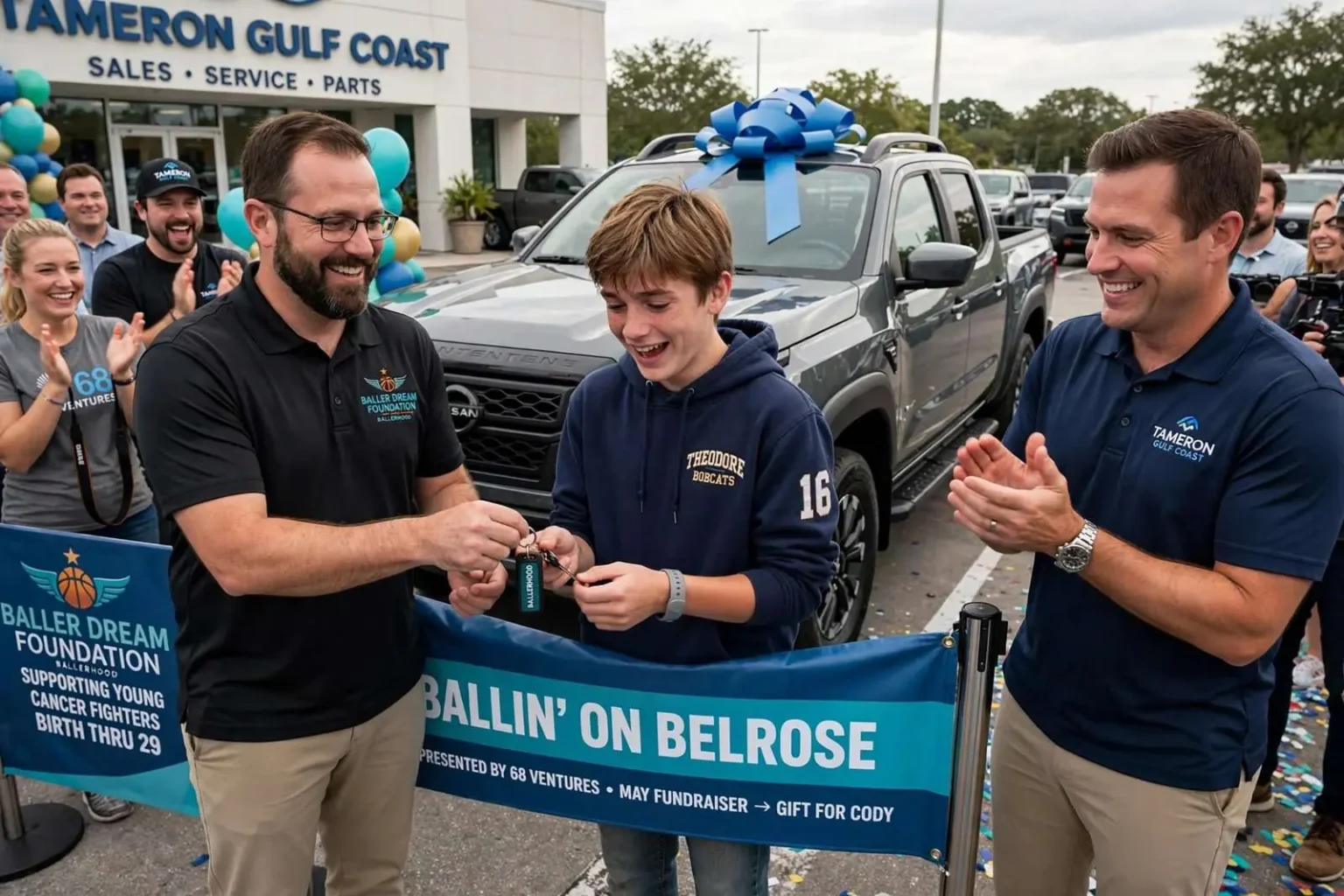
A 16-year-old Theodore High School student who spent two years fighting cancer was surprised Tuesday with his first vehicle, a gift from three local organizations that have supported him through his recovery.
Cody Scott was diagnosed with Hodgkin’s lymphoma at age 14. During his treatment, he found support through the Baller Dream Foundation, a local nonprofit that assists young people battling cancer from birth through age 29. On Tuesday, the foundation joined 68 Ventures and Tameron Gulf Coast to present Scott with a Nissan Frontier.
The surprise transformed an ordinary Tuesday into the kind of afternoon a family remembers for years. Scott arrived expecting something far less dramatic, and instead found the people who had walked with him through two years of treatment gathered to hand him the keys to his first truck.
“Instead of calling them patients we called them ballers, and Cody Scott here is a part of our ballerhood,” said Frank DeBlasi, founder of the Baller Dream Foundation.
Two Years of Treatment
Hodgkin’s lymphoma, the disease Scott faced, is a cancer of the lymphatic system that is diagnosed in roughly comparable numbers of adolescents and young adults each year, and it is among the more treatable forms of cancer — but the treatment is grueling, typically involving months of chemotherapy and, in some cases, radiation. For a teenager, the disease disrupts everything at once: school, sports, friendships and the ordinary momentum of growing up. Students in treatment often fall behind academically, miss the seasons of the sports they play, and watch their peers move on with routines they cannot share.
Scott’s diagnosis at 14 landed him in that world mid-adolescence, and his two years of fighting it spanned middle school into high school. Survivors of adolescent cancer frequently describe the end of treatment as its own transition — the medical team steps back, the calendar opens, and the question becomes how to step back into the life the disease interrupted. That is the stage where organizations like Baller Dream focus much of their work, on the theory that recovery is more than the last scan.
The Fundraiser Behind the Gift
The gift traces back to Ballin’ on Belrose, the foundation’s annual fundraiser presented by 68 Ventures. Scott took part in this year’s event in May, which drew more than 550 runners and raised $100,000 to support young cancer patients. That fundraising, combined with a contribution from Tameron Gulf Coast, made the vehicle gift possible.
The arithmetic of the gift tells the story of how local philanthropy actually works. Hundreds of runners paying entry fees and gathering pledges in May became a pool of money that the foundation could direct toward the young people it serves; a dealership’s contribution converted that pool into a specific, life-changing present for one of them. Scott was not a stranger to the people who funded his truck — he had run in the event himself, part of the community that raised the money before knowing where part of it would land.
68 Ventures, the Daphne-based development and investment company that presents the annual fundraiser, has built its community involvement around the Gulf Coast region where it does business, and its partnership with the foundation has made Ballin’ on Belrose one of the area’s signature charity events. Tameron Gulf Coast, the dealership that supplied the vehicle, completes the triangle: a nonprofit that identifies the need, a company that helps fund it, and a business that fills it directly.
“Anytime we can give back in any meaningful way we love to do that and we try to do that,” said Bryan Breakfield, chief operating officer and part owner of Tameron Gulf Coast.
The Surprise Itself
Scott said he had no idea what awaited him when he arrived at the surprise.
“I feel great, everyone at Baller Dream I really appreciate them, it’s a great gift,” Scott said. “I knew we were driving here for something but I didn’t know what. I think it looks great, I feel the best I’ve felt in my life to be honest.”
First vehicles occupy a special place in teenage milestones, and for a young man whose last two years were measured in treatment cycles and hospital visits, a truck of his own represents something more than transportation. It is independence: the ability to drive himself to school, to work, to friends’ houses — the ordinary freedoms that cancer treatment put on hold. The Nissan Frontier, a compact pickup with a reputation for durability, suits a 16-year-old on the Gulf Coast, where trucks are as common in high school parking lots as sedans.
His comment about feeling the best he has felt in his life carries its own weight. Cancer survivors measure their recovery in milestones, and the return of everyday energy — the kind that makes a new truck exciting rather than exhausting — is among the most meaningful. Scott’s two years of treatment ended with him healthy enough to stand in a parking lot, thank a crowd, and drive himself home.
The Foundation’s Model
Organizers said the surprise reflects the Baller Dream Foundation’s broader mission of bringing hope and encouragement to young people facing cancer, long after their treatment has ended.
That after-treatment focus is what distinguishes the organization from many cancer charities. Foundations in the pediatric and young-adult cancer space often concentrate on research or on helping families pay bills during treatment; Baller Dream’s work with patients from birth through age 29 extends into the period when the medical system steps back but the practical and emotional recovery continues. Young adults in that window face particular challenges — many are too old for pediatric support programs but lack the resources of established adults, and the foundation’s age ceiling is designed to reach them.
The “baller” identity at the center of the foundation’s culture is part of that work. The language reframes the patient as the fighter, the athlete, the member of a team — a deliberate choice aimed at young people who do not want to be defined by a diagnosis. DeBlasi’s description of Scott as part of the “ballerhood” is the vocabulary of belonging, and for patients whose treatment isolated them from their peers, the belonging persists after the treatment ends.
Events like the truck presentation also serve the foundation’s public face. Every gift given visibly — with the recipient, the donors and the community present — shows potential supporters what their contributions do, and it shows other young patients and families what the organization can be for them. The May fundraiser that funded this gift drew its 550 runners from exactly that cycle: a community that sees the results and comes back the next year to run again.
For Theodore High School’s junior class, one classmate starts the school year with his own truck, a clean bill of health, and a story his classmates watched unfold. For the organizations that made it happen, the surprise was the point — a moment of unalloyed good news, earned the hard way over two long years.
Theodore and the Community That Showed Up
Theodore, the Mobile County community south of the city along U.S. 90, has long shown the kind of neighborhood loyalty that events like this one draw on. The area’s high school sits at the center of community identity, and local businesses and families have a history of rallying around their own — from athletic program fundraisers to holiday toy drives. Scott’s surprise tapped directly into that network: the people in the parking lot Tuesday were not a corporate delegation but the same runners, sponsors and volunteers who make up the foundation’s Gulf Coast base.
The geography of the gift is itself a story of local ties. The foundation operates in the Mobile area; 68 Ventures is headquartered across the bay in Daphne; the dealership serves customers on the Eastern Shore and in Mobile County; and the recipient is a Theodore student. Every dollar raised in May, and every hour volunteered, stayed within the region — a closed loop of local giving that charity organizers cite when they argue that community fundraisers outperform national campaigns in visibility and impact per dollar.
What the Truck Represents Going Forward
The timing of the gift, in the weeks before a new school year, positions Scott to start classes with a normalcy that would have been unimaginable during his treatment. A student driving himself to Theodore High School, managing his own schedule, and planning weekend drives with friends is living the ordinary life that illness interrupted at 14.
The foundation’s supporters will keep watching his progress, and Scott’s story now becomes part of the organization’s own record — one more example of what the “ballerhood” delivers. Future fundraisers will point to it. Other families navigating a new diagnosis will hear about it and reach out. The May event next year will have a beneficiary story to tell that made the case better than any brochure.
For now, the story belongs to a 16-year-old and his truck. Scott thanked the foundation, the sponsors and the crowd around him on Tuesday, and then there was the matter of the drive home — his first in a vehicle that carries two years of community effort under the hood. It is, as he put it, the best he has felt in his life, and the community that watched him earn it would not have it any other way.