Theodore Worker Was Hospitalized After 2008 Conveyor-Belt Accident
Archived WKRG coverage reported that a worker was hospitalized after a conveyor-belt accident at a Theodore business in 2008.
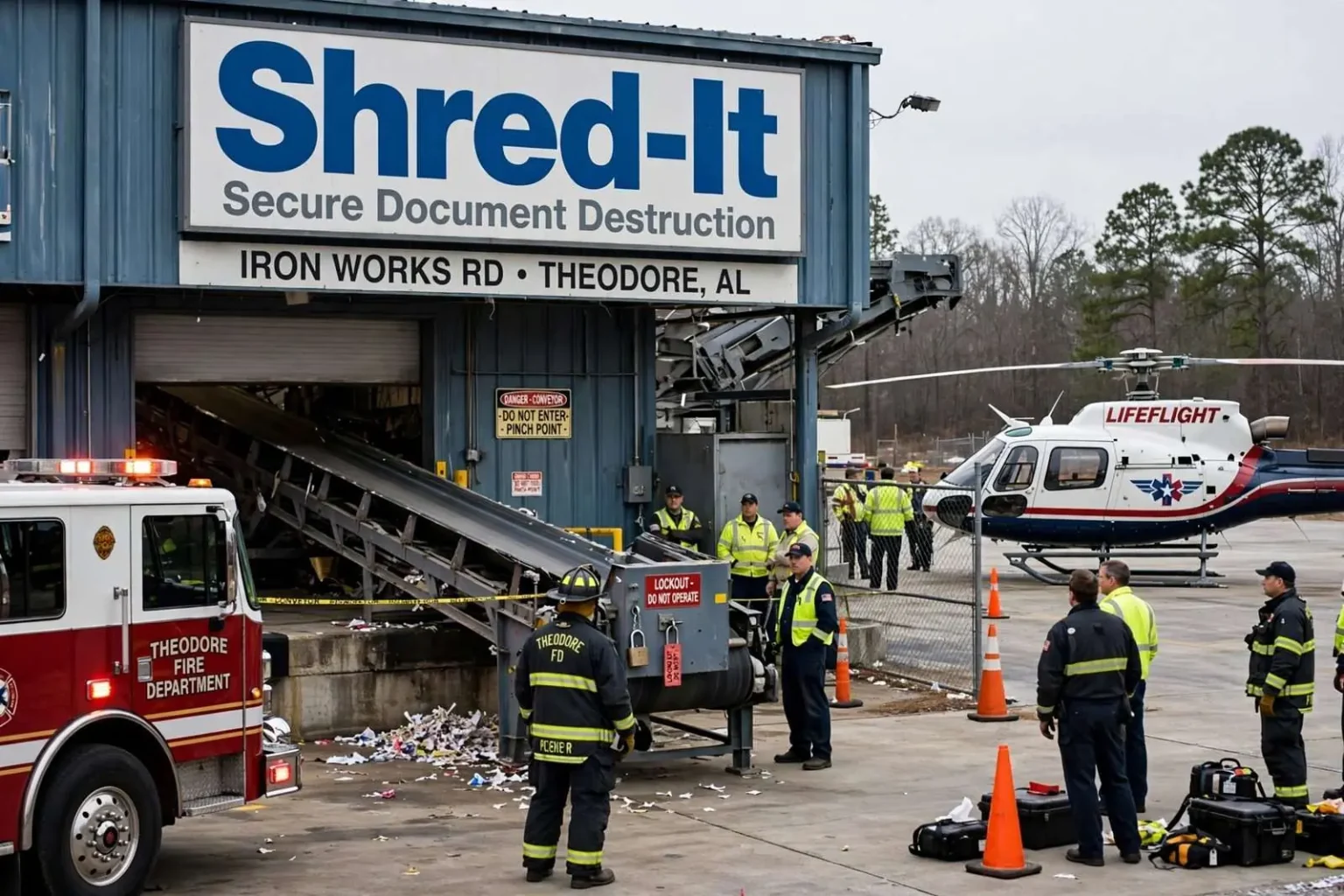
Historical public-safety report, published from archived local news coverage. A worker was taken to an area hospital after his hand became trapped in a conveyor belt at a Theodore business in February 2008, according to an archived local news report. The injury underscored the hazards that come with the industrial equipment used across the warehouses and light-manufacturing sites scattered through the Theodore area of Mobile County.
The station reported that the incident occurred at the Shred-It company on Iron Works Road while employees were moving shredded paper into a warehouse. Shred-It is a national document-destruction company, and its Theodore operation handled the secure disposal of sensitive paper records for businesses, banks, medical offices, and government customers across the Mobile area. Once documents pass through industrial shredders, the resulting confetti-like paper has to be baled or moved into storage before it can be recycled, and conveyor belts are the standard way crews move that volume of loose shredded material around a warehouse floor.
Conveyors of that kind present a well-known set of dangers to the people working beside them. Moving belts, rollers, and drive mechanisms can catch a sleeve, glove, or hand in a fraction of a second, and the continuous motion of the machinery keeps pulling rather than releasing. Safety rules for such equipment call for guards over pinch points, emergency stop cords within reach of the operator, lockout procedures before clearing jams, and training so that workers never reach across or into a running belt. Industrial safety investigators routinely look at each of those elements after a conveyor injury to understand what failed.
A Lifeflight helicopter transported the worker to a local hospital after emergency personnel made several attempts to free his hand. The decision to call an air ambulance reflected the seriousness of the injury and the difficulty of the rescue: with a hand trapped deep in a machine, firefighters and medics on the scene had to carefully dismantle or back off the machinery without causing further harm, a slow process that made rapid transport to definitive trauma care a priority once the worker was freed.
The Emergency Response in Theodore
Incidents like this one mobilized several layers of response at once. Theodore is served by volunteer and combination fire departments in southern Mobile County, with mutual aid available from neighboring departments and from the Mobile Fire-Rescue system when specialized rescue equipment is needed. A machinery entrapment calls for more than an ambulance: responders bring heavy and precision tools, coordinate with a supervisor at the plant to kill power to the equipment, and work methodically to protect the injured worker from further injury while the machine is taken apart around him.
The Lifeflight helicopter that completed the transport operated as part of the regional air medical network covering the central Gulf Coast. For patients with severe crush injuries, air transport can cut a trip that might take 30 minutes or more by ground to a fraction of the time, and trauma protocols across Mobile County long favored flying patients with serious extremity injuries directly to the region’s higher-level emergency departments. Crews on the ground in Theodore stabilized the worker and prepared him for the flight while the rescue operation concluded.
The worker’s name was not released in the original report, which is common practice in coverage of workplace injuries where no fatality has occurred. Newsrooms generally withhold identifying details of injured workers unless the individual or the family chooses to speak publicly, both out of medical privacy concerns and because employment records are not public. The company and investigators, meanwhile, focus their attention on how the injury happened and what can prevent a repeat.
Workplace Safety Context in South Mobile County
The Theodore area along U.S. 43 and the corridors near Tillman’s Corner hosts a mix of distribution centers, service businesses, contractors, and industrial operations that take advantage of the area’s position between Mobile’s port and the residential growth of southern Mobile County. That industrial base brings steady employment to the community, and with it the routine exposure of workers to forklifts, balers, shredders, and conveyor systems that must be maintained and operated correctly to stay safe.
Federal workplace safety rules administered by the Occupational Safety and Health Administration apply to operations like the Shred-It facility in Theodore. OSHA’s machine-guarding standards require that moving parts on conveyors and similar equipment be guarded so that employees cannot contact pinch points during normal operation, and the agency’s lockout and tagout rules govern how machines are de-energized before workers clear jams or perform maintenance. Employers must also train workers on the specific hazards of the machines they operate and keep records of reportable injuries, and serious hospitalizations trigger OSHA notification requirements that can lead to an inspection.
Hand injuries remain among the most common industrial injuries nationwide, and conveyor systems are a recurring source of them. Safety engineers who study these accidents emphasize a consistent set of lessons: never reach into a moving belt, treat every jam as a stop-and-lockout event, keep loose clothing and gloves away from rollers, and ensure emergency stops are tested on a schedule. Employers that institutionalize those habits, through daily walk-throughs and near-miss reporting, tend to see fewer of the entrapment events that send workers to the hospital.
What Happened After Such an Injury
For the worker, an injury serious enough to require helicopter transport typically began a long recovery involving surgery, rehabilitation, and questions about returning to industrial work. Alabama’s workers’ compensation system covers medical treatment and partial wage replacement for employees hurt on the job, and workplace injury claims in Mobile County proceed through that framework rather than through ordinary negligence lawsuits in most circumstances. The weeks and months after an incident like the one on Iron Works Road usually involve coordination among the employer, the insurer, treating physicians, and the worker’s family.
For the company, an entrapment injury prompts an internal review alongside any regulatory inquiry: what task was underway, whether guards and stops functioned as designed, what training the crew had received, and whether the method of moving shredded paper that day followed standard procedure. Operations that handle high volumes of loose paper rely on those conveyor transfers daily, so findings from such reviews often translate directly into revised procedures or added guarding.
This historical account contains only the public-safety details available at the time and does not report the worker’s later condition. The February 2008 incident at the Iron Works Road facility stands as a reminder of the speed with which routine warehouse work can turn dangerous, the readiness of Mobile County’s emergency network, and the role that air medical transport plays in getting critically injured workers from scenes in Theodore and other south Mobile County communities to the trauma care they need.
How Shredding Operations Work Behind the Scenes
The document-destruction industry grew rapidly through the 1990s and 2000s as federal privacy rules and corporate identity-theft concerns pushed businesses to stop throwing sensitive records in dumpsters. Companies like Shred-It built their services around certified collection containers at customer sites, trucks with mobile shredding systems, and plants where loose shredded paper is compressed into bales and sold to paper mills for recycling. Every step of that chain is mechanical, and the transfer points between shredder, conveyor, and storage are where workers interact most closely with the equipment.
Moving shredded paper is deceptively demanding work. The material is light, abrasive, and voluminous, so facilities depend on large conveyors and balers to handle quantities that would be impractical to move by hand. Paper dust in the air, the noise of high-throughput machinery, and the repetitive rhythm of loading and clearing all contribute to an environment where attention can drift, which is exactly why the industry’s safety literature keeps returning to guarding, stop cords, and lockout discipline as the fundamentals that keep hands away from moving parts.
A Lasting Lesson for Local Workplaces
Accidents like the one reported in Theodore in February 2008 tend to have effects well beyond the single facility involved. Nearby employers in similar lines of work often revisit their own training after a serious local injury, and emergency responders carry the lessons of a difficult machinery rescue into their preplanning for industrial sites in their districts. Fire departments across south Mobile County maintain familiarization with the warehouses and plants along Iron Works Road, U.S. 43, and the surrounding commercial corridors precisely so that a complex extrication does not have to be improvised from scratch.
For the public, the episode also illustrated the layered emergency system that stands behind industrial south Alabama: first responders trained in machinery rescue on the scene in Theodore, an air medical crew able to lift a critically injured patient quickly, and a hospital trauma team receiving them. That chain worked as designed on a winter day in 2008, and its performance was as much a part of the story as the malfunction that set it in motion. The archived report preserves what could be known at the time: a worker injured, a difficult rescue completed, and a flight to the hospital that gave him the best available chance at recovery.