This Week in Alabama Politics: Court Tests, Party Leadership and a Redrawn District
Alabama's political world faces a busy week: a residency case before the state Supreme Court, new Democratic Party leadership, a Republican push to close primaries, and a reshaped congressional race.
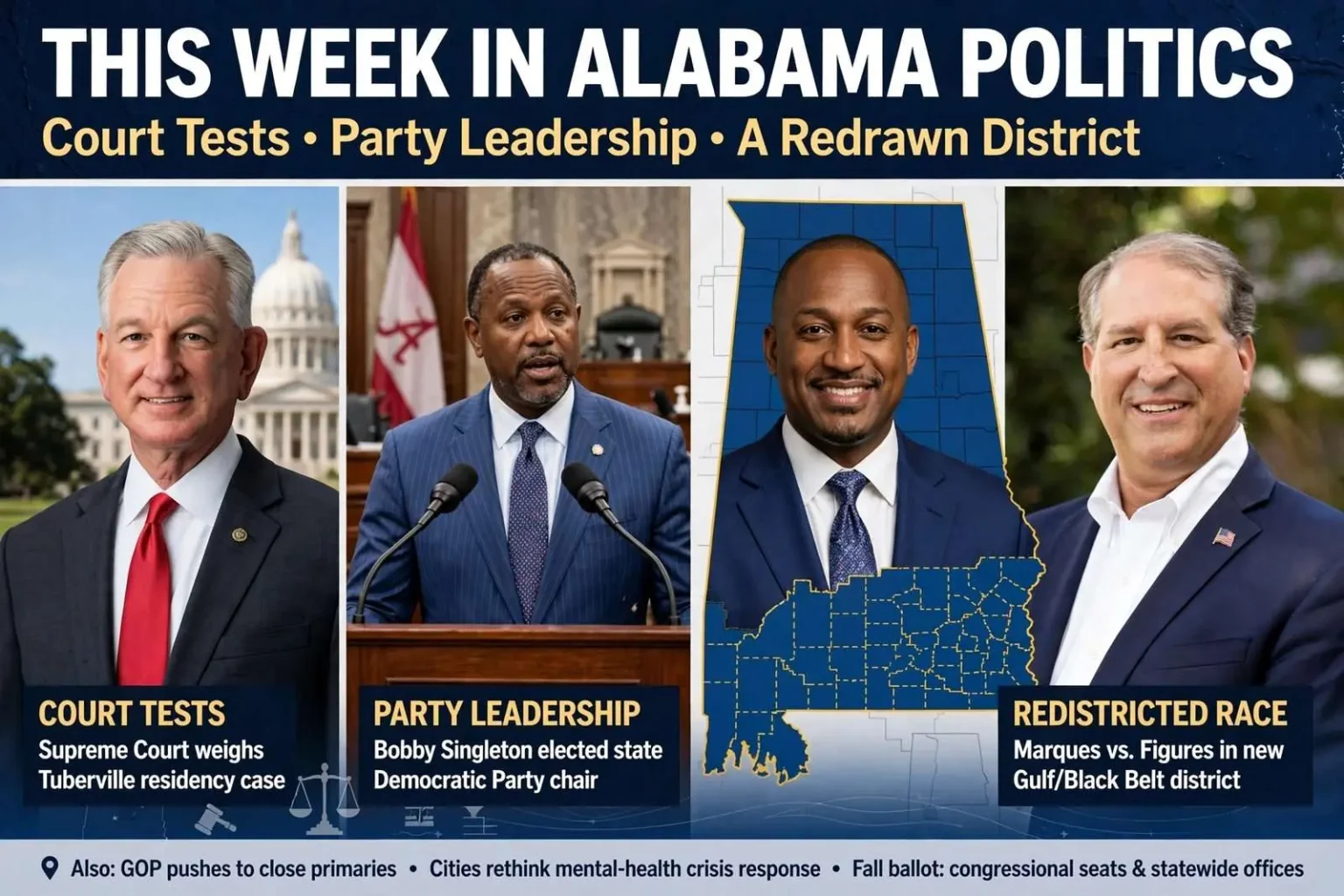
Alabama’s political landscape faces several tests this week, from a residency dispute working through the courts to new leadership atop the state’s Democratic Party and a congressional map that has reshaped the race for a U.S. House seat. The issues move on separate tracks but share a common thread: each will help decide how Alabama’s elections look and function heading into the fall ballot, when every congressional seat and a pair of statewide offices will be decided by voters across the state.
Alabama Supreme Court Weighs Tuberville Residency Case
The Alabama Supreme Court is confronting a threshold question in the residency case surrounding Tommy Tuberville: whether any court has the authority to enforce the seven-year residency requirement in the state’s constitution before voters go to the polls. The former Auburn University football coach entered the race for governor as the best-known name in the field, but a legal challenge has argued that his ties to the state do not satisfy the constitutional standard, setting up a fight that could reshape the top of Alabama’s 2026 ballot.
Residency requirements for candidates are a recurring feature of American elections, and disputes over whether — and when — a court can step in to enforce them ahead of an election are not unusual when a candidate’s ties to a state are challenged. Alabama’s constitution has long required gubernatorial candidates to have lived in the state for seven consecutive years before the election, a standard that appears in the founding document drafted in 1901. Courts in other states have wrestled with the same question and generally hesitate to strike candidates from ballots absent clear proof, wary of substituting judicial judgment for the voters’ own.
The timing matters as much as the substance. Ballots must be printed, absentee voting deadlines approach and qualifying has closed, all of which compress the window in which a court can act. If the Supreme Court declines to intervene, the challenge effectively ends and the question returns to voters; if it finds jurisdiction and rules against the candidate, party committees would face the task of replacing a nominee at the top of the ticket. Either outcome will be watched closely by both parties, because the answer will define how easily residency challenges can be mounted against candidates in future cycles.
Singleton Wins Alabama Democratic Party Chairmanship
Bobby Singleton won a landslide victory to become the new chairman of the Alabama Democratic Party. The longtime state senator from Greensboro, whose district stretches through Alabama’s Black Belt, has spent years in Senate leadership and brings deep relationships across the party’s rural and urban wings to the post. His election closes out a leadership transition that began when the previous chairman stepped aside, and it hands the party’s top job to a figure known for coalition-building rather than factional warfare.
Party chairs typically oversee fundraising, candidate recruitment and organizing efforts heading into major election cycles, and a change in leadership often signals a shift in strategy for a party heading into the fall. For Alabama Democrats, the assignment is steep: the party has not won a statewide race in Alabama since 2008 and enters the fall as a heavy underdog in every statewide contest. Singleton’s task will be to field competitive candidates in as many districts as possible, keep the party’s legislative caucuses funded and rebuild the county-level organizations that once formed the backbone of Democratic politics in the state.
The chairmanship also carries a symbolic weight in a party whose base is concentrated in the Black Belt, in Birmingham, in Montgomery and in Mobile. Singleton’s home county of Hale sits in the heart of that Black Belt political geography, and his rise reflects the centrality of Black voters and rural organizers to whatever revival the party manages. Observers will be watching whether he can hold together the coalition that elected him through a difficult election year.
Republicans Push to Close Alabama’s Primaries
Meanwhile, Alabama Republicans are pushing to close the state’s primary elections. In a closed primary system, only voters registered with a party can cast a ballot in that party’s primary, as opposed to an open primary, where any registered voter can participate regardless of party affiliation. Alabama currently holds open primaries, and the push to change that system would mark a significant shift in how the state’s most competitive elections are decided.
The debate is not academic in a state where the real competition usually happens in the Republican primary rather than the November general election. Legislative seats, county offices and most statewide races are effectively decided when Republican voters choose their nominees, which gives the rules governing who may vote in that contest outsized importance. Supporters of closing the primary argue that only committed party members should pick the party’s standard-bearers, preventing what they see as crossover manipulation by opposing voters or, in some cases, by Democrats whose general election prospects are slim.
Critics counter that closing the primary would lock out the independent and moderate voters who make up a meaningful share of the Alabama electorate, and would push party nominees toward the ideological extremes of a primary electorate. Any change would also require logistical groundwork, since Alabama does not register voters by party, meaning a closed system would require either party registration or a pledge system at the polls. The Alabama Republican Party has debated the question for years, and the current push suggests the issue will be resolved ahead of future cycles rather than this fall’s ballot.
Marques-Figures Race Draws National Attention
A newly redrawn congressional district has reshaped the race for November, setting up a high-stakes matchup between Rhett Marques and Shomari Figures. The district, redrawn after federal litigation over Alabama’s congressional map, now runs a band across the Gulf Coast and the Black Belt, connecting Mobile’s suburbs with counties that have not shared a congressional district in generations. The redrawn lines followed a long court battle in which federal judges found that the state’s previous map likely diluted the voting strength of Black Alabamians, ordering a second majority-Black or near-majority-Black district for the southern part of the state.
Redistricting can dramatically change the competitiveness of a race by shifting which voters live within a district’s boundaries, and the new lines have turned this contest into one of the most closely watched congressional races in the state this fall. Figures, a Mobile attorney with experience in the Justice Department, and Marques, a Republican former congressional staffer and attorney, are competing for a seat that both parties view as genuinely winnable — a rarity in Alabama, where congressional races are rarely competitive in November. National party committees and outside groups have taken notice, and the contest is expected to draw significant spending as both sides test the new district’s electorate.
The outcome will also determine how the new district performs as a template. Both parties will study the results for lessons about how the redrawn coalition of urban Mobile, the Black Belt and the suburban Gulf Coast behaves at the polls, with implications for how Alabama’s congressional map is contested for cycles to come.
Cities Rethink Mental-Health Crisis Response
Away from the campaign trail, Alabama’s largest cities are reexamining how they respond to mental-health crises, part of a broader national conversation about whether armed police officers should be the default responders to calls involving a mental-health emergency. The question has taken on urgency in communities across the country after a series of high-profile encounters in which police responses to people in crisis ended in tragedy, and Alabama cities are among those weighing alternative models.
The options under discussion in cities like Birmingham, Montgomery and Mobile follow models that have emerged elsewhere in the country. Some cities have created dedicated crisis response teams that pair mental-health professionals with emergency medical technicians, dispatching them instead of — or alongside — police officers on qualifying calls. Others have adopted co-responder programs that embed clinicians with police departments, or crisis intervention training that prepares officers to de-escalate encounters and connect people to treatment rather than arrest.
The stakes are practical as well as philosophical. Police departments report that a substantial share of their call volume involves people experiencing mental-health emergencies, a burden that pulls officers away from other work and often produces outcomes that fall short of what either the caller or the person in crisis needs. Emergency rooms and county jails have absorbed the consequences, with jails in particular functioning as de facto mental-health facilities for inmates whose underlying condition was never treated. County sheriffs and municipal judges across Alabama have voiced the same frustration.
Building an alternative takes money and coordination. Crisis response programs require funding for clinicians, dispatch protocols that separate medical emergencies from criminal ones, and somewhere to take people in crisis other than a jail cell — a gap that Alabama’s strained network of community mental-health centers has struggled to fill. State officials have expanded crisis centers in recent years with the help of federal relief dollars, and city leaders are now weighing how their own budgets and 911 systems can connect to that growing infrastructure.
For city governments, the decisions made this year will shape how the next decade of crisis calls unfolds. Whether Alabama’s largest cities adopt dedicated response teams, expanded co-responder programs or a hybrid model, the direction of travel is clear: the default answer of sending an armed officer to every mental-health call is under review, and the alternatives are moving from pilot projects to policy.