Thomasville Police to Become First Alabama Agency Using Pursuit Warning Devices
Thomasville police will install 20 donated Pursuit Alert devices that warn nearby drivers of high-speed chases, a first for any Alabama agency.
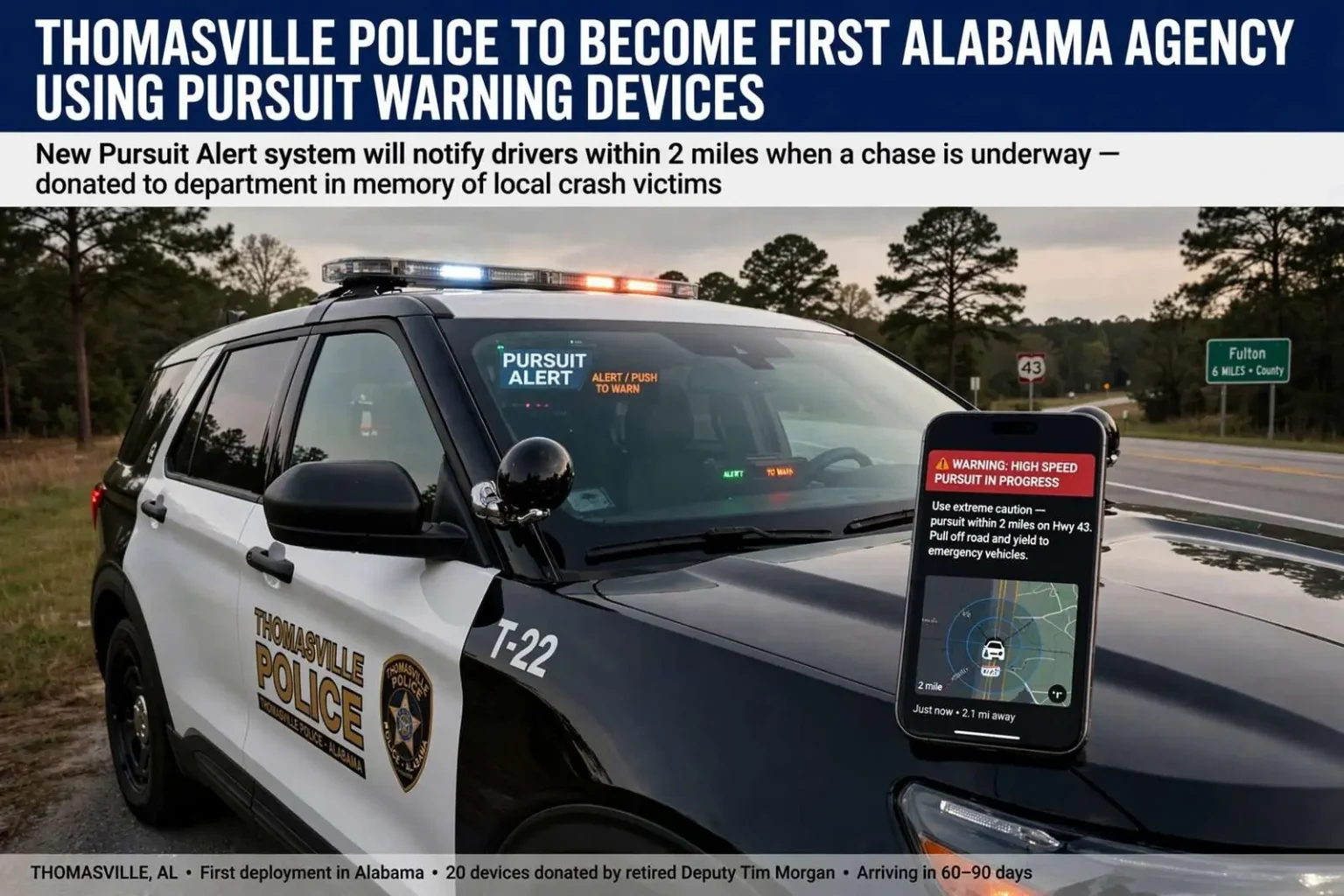
The Thomasville Police Department will equip its patrol fleet with technology designed to warn nearby drivers when officers are in a high-speed chase, becoming the first law enforcement agency in Alabama to use the system. Twenty Pursuit Alert devices are expected to arrive within 60 to 90 days, donated to the department by retired sheriff’s deputy Tim Morgan, who developed the technology and has spent years trying to get it into patrol cars after a career spent on the other side of the problem.
The system is built around a simple idea drawn from alerts drivers already know. Drivers download a companion app that notifies them when a pursuit is underway within a two-mile radius. The alert is triggered manually: an officer presses a button on the device mounted in the patrol car, which sends the signal out to phones in the area. “It’s a very distinct audible tone followed by a voiceover that says warning, high speed pursuit in progress use extreme caution,” Morgan said.
Police Chief Mitchell Stuckey said the goal is simple: give motorists enough warning to get out of the way. “We want to make sure the public has every opportunity to know ahead of time, or during this thing, so they can take preventative action and pull off the road or at least be aware that something may be heading their way,” he said. In a pursuit, the danger is rarely confined to the two vehicles involved; drivers pulling out of side streets or crossing intersections have no way of knowing a chase is bearing down on them until it arrives.
Council Signs Two-Year Contract
City council members voted unanimously Monday night to approve a two-year contract with the company behind the devices, clearing the way for the department to become the system’s first user in the state. Mayor Sheldon Day framed the decision as part of a wider push to look for new public safety tools. “We look at what can we do different, what can we do that would enhance public safety in the future,” he said. The unanimous vote reflected a council that saw little downside in a technology being provided at no cost to the city for the initial deployment.
Thomasville, the largest city in Clarke County, has positioned itself repeatedly as a small city willing to try early-stage public safety and community technology, and city leaders have used that reputation to attract attention and resources that larger neighbors sometimes command. The two-year contract gives the department and the company time to evaluate how the system performs in real chases before any decision about expansion or renewal.
Donated in Memory of a Local Family
The donation follows a fatal crash last month on Highway 43 near Fulton. Thomasville officers were pursuing a driver who crossed the median and struck an oncoming vehicle head-on, killing three members of the same family. The crash has haunted the department and the region, and it stands as exactly the kind of outcome the new technology is meant to prevent: an innocent family on the road, unaware that a chase was coming, with seconds or less to react.
Morgan is providing the units at no cost to the department in their memory. “All of the first responders who responded that night, they were tasked with dealing with a horrible situation,” Stuckey said. The crash also reverberated through the small communities along the Highway 43 corridor between Thomasville and the paper mill towns to the south, where the family’s loss was felt personally by neighbors, schools and churches across Clarke County.
Remembering Megan Brunson
The donation was inspired by a deadly crash days earlier that claimed high school teacher Megan Brunson and her mother, Wanda, innocent victims caught in the path of a pursuit. Morgan, a retired sheriff’s deputy from South Carolina who developed the technology, said the tragedy in Thomasville moved him to act. The two deaths gave the device’s arrival in Thomasville a deeply personal dimension, tying the first deployment in Alabama to a name and a face the community knew.
Beyond the local donation, Morgan pledged 1,000 Pursuit Alert units free of charge to law enforcement agencies across Alabama in Megan’s memory. The pledge would make Alabama the proving ground for the technology’s widest deployment, with agencies across the state able to adopt the system without the purchase cost that often stalls new public safety tools in their first years. Morgan has described the in-car device as working much like a tornado or AMBER alert: an officer pushes a button, and drivers within a two-mile radius receive a distinct audible warning on their phones that a high-speed pursuit is in progress.
That analogy explains both the promise and the design of the system. Tornado and AMBER alerts work because they interrupt whatever a person is doing with a tone that cannot be ignored, and because they carry a short, specific instruction. Pursuit Alert borrows that pattern and shrinks its radius, so that the warning reaches only the people actually in the path of the chase, rather than alarming an entire county for an event that will pass in minutes.
Why Pursuits Are So Dangerous
Police pursuits are among the most unpredictable events in law enforcement. Officers are trained to weigh the seriousness of the offense against the risk a chase poses to the public, and departments across the country have restricted pursuits for minor violations precisely because the collateral danger is real. When a fleeing driver crosses a center line or runs a light, the people most likely to be hurt are those who never chose to be part of the chase at all, which is the gap Pursuit Alert is designed to close by giving ordinary drivers those missing seconds.
For a department the size of Thomasville’s, covering a city along a busy federal highway, twenty devices would put the warning capability in every patrol vehicle, meaning that any pursuit that starts inside the city can broadcast its warning without a dispatcher having to relay anything manually. The officer’s button press sends the alert in real time, and the two-mile radius extends beyond the city limits along Highway 43, covering stretches of road where the last month’s fatal crash occurred.
What Happens in the Next 60 to 90 Days
Between now and the devices’ arrival, the department will integrate the units into its fleet and train officers on when and how to trigger the alerts. The public side of the equation will also need attention: the companion app works only if drivers in the area have it installed, so the department and city leaders are expected to spend the rollout period encouraging residents to download it and explaining what the warning tone means when it sounds.
If the Thomasville deployment goes well, Morgan’s pledge of 1,000 additional units means other Alabama agencies will be watching, and the system’s first-in-state status here could grow quickly. For now, the focus stays local: a city council’s unanimous vote, a chief’s determination that his officers’ chases should never again arrive without warning, and a donation made in memory of three family members and a teacher and her mother who should still be alive. The devices named for the problem they address will arrive in Thomasville within the next two to three months, and the state’s first pursuit warnings will sound from there.
A Technology Born From Experience
Pursuit Alert exists because its creator spent years on the roads where pursuits end badly. Morgan’s career as a sheriff’s deputy gave him a front-row view of what high-speed chases do to everyone near them, and the device reflects the practical judgment of someone who has stood at crash scenes and counted the cost. Rather than a system that depends on dispatch chains, radio traffic or a driver’s luck, the button-press design puts the decision in the hands of the pursuing officer at the moment the pursuit begins, when the warning is worth the most.
The two-mile radius is calibrated to the speeds a fleeing vehicle can reach. At highway speeds, a pursuit can cover that distance in under two minutes, which is roughly the warning window a driver needs to pull off, slow down or clear an intersection. The alert’s voiceover tells recipients what is happening and what to do, borrowing the plain-language style of weather warnings, because a tone alone would leave many drivers confused about whether the danger is ahead, behind or beside them.
Small Cities as Early Adopters
It is no accident that the first deployment in Alabama is happening in a city the size of Thomasville rather than in one of the state’s largest departments. Big-city agencies often face long procurement cycles, union and policy reviews, and integration questions with existing alerting infrastructure, while smaller departments can move from demonstration to deployment in weeks. Thomasville’s leadership has shown before that it is willing to be first, and the reward for that willingness is both improved safety for residents and a seat at the front of a conversation that is likely to spread across the state.
For Clarke County, the stakes are concrete. Highway 43 carries commuters, school traffic and commercial trucks through the heart of the county, and the crashes that prompted the donation happened on that road. Every driver in Fulton, Thomasville and the surrounding communities who installs the app becomes part of a warning network that did not exist last month, one built at no cost to taxpayers and dedicated to the memory of the people the system arrived too late to help.
The Broader Push for Safer Pursuits
The Thomasville deployment arrives amid a national conversation about how police pursuits should be conducted, when they should be called off and what technology can do to reduce their toll. Departments that have adopted similar warning systems report that the public side of the equation grows over time, as more drivers install the app after each high-profile chase, expanding the network’s reach with every deployment. Mayors and chiefs who have embraced the tools describe them as one of the few interventions that protects the public without restricting officers’ ability to do their jobs.
Stuckey has framed the department’s adoption as a promise to the community, and Day’s vote for the contract fit a pattern of the city trying new tools before its neighbors do. Morgan’s pledge ensures that whether or not other agencies move quickly, the means to follow Thomasville’s lead will be available across Alabama. The next chapter belongs to the rollout: twenty devices, sixty to ninety days, and a waiting state watching to see whether a button in a Thomasville patrol car can keep an innocent driver out of the path of a chase.