Thomasville woman arrested after chase ends in ‘largest drug bust in Fulton’s history’
A Thomasville woman was arrested after a chase ended in what Fulton police called the largest drug bust in the town's history.
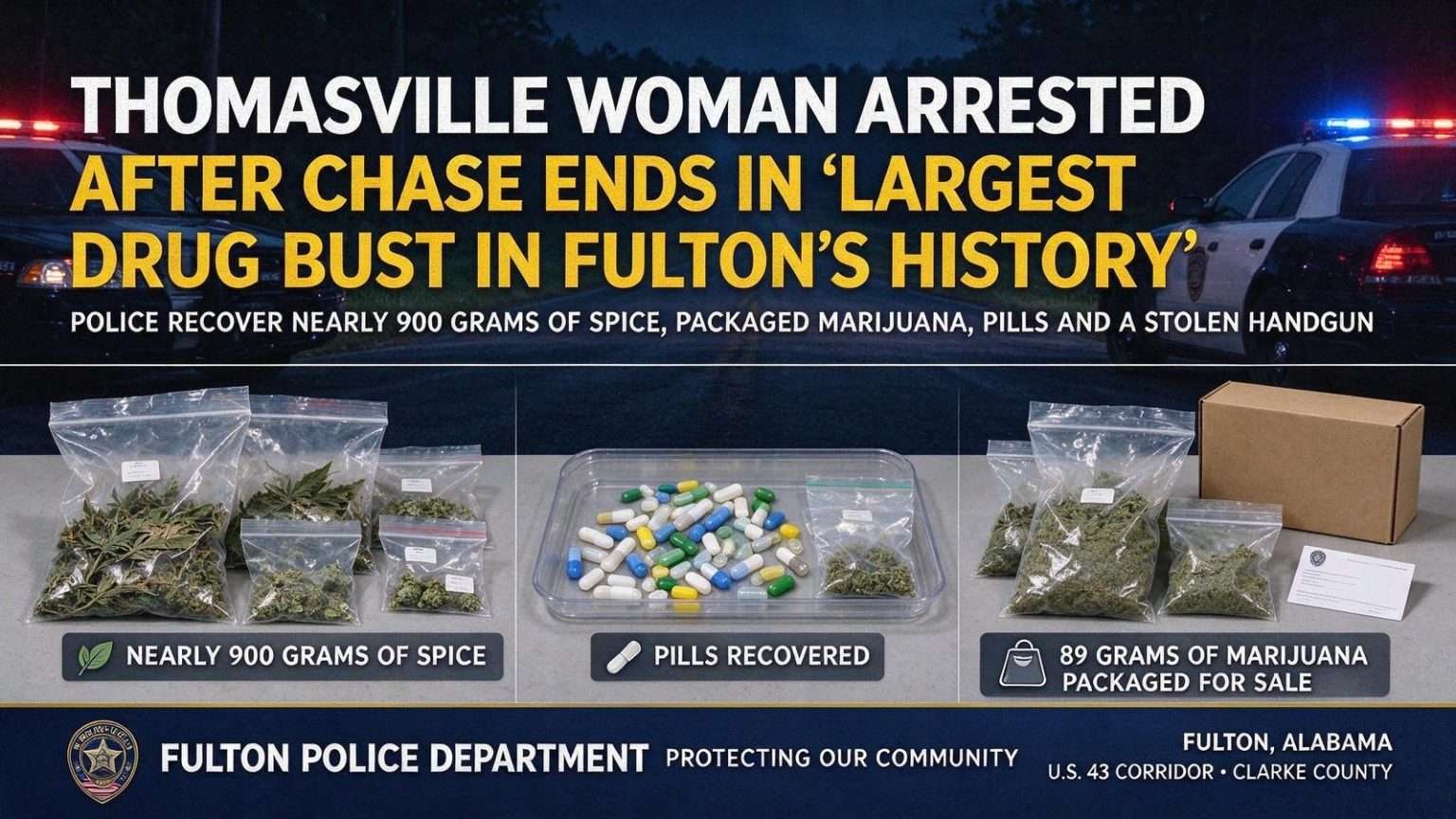
FULTON, Ala. — A Thomasville woman has been arrested following a vehicle pursuit that ended in what Fulton police are calling the largest drug bust in the small Clarke County town’s history. The chase began late Sunday night when the driver eluded a safety checkpoint, and it ended with officers recovering a haul of illegal drugs and a stolen handgun, according to Fulton Police Chief Ethan Elmore.
Chief Elmore said officers recovered nearly 900 grams of synthetic marijuana, known as spice, along with 89 grams of marijuana that had been packaged for sale, a number of pills, and a stolen handgun. The quantity of spice alone sets the seizure apart for a department the size of Fulton’s, whose officers cover a town of a few hundred residents along U.S. 43 in Clarke County.
The driver, identified as Jazmine Cade of Thomasville, eluded a safety checkpoint late Sunday night, prompting the chase that followed. When the pursuit ended, officers took her into custody and searched the vehicle, turning up the drugs and the gun. She was booked into the Clarke County Jail in Grove Hill, where she faced charges connected to the drugs, the firearm, and the flight from police.
A checkpoint, a pursuit, and a major seizure
Safety checkpoints are a familiar tool for small-town police departments across Alabama, used to check drivers for licenses, insurance, and impairment, and occasionally to look for other violations. Fulton officers set up their checkpoint late Sunday night along the routes that carry traffic through the town, and the driver now charged in the case avoided the stop instead of proceeding through it, drawing police attention and setting off the pursuit.
Vehicle pursuits in rural Alabama unfold quickly. Officers must weigh the seriousness of the suspected offense against the dangers a chase poses to the public, and departments train their officers to call off pursuits when the risk outweighs the need to apprehend. In this case, the pursuit ended with the driver in custody and the vehicle searched, and what officers found exceeded anything in the department’s recent experience.
Nearly 900 grams of spice represents a substantial quantity of synthetic marijuana for any jurisdiction, and particularly for a town Fulton’s size. Synthetic cannabinoids are laboratory-produced chemicals sprayed onto plant material and sold under brand names that suggest the products are harmless herbal mixtures. Health officials and emergency physicians across Alabama have repeatedly warned about the drugs, which can cause severe reactions including agitation, seizures, psychosis, and death, and whose potency varies unpredictably from batch to batch.
What was recovered
Along with the spice, Chief Elmore said officers found 89 grams of marijuana packaged for sale. Packaging is a detail that matters in charging decisions: marijuana divided into individual quantities supports distribution charges rather than simple possession, and the distinction carries significantly different penalties under Alabama law. The pills recovered in the stop add another dimension, since possession of controlled substances in pill form brings its own charges depending on what the pills are determined to be.
The stolen handgun rounds out the seizure. Firearms recovered during traffic stops and pursuits are checked against national databases to determine whether they have been reported stolen, and a stolen weapon in the possession of a driver fleeing police compounds the legal exposure substantially. Alabama law treats certain firearm offenses as felonies, particularly when drugs are involved in the same case, and federal charges are possible in cases where a stolen gun is connected to drug trafficking.
The combination — a large quantity of synthetic drugs, marijuana packaged for sale, controlled pills, and a stolen firearm, all in one vehicle stopped after a pursuit — is the kind of case that small-town chiefs describe as the exception rather than the rule, and Chief Elmore characterized the seizure as the largest in Fulton’s history.
Fulton sits in the southern part of Clarke County along U.S. 43, the highway that links Thomasville to the south with Grove Hill, Jackson, and ultimately Mobile. The town’s small police department handles the everyday calls of a rural community, and a case involving a felony pursuit and a haul of this size places unusual demands on a department with limited personnel. Departments in Clarke County routinely assist one another, and larger agencies in the region, including the sheriff’s office and neighboring municipal departments, are often called on for support in cases that outgrow local capacity.
Thomasville, the community where the driver is from, lies to the north along the same U.S. 43 corridor and is the largest city in the area, which means traffic between the two towns is constant. The corridor has historically seen law enforcement attention precisely because it funnels regional traffic through small communities, and checkpoints like the one that triggered Sunday night’s pursuit are part of how local departments monitor that flow.
How drug cases move through the courts
After booking at the Clarke County Jail in Grove Hill, the case moves into the court system. Drug weight matters enormously in Alabama’s sentencing structure, and the quantity of synthetic cannabinoids involved in this case would place the potential charges at the felony level. Possession with intent to distribute, receiving a stolen firearm, and charges connected to eluding police each carry their own penalties, and prosecutors will decide what to file based on the evidence gathered during the stop and search.
Lab confirmation is a key step in any drug case. Substances seized as suspected spice or marijuana must be analyzed by the state’s forensic laboratories before prosecutions proceed, since the specific chemical composition determines what charges apply. Alabama Department of Forensic Sciences labs handle that work for cases across the state, and the results typically arrive weeks or months after the seizure, shaping the charges prosecutors ultimately pursue.
The pill identification follows a similar path. Pills recovered in a vehicle can range from prescription medications to counterfeit tablets containing synthetic opioids, and laboratory analysis determines how the case is charged. In recent years, law enforcement agencies across Alabama have warned that a growing share of illicit pills contain fentanyl, a synthetic opioid potent enough that small quantities can be lethal, which is one reason seizures involving unknown pills are handled with heightened caution.
Synthetic marijuana and its dangers
The spice recovered in Fulton is part of a drug category that has troubled health officials across Alabama for more than a decade. Synthetic cannabinoids are not marijuana in any chemical sense — they are man-made compounds that act on the same brain receptors as THC but often far more powerfully and unpredictably. Emergency departments across the state have treated patients for severe bleeding, kidney injury, seizures, and psychiatric crises tied to the drugs, and the compounds change so frequently that laboratories struggle to identify each new variant.
Because the chemicals are sprayed onto plant material with no quality control, two batches sold as the same product can differ wildly in potency, and users have no way to gauge a dose. That unpredictability is the core of the public health warning that accompanies every major seizure of the drug: synthetic cannabinoids carry risks that natural marijuana does not, and the consequences of use can be sudden and severe.
For Fulton, the seizure removes a significant quantity of those drugs from circulation in a small community where their impact would otherwise be felt locally. Chief Elmore’s description of the stop as the largest drug bust in the town’s history reflects both the quantity involved and the reality that a department Fulton’s size rarely encounters a case of this scale.
The pursuit itself will be reviewed as part of the case record. Vehicle pursuits are among the riskiest activities police undertake, and officers’ decisions during a chase — whether to continue, when to break off, how to bring a vehicle to a stop — are subject to department policy and, in serious cases, to review by supervisors. In this instance the pursuit ended without reported injuries to officers or the public, and the arrest followed immediately.
Charges connected to fleeing a checkpoint or eluding police add a separate layer to the case. Alabama law treats attempting to elude a law enforcement vehicle as an offense in its own right, with penalties that increase when the flight endangers others, and the facts of the pursuit will be part of the evidence prosecutors present alongside the drug and firearm charges.
Stolen property cases also continue beyond the original arrest. A recovered handgun is traced through its serial number to the owner who reported it stolen, and that information can generate additional charges and, occasionally, separate cases connected to the original theft. Recovered firearms are held as evidence until the courts resolve the case, after which they may be returned to their owners.
The role of the Clarke County Jail
The driver was booked into the Clarke County Jail in Grove Hill, the facility that houses defendants awaiting trial and offenders serving shorter sentences across the county. Booking involves recording the charges, photographing and fingerprinting the defendant, checking warrants and prior records, and setting the initial conditions for a bond hearing. From there, defendants either post bond or remain in custody while their cases move through the district and circuit courts.
Drug and firearm cases of this size typically proceed through the district court for preliminary hearings before moving to a grand jury, whose indictment sends the case to circuit court for trial. The process takes months, and during that time the evidence — the drugs, the pills, the handgun, and the vehicle — remains in the custody of law enforcement as exhibits.
The case began with a routine safety checkpoint late Sunday night, escalated into a pursuit, and ended with the largest drug seizure in Fulton’s history: nearly 900 grams of synthetic marijuana, 89 grams of marijuana packaged for sale, a number of pills, and a stolen handgun, according to Chief Ethan Elmore. Jazmine Cade of Thomasville was booked into the Clarke County Jail, and the case now moves forward in the courts.