‘Blackmail’ and ‘French Workers’: A Kansas Congressman Escalates the Tanker War
As Mobile fumed over one senator's slight, a Kansas congressman kept up his own campaign against the Airbus-built tanker, accusing supporters of the aircraft of blackmailing the Air Force.
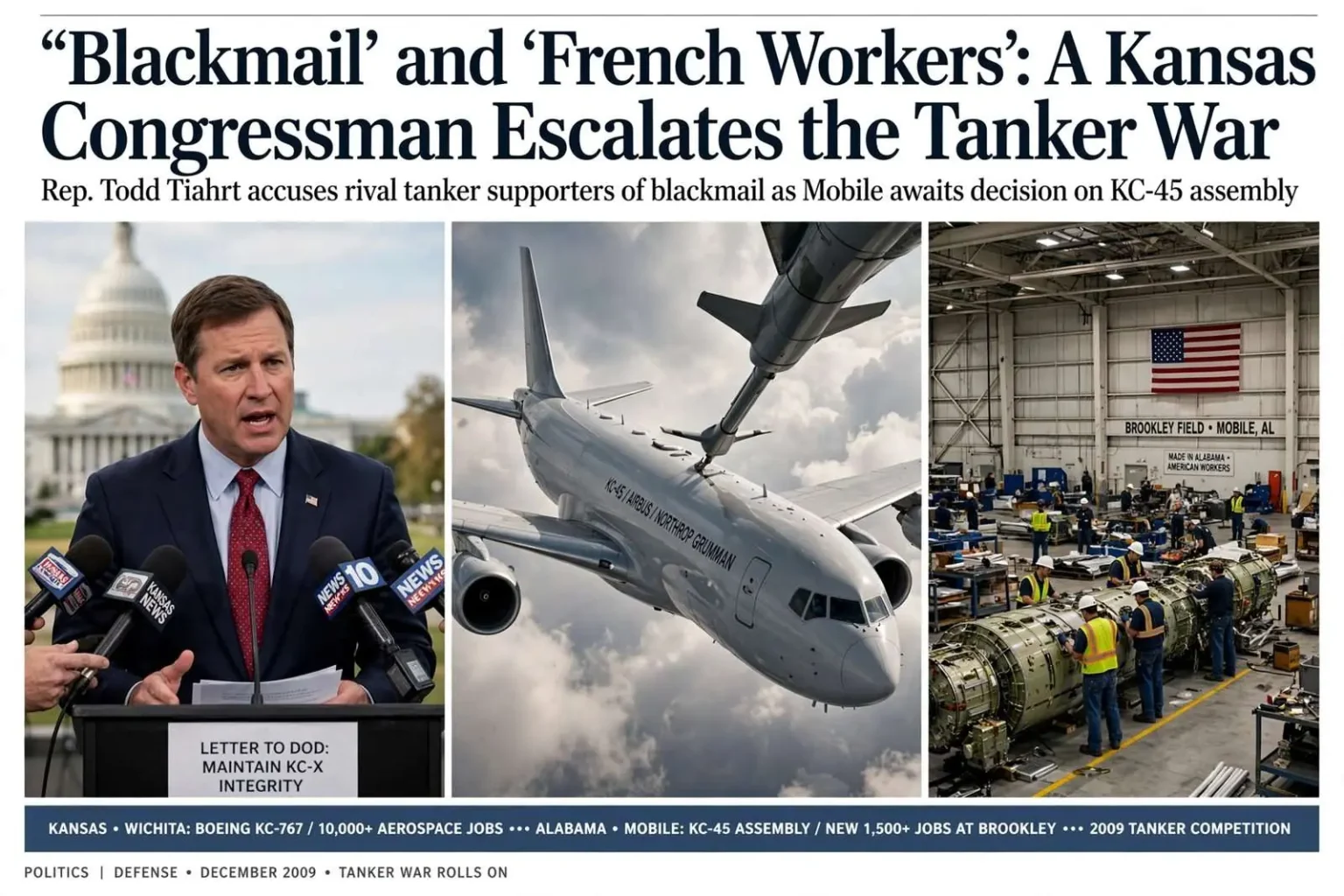
Mobile spent the week answering Sen. Patty Murray of Washington, who had told a national radio audience she had never seen anyone in Alabama build anything. But Murray was, at most, a challenger for the title. The reigning champion of anti-Airbus rhetoric on Capitol Hill remained U.S. Rep. Todd Tiahrt of Kansas. Tiahrt, whose district includes Wichita — where Boeing would perform substantial work on its KC-767 tanker — was not conceding the crown. This week he accused supporters of the rival aircraft of trying to blackmail the United States Air Force. For Mobile, a city that had spent years building its economic hopes around winning the tanker, the week was another round in a fight it could not afford to sit out and could not win from the floor of Congress.
The accusation
“Supporters of a French tanker, such as Senator John McCain, have continued using blackmail efforts to pressure the Air Force to change its requirements in favor of an Airbus platform,” Tiahrt said. He said that he, Sen. Sam Brownback and Sen. Pat Roberts had written to the Under Secretary of Defense for Acquisition urging him to “maintain the integrity of the KC-X Tanker program and reject these latest blackmail efforts that would skew the competition toward French workers.”
“The Air Force undoubtedly knows the essential requirements for a medium size tanker and the needs of the warfighter better than Senator McCain or any competitor,” Tiahrt continued, “and should reject all blackmail attempts to skew this competition toward Airbus. If Airbus decides it cannot meet the needs of the Air Force, the Department of Defense should not delay in awarding the contract to the American-made Boeing KC-767.” The letter and the rhetoric were two halves of one strategy: a formal objection for the Pentagon, a quotable version for the press. By framing the competition as America against France, the Kansas delegation put every member of Congress who wanted defense jobs in their district on notice that supporting the Northrop bid meant defending a foreign company.
The rhetoric worked precisely because it blurred a distinction that meant everything in Mobile. EADS — the European aerospace parent of Airbus — was indeed the designer of the rival airframe. But the aircraft Tiahrt kept calling a “French tanker” was to carry an American flag, an American air force serial number, and an Alabama assembly line.
What Mobile heard
The phrase “French workers” was the point, and everyone in Mobile knew it. The aircraft in question, the Northrop Grumman/EADS KC-45, was to be assembled in Alabama, at Brookley Field on the western shore of Mobile Bay, by American workers hired in Mobile County. The Airbus parentage of the airframe was real; so were the jobs, which would have been the largest single industrial employment event in the city’s modern history. A city that had spent half a century watching its Navy yard close and its manufacturing base thin out was being told, in effect, that the biggest thing to happen to it in generations was somehow foreign.
Recasting an Alabama assembly line as a French one was a rhetorical strategy, and an effective one in a procurement fight that was ultimately being decided by politics as much as by engineering. Members of Congress who would never cast a vote on the tanker contract nonetheless shaped the climate in which the Air Force and the Office of the Secretary of Defense made their decisions, and a sustained drumbeat about foreign work shaped that climate profoundly. The Northrop/EADS team answered each round with fact sheets about American suppliers in dozens of states, but fact sheets travel badly while chants travel well.
Mobile’s officials, from the mayor to the county commission, spent much of 2009 and 2010 trying to break that framing — pointing to the engineering center already operating at Brookley, to the aircraft maintenance work done in Mobile on Boeing airliners, and to the Coast Guard aircraft serviced near Mobile Regional Airport. The rebuttal was meant to establish a simple fact: Alabama already built and fixed airplanes. The engineering center at Brookley had put Gulf Coast workers into design and analysis work supporting commercial aircraft programs, and the maintenance facilities around the city serviced airframes — including Boeing’s own — for carriers from around the world. The irony that Boeing jets were regularly tended by Mobile mechanics was a staple of the city’s argument.
Tiahrt had reasons to be loud beyond the merits. He was running for the U.S. Senate in Kansas in 2010 and, according to polling at the time, trailing in the Republican primary. In Wichita, a city whose identity is bound up with aircraft manufacturing, no position was safer or more useful than an aggressive defense of Boeing. Wichita had spent decades as one of the great centers of American aviation, and every politician in the state knew that the fastest route to a photogenic defense of Kansas jobs ran through the tanker program.
That, in miniature, was the whole tanker fight. Two American regions, each with tens of thousands of aerospace jobs at stake, each with a congressional delegation whose political survival depended on delivering. Washington state had Boeing’s commercial empire and its union workforce; Kansas had the Wichita plant and its supplier chain; Alabama had the promise of a brand-new assembly complex and the desperation of a state that had lost its textile and apparel jobs and needed heavy industry to replace them. Each delegation told the Pentagon the same essential thing — that its state was where American defense work belonged — and each treated the other’s bid as, by definition, unfair.
The Air Force’s requirement — a replacement for a fleet of KC-135 tankers then more than fifty years old — was the least contested fact in the entire debate. The tanker fleet dated to the Eisenhower era, and the aircraft that kept bombers in the air and fighters fed over Afghanistan and Iraq were, by any measure, at the end of their service lives. Everyone agreed a replacement was overdue. The fight was over who would build it, where the work would land, and whose requirements — sized to whose airframe — the Air Force would write into the contract.
McCain in the middle
Tiahrt’s naming of John McCain was pointed. The Arizona senator had been the original scourge of the tanker program, having exposed the sole-source leasing arrangement earlier in the decade that ended with Boeing and Defense Department officials prosecuted and, in some cases, imprisoned. The scandal had forced the Air Force to cancel the first tanker deal, put procurement officials in federal court, and begin again — this time, at McCain’s insistence, under rules designed to guarantee genuine competition rather than a pre-arranged winner.
McCain’s insistence on a genuinely competitive process was, from the Boeing camp’s perspective, indistinguishable from advocacy for Airbus. If the competition was truly open, the European-designed airframe assembled in Alabama could win; therefore, in the Kansas and Washington reading, openness itself was the tilt. From Mobile’s perspective, it was the only reason the city was in the running at all. Without the scandal and the reformed rules, there would have been no competition to enter — Boeing would have kept the work it had arranged for itself.
The Defense Department’s revised request for proposals was in a comment period. Alabama’s delegation, led by Sen. Jeff Sessions, was arguing that the new rules had been rewritten to favor the smaller Boeing aircraft — that the sizing, range and fuel requirements as drafted described the KC-767 rather than the larger, more capable KC-45. Kansas and Washington were arguing that the process was being bent the other way, tilted toward an airframe designed abroad. Both sides could not be right. But both, for the moment, were being heard.
For Mobile, the stakes in the comment period were measured in more than the assembly line itself. The aerospace complex the city had been assembling — the engineering center, the maintenance operations, the suppliers lining up near Brookley — would consolidate or collapse depending on whether the final assembly work came. Officials in the mayor’s office and the county commission kept their public tone measured while the delegations traded charges, knowing that the Pentagon had absorbed a decade of tanker politics before and that the final decision would be made in offices none of them could enter. The week’s episode — a senator’s insult answered by a congressman’s accusation — was background noise with a soundtrack the city could not turn off.
The episode also illustrated how much the tanker war had changed the politics of the Gulf Coast. Alabama’s delegation, split between parties, had unified behind the Northrop/EADS bid with a discipline the state’s politicians rarely manage on any issue. Sessions made the Pentagon’s sizing criteria a personal project, walking colleagues through charts comparing the two aircraft’s fuel offload and range. House members from both parties echoed the same numbers. Whatever else the tanker did for Mobile, it briefly made the state’s Washington presence speak with one voice — a voice the Pentagon could not dismiss as easily as a single city’s Chamber of Commerce.
Across the bay and the years, the fight had already taught Mobile’s civic leadership lessons about how defense procurement really works. Contracts of this size are decided not once but repeatedly — through requests for proposals, comment periods, source selections, protests and appeals — and each stage is a fresh opportunity for a rival delegation to bend the outcome. The city had watched a previous Northrop/EADS victory in the competition get overturned on appeal after Boeing’s protest, and had learned that winning the aerial refueling tanker contract once guaranteed nothing. That experience hung over every exchange of the current round, including Tiahrt’s.
For the record, Mobile’s response to Murray’s remark had been quieter than its response to Tiahrt’s, largely because there was less in it to answer. Her comment, made in passing on a national radio program, was simply wrong as a matter of fact — the city had built ships, aircraft components and heavy industry for a century — and local officials corrected it without savoring the moment. The Tiahrt letter, by contrast, went to the decision-maker, arrived on official stationery over three signatures, and used language — blackmail, French workers — designed to stick. In a procurement fight, the second kind of noise matters more, and everyone involved understood which of the week’s insults had actually put something at risk.
The week ended as most weeks of the tanker war had: with the aircraft unchanged, the KC-135s still flying, the comment period still open, and two states’ delegations still arguing that the other’s tanker was un-American. Mobile kept its message focused on the only fact it could control — that if the contract came, the planes would be built by Alabamians, on the western shore of Mobile Bay, at the field where the city’s aerospace hopes had gathered — and waited for the Pentagon’s next move in a competition that had already outlasted two secretaries of Defense and looked prepared to outlast the decade.