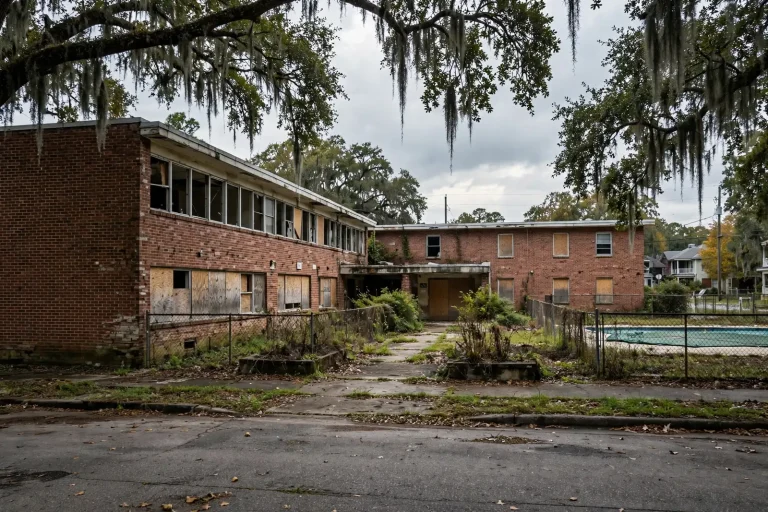
Traveling Exhibit on Willard Psychiatric Center Patients Opens at Mobile Government Plaza
A free exhibit on the lives of Willard Psychiatric Center patients, told through suitcases found in the hospital's attic, runs through Nov. 12 in Mobile.
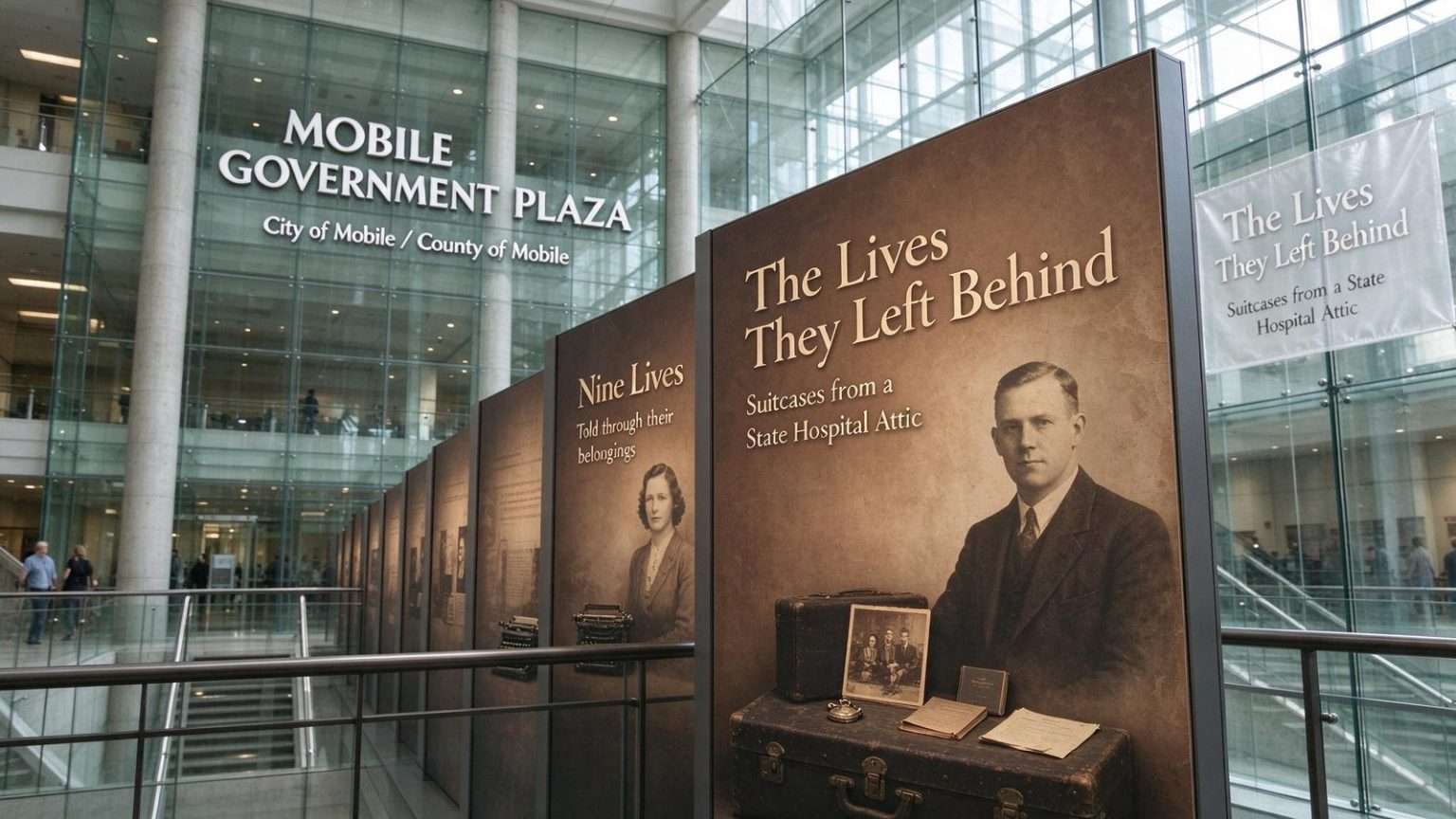
A free traveling exhibit exploring the lives of psychiatric patients institutionalized decades ago is on display at the Mobile Government Plaza atrium through Nov. 12, offering local residents a rare, personal look at the history of mental health treatment in America.
“The Lives They Left Behind: Suitcases from a State Hospital Attic” is presented locally by the National Alliance on Mental Illness (NAMI) of Mobile, AltaPointe Health Systems and NAMI Alabama. Admission is free.
The exhibit’s stop in Mobile brings it to one of the city’s most public spaces. The Government Plaza atrium — the shared home of Mobile’s city and county governments downtown — draws a daily flow of residents conducting business with municipal and county offices, and exhibits mounted there reach an audience that might never seek out a museum. Organizers say that accessibility is part of the point: the stories on display belong to ordinary people, and they are being shown in an ordinary civic place.
The local partners each bring a stake in the subject. AltaPointe Health Systems serves as the regional provider of mental health and substance abuse services across Mobile and surrounding counties, operating outpatient programs, crisis services and community support for thousands of residents each year. NAMI Mobile and NAMI Alabama are affiliates of the nation’s largest grassroots mental health advocacy organization, run by families and individuals with lived experience of mental illness.
427 forgotten suitcases
The exhibit grew out of a discovery made in 1995, when workers closing New York’s Willard Psychiatric Center in the Finger Lakes region found 427 suitcases, trunks, crates and bundles stored in the facility’s attic. The items had belonged to patients committed to the institution, some of whom lived out their entire lives there.
Willard, which opened in 1869 on the shore of Seneca Lake, was for more than a century one of New York’s principal institutions for people with mental illness. Its closure in 1995 marked the end of an era in American institutional care, and the attic discovery came as staff prepared the sprawling campus for its transition to a state correctional facility. The suitcases — many never reclaimed by families who had long since lost contact — held the ordinary belongings of lives interrupted: work clothes, photographs, letters, tools, keepsakes.
The find led to a decade-long research project by Darby Penney, a leader in the human rights movement for people with psychiatric disabilities, and Dr. Peter Stastny, a psychiatrist and documentary filmmaker. The two studied the belongings and pieced together biographies of the people who once owned them.
Cinematographer Lisa Rinzler documented the artifacts for the project, which later became a book published by Bellevue Literary Press and the traveling exhibit now on display in Mobile.
Nine lives, told through their belongings
The exhibit centers on nine patients who were committed to Willard and died there. Seven-foot-high panels display a portrait of each person alongside their life story, photographs and items from their suitcases, giving visitors a window into who they were before they were institutionalized.
The nine profiles span the decades of institutional care in New York, and each tells a version of the same pattern: admission in young or middle adulthood, often following an episode that families of the era had few resources to manage, followed by years — sometimes a lifetime — inside the hospital’s walls. The suitcases suggest lives that were expected to continue: packing that anticipated a return home that never came.
According to Penney, mental health history “is almost always told by psychiatrists and hardly ever by patients or through patients’ lives,” making the project unusual in centering patients’ own stories. The biographies reconstruct individuals as workers, immigrants, parents and neighbors — details drawn from hospital records, census documents and the objects themselves — rather than as case files defined by a diagnosis.
That reframing is what has distinguished the exhibit as it has traveled. Rather than a history of psychiatric medicine, it is a history of people, displayed through the things they carried with them on the day they were committed.
Bringing the exhibit to Mobile
The Exhibition Alliance, based in New York City, and The Community Coalition manage the traveling exhibit and bring it to venues around the country. Its installation in Mobile resulted from the partnership among the local NAMI affiliate, the statewide organization and AltaPointe, whose staff see the exhibit as an educational tool for a community still grappling with how mental health care is delivered.
Alabama’s own history gives the display particular resonance here. The state’s Bryce Hospital in Tuscaloosa, opened in the same era as Willard, became the subject of a landmark federal lawsuit in the 1970s — Wyatt v. Stickney — that established a constitutional right to treatment in state psychiatric institutions and reshaped mental health law nationwide. The deinstitutionalization that followed emptied hospitals like Bryce and Willard, transferring care to community providers such as AltaPointe.
Exhibit organizers say the comparison is not an accusation but a lesson: the suitcases document what happened when care was institutional and distant, and they invite visitors to consider what community-based care owes the people it serves today.
What visitors will see
The atrium installation places the nine panels in a walkable sequence, allowing visitors to move from one life story to the next as they would through a gallery. The scale of the panels — seven feet high — makes the portraits the exhibit’s most immediate element: faces of men and women photographed in the primes of their lives, often decades before their deaths at Willard.
Alongside the portraits, the displayed suitcase contents make the stories tangible. Visitors will see the objects each person carried — clothing appropriate to a trade, family photographs, handwritten letters, small personal possessions — each item tied to the biography on the panel. The photograph documentation by Lisa Rinzler, whose work on the project captured the artifacts with the care of a film cinematographer, renders the objects in detail that preserves their wear and use.
The exhibit requires no prior knowledge of mental health history. Organizers designed it for general audiences — school groups, government employees passing through the atrium, families — and the free admission removes any barrier to visiting during a lunch hour or between errands at the plaza.
Why the story matters now
Mental health advocates in the Mobile area see the exhibit as a counterweight to the stigma that still surrounds mental illness. More than a century after Willard received its first patients, advocates say, families confronting a psychiatric diagnosis still encounter isolation and misunderstanding, and the exhibit’s subjects — remembered now as full people — illustrate the cost of a system that once simply removed people from their communities.
The timing also connects to modern policy questions. Community mental health care in Alabama remains stretched: crisis services, supportive housing and community providers like AltaPointe absorb demand that once would have been routed to state hospitals, and advocates argue that funding decisions made at the state level determine whether the mistakes of the institutional era are repeated in new forms, including homelessness and incarceration.
NAMI affiliates across the country have used the exhibit as a starting point for those conversations, pairing displays with panel discussions involving providers, families and people in recovery. Mobile’s presentation through Nov. 12 gives local organizations a multi-week window to bring groups through the atrium.
The atrium setting also gives the exhibit a symbolic weight that organizers did not have to manufacture. The decisions about mental health funding, courts and services that shaped lives like those on display are made in buildings exactly like the one hosting the exhibit — by elected officials, judges and agency staff who walk past the panels each day the display is up.
Visit information
The exhibit is free and open to the public during Government Plaza’s regular hours through Nov. 12. The plaza building, which houses Mobile’s city hall and county government functions, is accessible downtown, and visitors are invited to view the display at their own pace.
Organizers encourage educators and group leaders to contact the presenting organizations to arrange visits, and materials accompanying the exhibit provide context for discussions about the history of mental health care and the services available in the Mobile area today. Information about AltaPointe’s programs and NAMI’s local support groups is available through the presenting partners for anyone whose visit raises questions about mental health services in the region.
For the families of the nine patients profiled, the exhibit’s travels have occasionally produced something unexpected: relatives who never knew what became of an ancestor encountering, in a public building in another state, a photograph and a biography that finally answered a generations-old family question. Organizers say those moments justify the decade of research behind the project.
The exhibit leaves Mobile on Nov. 12, continuing its national tour carrying the stories of the nine Willard patients — and the 427 suitcases behind them — to the next community willing to look.