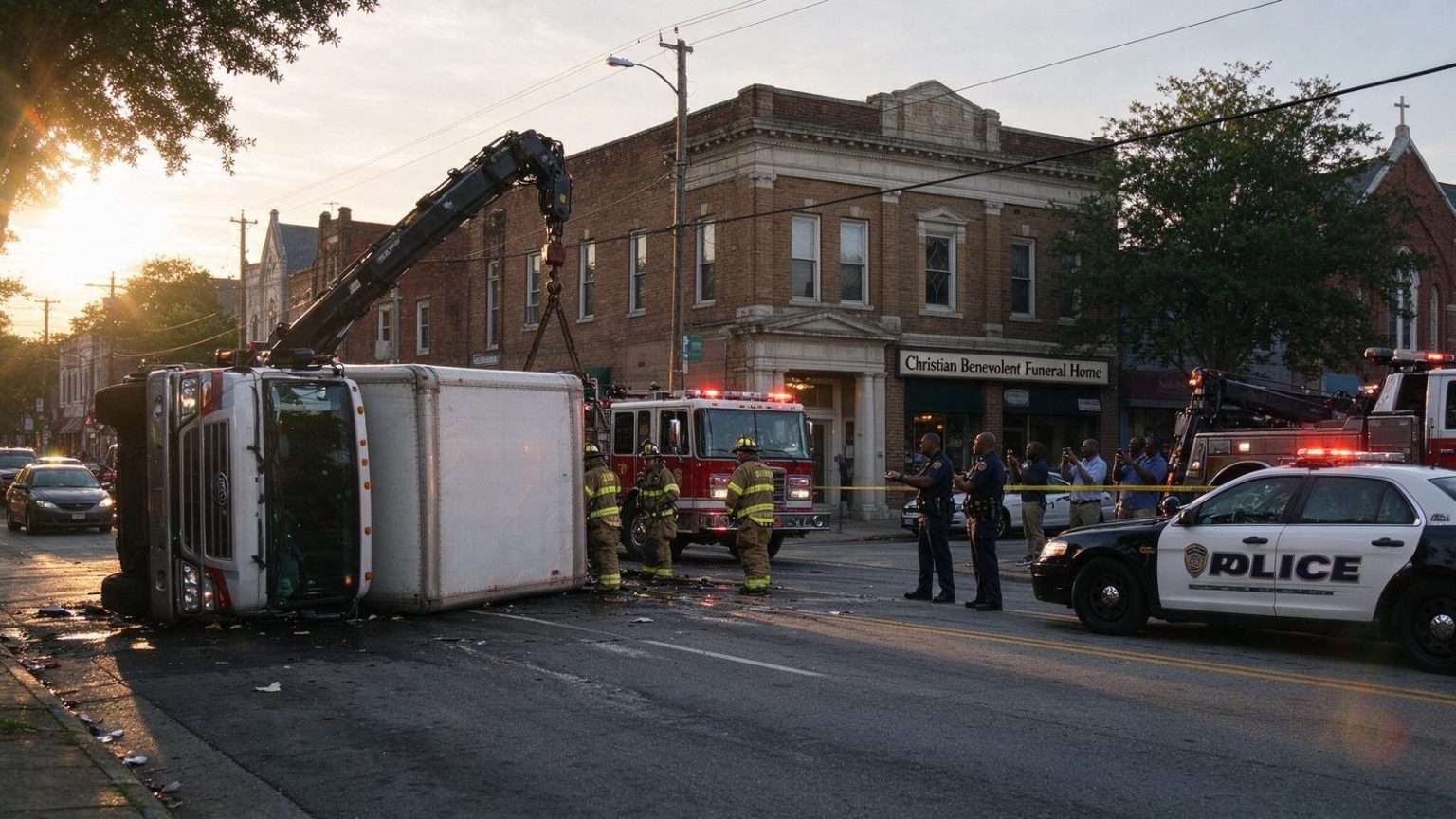
MOBILE, Ala. — A truck overturned in front of Christian Benevolent Funeral Home on Hamilton Street in Mobile on Sunday afternoon. The crash happened a little before 5 p.m. The driver was transported to the hospital, and the extent of their injuries was not immediately known.
Hamilton Street runs through a busy section of Mobile just west of downtown, an area where neighborhood streets, medical district traffic and downtown commuter routes converge. Christian Benevolent Funeral Home is a long-established institution in the city, among the most recognized African American funeral homes on the Gulf Coast, and its location on Hamilton Street is well known to residents across the area. The sight of an overturned truck in front of the landmark building drew onlookers as fire and police crews responded to the scene.
Responding to an Overturned Vehicle
Overturned vehicle crashes require a significant response even when injuries appear minor. Mobile Fire-Rescue units typically handle stabilization of the vehicle, control of any fluid spills, and extrication if the driver or passengers are trapped, while police manage traffic around the scene. On a street like Hamilton, which carries steady local traffic connecting downtown Mobile with the neighborhoods to the west, crews must often close a lane or the full block while a heavy tow truck rights the vehicle, a process that can take an hour or more.
Injuries in rollover crashes vary widely depending on the type of truck involved, the speed at the time of the overturn, and whether the occupant was restrained. Pickup trucks, box trucks and commercial vehicles have higher centers of gravity than passenger cars, making them more susceptible to rolling over in sharp evasive maneuvers or when wheels drop off the pavement edge. Mobile’s older street grid, with its narrow lanes and frequent intersections, adds conditions that demand driver attention, particularly on weekend afternoons when pedestrian and vehicle traffic mixes near businesses and churches.
The driver was transported to a local hospital for evaluation. In Mobile, that generally means University of South Alabama Medical Center or Providence Hospital, depending on the nature of injuries and the direction of transport. Authorities did not immediately release the driver’s condition, and police typically hold details until the initial investigation is complete and family members have been notified of any serious injuries.
Traffic and the Neighborhood Context
The area around Hamilton Street sits near the heart of Mobile’s historic African American business district, a stretch of the city that has been shaped by institutions like Christian Benevolent Funeral Home for generations. The funeral home has served families across the Gulf Coast for decades and anchors a corridor of churches, small businesses and community organizations. A crash directly in front of such a well-known landmark naturally generates attention and concern among residents who know the building and the street well.
Sunday afternoon crashes in Mobile frequently occur during lulls in traffic when speeds run higher than weekday conditions, and investigators weigh factors such as speed, distraction, vehicle condition and road surface when reconstructing how a truck ended up on its side. In cases where a commercial vehicle is involved, police may also coordinate with the company that owns the truck and, when applicable, state commercial vehicle enforcement officers who inspect the vehicle for mechanical violations.
Motorists who encountered the scene Sunday evening faced temporary closures and detours while crews worked. Residents of the neighborhood are accustomed to occasional disruptions on the corridor, but officials urged drivers to slow down and give emergency workers room, noting that secondary crashes near scene work zones are among the most preventable dangers responders face. Anyone who witnessed the overturn was encouraged to contact Mobile police as investigators compiled their account of what happened.
As the scene was cleared and the truck removed, the street returned to normal traffic patterns. The investigation into the cause of the crash remains open, and further details about the driver’s condition and any contributing factors were expected as police completed their work.
Rollover Crashes and Road Safety in Mobile
Mobile’s traffic engineers and safety planners have long focused on the corridors that connect downtown with the city’s western neighborhoods, where older streets were built for lighter traffic than they now carry. Rollover crashes, while less common than rear-end or angle collisions, produce a disproportionate share of serious injuries because occupants are subjected to violent motion and partial ejection risk when unrestrained. Seat belt use remains the single most effective protection in a rollover, something Alabama’s “Click It or Ticket” campaigns have promoted for years across Mobile County.
Emergency response in the city is structured around Mobile Fire-Rescue’s network of stations, which places engine and rescue companies within minutes of most neighborhoods, including the area around Hamilton Street. For an overturned truck, the first-arriving company assesses whether fuel or other fluids are leaking, whether the vehicle is stable, and whether occupants require extrication. Mobile police then take over the crash investigation, documenting the scene and interviewing witnesses before the roadway is fully reopened.
Heavy recovery adds another layer to such incidents. Rigging an overturned truck for uprighting requires specialized tow equipment and trained operators, and the process is deliberate — a rushed recovery can damage underground utilities at the curb line or cause the load to shift. Crews typically sweep the roadway for debris and apply absorbent material to fluid spills before allowing traffic back through, which is why blocks in front of rollover scenes stay closed longer than many drivers expect.
For the neighborhood around Christian Benevolent Funeral Home, the Sunday incident passed without damage to the landmark building, and life on the corridor resumed its usual rhythm. The crash stands as a reminder for Mobile drivers: urban streets demand the same attention as highways, and the difference between a towed vehicle and a hospital trip often comes down to speed, restraint use and the moments before a truck begins to tip.
Commercial and work trucks are a daily presence on Mobile’s inner streets, serving the city’s port-related industries, construction sites and service businesses. Safety officials note that trucks operating on city streets face challenges distinct from highway driving: frequent stops, tight turns at older intersections, and interactions with pedestrians and parked cars along commercial corridors. When a truck overturns on such a street, investigators look closely at load weight and distribution, since an unbalanced or shifting load is among the most common contributors to a tip-over at low speed.
Witnesses to Sunday’s crash described a scene that unfolded quickly, with emergency vehicles arriving within minutes of the first calls. Bystanders gathered along the sidewalk in front of the funeral home as responders worked, a familiar pattern in a neighborhood where porches and storefronts look out on one of the city’s busiest local corridors. Police asked onlookers to remain clear of the scene while the truck was stabilized, noting that overturned vehicles can shift unexpectedly during recovery.
What Drivers Can Expect After a Crash Like This
After a truck overturn in an urban district, the sequence of events follows a standard pattern. Once patients are transported, the police crash investigation unit photographs the scene, measures skid and gouge marks, and interviews witnesses before vehicles are moved. If a commercial vehicle is involved, an inspection of the truck’s brakes, tires and load securement may follow. The driver’s information, insurance and any potential citations are handled through the police report, which becomes available through the department’s records process once approved.
Businesses and institutions along a closed block feel the disruption immediately. Sunday afternoon is among the busiest times for a funeral home, with visitations and services scheduled throughout the day, and a crash scene at the curb can complicate access for families arriving for services. In this case, crews worked to reopen the street as quickly as the recovery allowed, and the funeral home’s operations continued as scheduled.
Mobile police periodically report crash statistics to the city’s traffic safety committee, and corridors like Hamilton Street are reviewed when patterns of serious crashes emerge. Improvements such as added signage, signal retiming and speed feedback displays have been deployed on various city streets in recent years as part of the city’s broader effort to reduce injury crashes. None of those measures can eliminate driver error, officials acknowledge, but they are aimed at reducing the severity of the crashes that do occur.
As for the driver transported from the scene, hospital officials did not release information, consistent with privacy laws governing patient records. Police said the investigation was continuing and asked anyone with additional information, including dashboard camera footage from vehicles passing the area shortly before 5 p.m., to come forward. Such footage has become an increasingly valuable tool for investigators reconstructing urban crashes in Mobile and across the country.