Record Crowd Packs Ladd-Peebles for Presidential Campaign Rally
Ladd-Peebles Stadium drew one of Mobile's largest single-night crowds in years for a 2015 presidential campaign rally that spilled well beyond expectations.
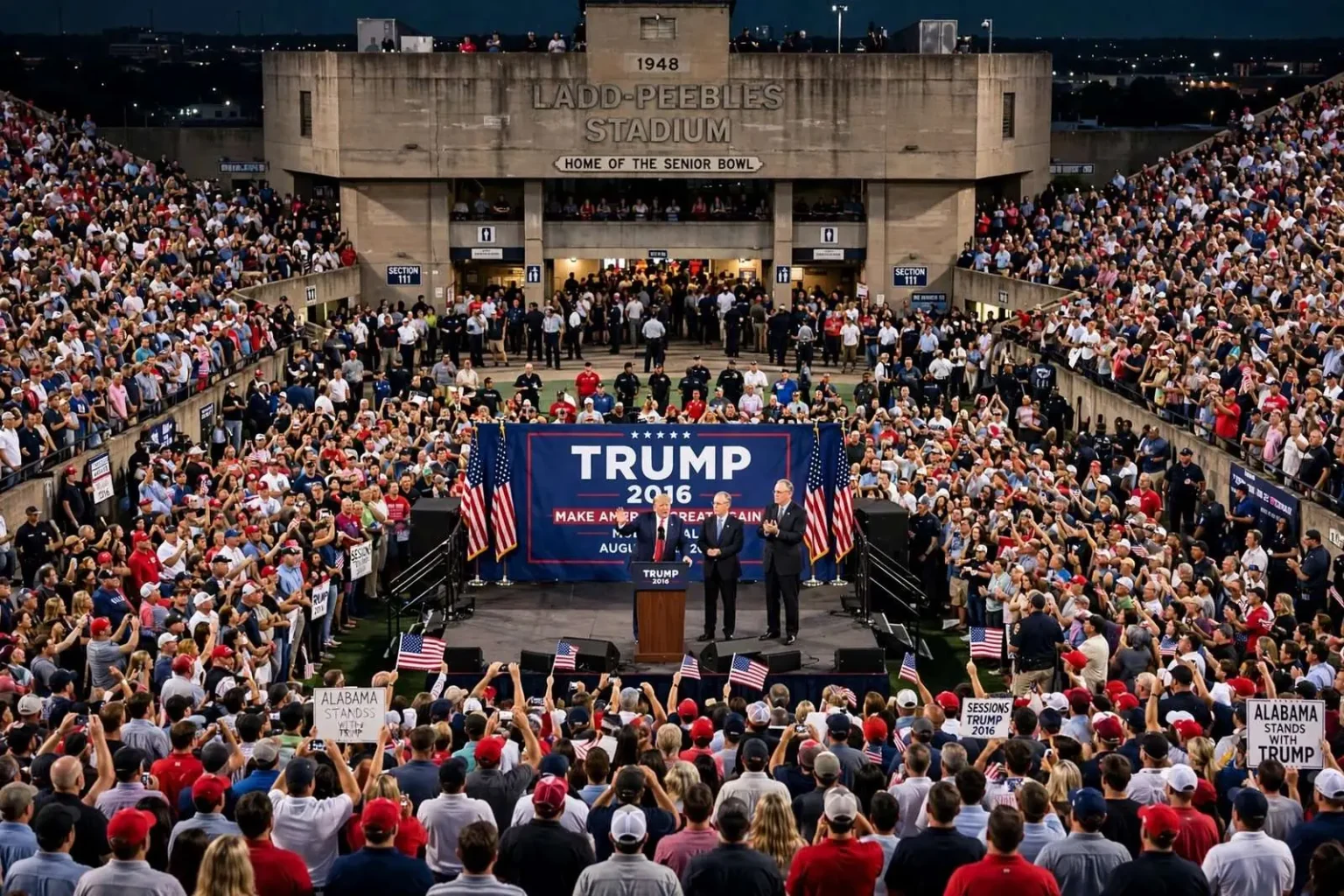
Ladd-Peebles Stadium filled to a size rarely seen outside of Senior Bowl week when a presidential campaign rally drew tens of thousands of people to Mobile on a Friday night in August 2015. The event, staged by Donald Trump’s upstart Republican campaign, brought the real-estate developer turned candidate to a Gulf Coast city that rarely lands a visit from a major-party presidential contender, much less one in the thick of a primary fight. Gates opened at 5 p.m., and by the scheduled 7 p.m. start, the stands and field-level areas around the historic Ann Street stadium were packed with attendees from across the region.
Traffic backed up on nearby streets for hours as drivers searched for parking near the venue, a rare sight for a stadium more commonly associated with high school and college football. The gridlock stretched well beyond the immediate neighborhood, snarling intersections along Ann Street and the surrounding corridors as cars circulated looking for any open patch of pavement. Many attendees abandoned their cars blocks away and walked in, joining rivers of supporters streaming toward the gates as the evening wore on. Residents who live near the stadium are used to football traffic a handful of Fridays each fall, but nothing on the scale of what arrived that night.
Mobile Mayor Sandy Stimpson acknowledged the buzz building around the city in the days leading up to the event, telling a radio interviewer that the rally had “got the city all stirred up.” City departments coordinated on traffic control and public safety in the areas surrounding the stadium as the crowd swelled well past initial estimates. Police officers directed intersections that are routinely unstaffed, fire and rescue units stood by in case of heat-related emergencies among the packed crowd, and public works crews handled the cleanup that followed the late-night exodus from the venue.
U.S. Sen. Jeff Sessions of Alabama appeared alongside the candidate during the event, drawing loud applause from the crowd gathered on the stadium turf and in the stands. Sessions, whose hardline positions on immigration had made him a favorite of the conservative grassroots, had emerged as one of the first sitting senators to embrace Trump’s campaign, and his presence on the stadium field lent the stop an added layer of significance for Alabama Republicans. The warm reception for both men underscored how receptive the Gulf Coast’s conservative base had become to the message that was reshaping the 2016 primary field.
A Move to the Big Stadium
The evening capped days of anticipation that began when the event was first announced for a much smaller downtown venue before ticket demand forced a move to the stadium. Organizers initially booked a space that could hold a few thousand people, but requests for tickets quickly overwhelmed the plan, and the rally was shifted to Ladd-Peebles, whose capacity dwarfs any indoor venue in the city. Even at the larger site, attendance pushed well beyond what many in the campaign’s local operation had expected, with lines stretching out of the parking lots long before the program began.
The relocation itself became part of the story, a tangible measure of the enthusiasm the campaign was generating in a region not usually on a presidential candidate’s summer itinerary. Primary-season stops in Alabama are traditionally brief airport hangar appearances or party dinners, not stadium rallies on a Friday night in August. The scale of the demand signaled to political observers that the Gulf Coast would be a contested and consequential corner of the upcoming March 1, 2016, SEC Primary, the regional round of voting that included Alabama and much of the South.
A Stadium Built for Football
For Ladd-Peebles, built in 1948 and long a fixture of Mobile’s sports and civic life, the rally marked one of the largest non-athletic gatherings the facility has hosted. The stadium has spent decades as the region’s premier football address, hosting the Senior Bowl each January, college bowl games, high school championships and, in the early years of the University of South Alabama’s football program, the Jaguars’ home games. Gospel concerts and other large public events have occasionally filled the venue, but a political rally drawing a football-sized crowd was unprecedented in its modern history.
Stadium staff and Mobile police worked together to manage the flow of attendees in and out of the venue, an operation more typical of Senior Bowl or high school playoff crowds than a weeknight campaign stop. Security screening funneled thousands of arrivals through a limited number of entrances, and campaign volunteers directed crowds on the field while police maintained perimeters in the parking areas. The cooperation between city personnel and stadium staff kept the evening free of major incidents despite the sheer size of the crowd and the summer heat that hung over the event from start to finish.
The stadium’s place in Gulf Coast memory made the setting fitting. Generations of Mobilians have watched championship teams, bowl games and graduating classes cross its turf, and the venue’s role as a civic gathering spot extends well beyond sports. Filling it for a political event drove home how large the rally had grown: every seat, every stretch of railing and a wide swath of the field itself were claimed by attendees who kept arriving after the program began.
The Local Economic Ripple
Local business owners near the stadium reported a noticeable bump in evening traffic as attendees arrived early and lingered afterward. Restaurants and convenience stores in the surrounding neighborhoods absorbed the overflow of a crowd that had hours to fill before and after the program, and vendors working the area did brisk business in water, snacks and campaign merchandise. For a strip of Mobile that sees its heaviest traffic on autumn Fridays, the rally delivered a mid-August economic jolt that business owners typically associate only with football season.
The rally’s footprint reached beyond the stadium itself. Hotels across the city filled with campaign staff, traveling media and supporters who made the trip from along the Gulf Coast, and local broadcasters devoted hours of live coverage to an event that dominated the region’s news cycle for days. For a city that had spent years working to attract national attention for its port, its aerospace sector and its revitalized downtown, the sudden international spotlight — however unplanned — offered a preview of the attention that comes when a community lands on the national political stage.
Scale That Stood Out in a Parade City
For a city accustomed to hosting Mardi Gras crowds and football weekends, the scale of the rally still stood out, with many longtime residents saying they could not recall another political event drawing a comparable turnout to a Mobile venue. Mobile knows how to absorb big crowds — its Carnival season fills downtown streets with hundreds of thousands of revelers each winter, and Senior Bowl week brings the nation’s football attention to the city every January. But those crowds build over weeks and come with elaborate municipal routines. A single political event assembling a football crowd overnight, with days of notice, was something else entirely.
The comparisons being drawn by residents reflected that uniqueness. Downtown Mardi Gras processions draw their crowds to the streets for a few hours at a time; a stadium rally concentrated the same energy into a fixed venue with one way in and out. Even attendees who had parked in the same lots for decades of football games described the evening as unlike anything they had experienced at the stadium, from the length of the lines to the diversity of the crowd, which included curious onlookers alongside committed supporters.
Mobile on the National Stage
The event added Mobile to a short list of Alabama cities to host a major-party presidential contender that election cycle, a distinction city leaders noted as a reflection of the region’s growing visibility on the national stage. Huntsville and Birmingham had drawn candidate visits in earlier cycles, and the state’s March 1 primary gave campaigns a reason to court Alabama voters in person. For Mobile, landing a stadium-scale rally confirmed what civic leaders had been arguing for years: the city’s population base, its venues and its media market made it a natural stop for anyone competing seriously for votes in the Gulf South.
The night also left its mark on the 2016 race in Alabama. The enthusiasm displayed at Ladd-Peebles foreshadowed the candidate’s decisive win in the state’s primary the following March, when Alabama Republicans delivered one of his largest margins of the entire nominating contest. Political organizers on both sides pointed back to the Mobile rally as the moment the scale of the movement became visible on the Gulf Coast, and the image of a packed football stadium on a summer Friday night became a fixture of the campaign’s story of grassroots momentum.
Long after the last supporters filed out of the parking lots, the rally remained a reference point in Mobile — a measure of the city’s ability to stage major events and a reminder that national politics, for one Friday night in August 2015, had chosen Ladd-Peebles Stadium for its stage.