Tuskegee Edges Fort Valley State 24-23 as the Port City Classic Fills Ladd-Peebles Again
Lorcan Ryans’ 35-yard field goal on the final play capped 17 unanswered points as Tuskegee erased a 16-point deficit to beat Fort Valley State 24-23 in the Port City Classic at Ladd-Peebles Stadium.
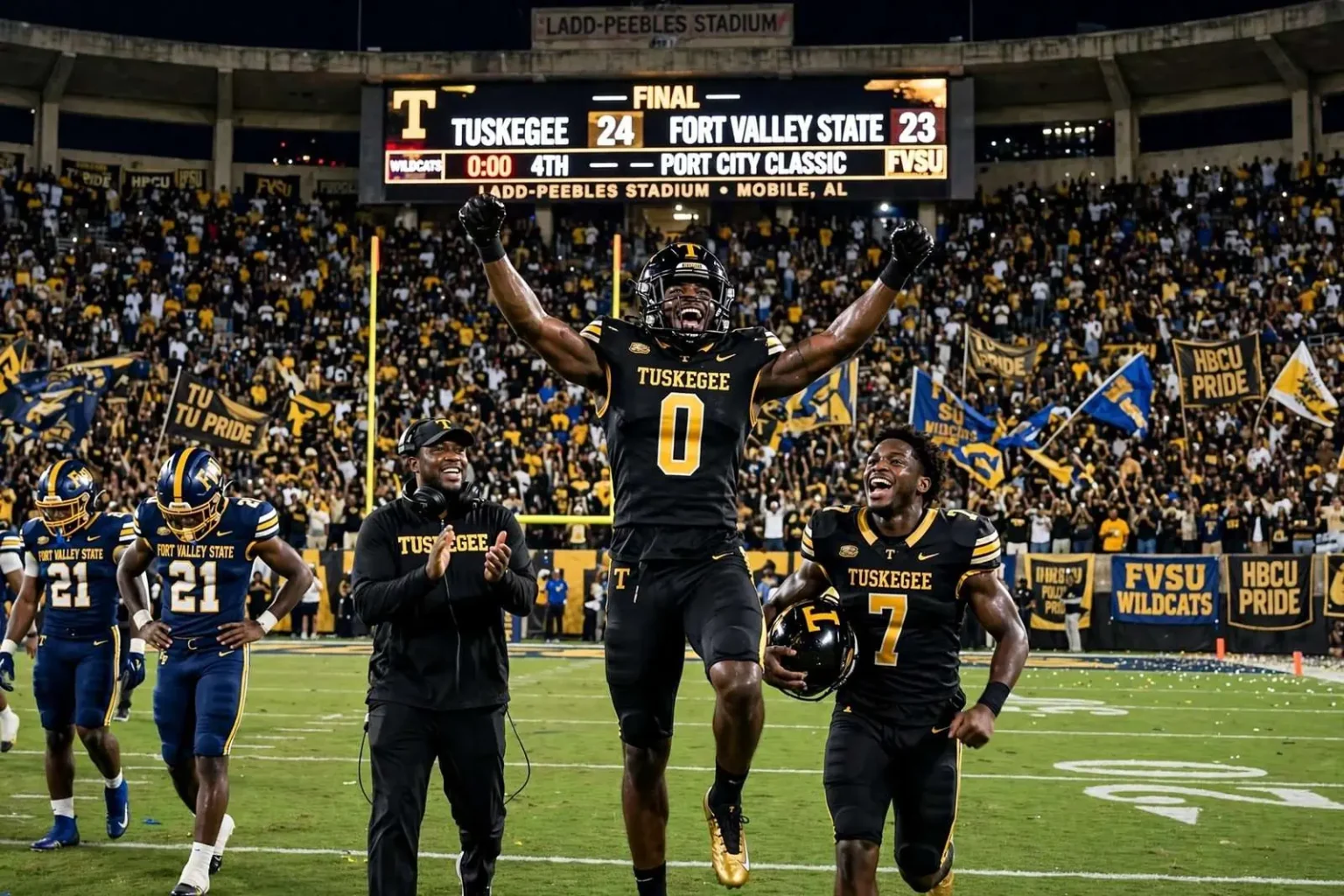
Tuskegee University trailed by 16 points with 14 minutes and 13 seconds left to play in the Port City Classic. It won the game on the last snap of the night.
Lorcan Ryans’ 35-yard field goal on the final play lifted the Golden Tigers past the Fort Valley State Wildcats 24-23 on Saturday night at Ladd-Peebles Stadium, capping 17 unanswered points and a comeback that turned a game Fort Valley State appeared to have in hand into the closest finish the classic has produced.
The scoreboard at Ladd-Peebles Stadium read 24-23 when it was over, which is about as close as an annual rivalry showcase can get without going to overtime. Tuskegee University held on to beat Fort Valley State in this year’s Port City Classic, capping a weekend that turned Mobile into a destination for HBCU football fans from across the Southeast.
The final margin was one point. For most of the people in the stands, the number was almost beside the point.
Seventeen Unanswered Points in the Fourth Quarter
Fort Valley State took a 23-7 lead with 14:13 to play and, for a stretch of the fourth quarter, looked like the team in the driver’s seat.
Less than a minute after the Wildcats scored that fourth-quarter touchdown, Tuskegee quarterback Bryson McGrew connected with Ean Nation on a 74-yard touchdown pass. Ryans’ extra point cut the deficit to 23-14.
At the eight-minute mark, McGrew found Rashad Wilson Jr. for a 39-yard scoring pass. Ryans’ point-after kick made it 23-21, and a game that had felt settled was suddenly a one-possession game with the clock still working in Tuskegee’s favor.
The decisive break came on special teams. Joshua Fuentes recovered a blocked Fort Valley State punt, handing the Golden Tigers possession at the Wildcats’ 25-yard line. Minutes later, Ryans lined up for the 35-yard attempt that ended the game.
Two long touchdown passes and a blocked punt is a compressed version of how comebacks actually happen in college football: an offense that can cover ground in one snap, and a special teams unit that shortens the field at the moment it matters most. Tuskegee needed all of it inside the final quarter of an hour.
By the Numbers: Fort Valley State Won Almost Everything but the Game
McGrew finished 5 of 6 passing for 171 yards and three touchdowns — a stat line built almost entirely on explosive plays rather than sustained drives.
Fort Valley State won the statistical battle comfortably:
- First downs: Fort Valley State 18, Tuskegee 8
- Total yards: Fort Valley State 392, Tuskegee 227
- Rushing yards: Fort Valley State 213, Tuskegee 44
- Passing yards: Tuskegee 183, Fort Valley State 179
The Wildcats nearly doubled Tuskegee’s output and more than quadrupled its rushing production. What they could not do was stop the two throws that erased a 16-point lead, or cover a punt in the game’s closing minutes. Games decided by a single point tend to hinge on that kind of imbalance — possession-by-possession dominance undone by a handful of snaps.
A Weekend Built Around More Than a Game
The Port City Classic has grown into one of Mobile’s signature sports weekends, and the crowd it draws is not primarily a local one. Fans and alumni of both programs traveled for hours to reach Ladd-Peebles.
“They came from Americus,” said Fort Valley State fan Stan Jocy. “Took us a couple hours to get here, but we are here.”
Others came a great deal farther. Leander Adams, a Fort Valley State graduate from the class of 1975 and a season ticket holder, put his travel time at eight hours.
That willingness to drive most of a day for a regular-season football game says something specific about HBCU athletics. The classic format — two historically Black colleges and universities meeting at a neutral site in a city with a large alumni presence — has functioned for decades as an annual reunion as much as a competition.
‘TU Pride. HBCU Pride.’
Tuskegee fan Raven Lang framed the weekend in exactly those terms.
“TU PRIDE. HBCU PRIDE,” Lang said. “It’s a great community event to bring everybody together.”
Asked what the institution meant to her, Lang’s answer moved past football entirely.
“It means the world to me,” she said. “It made me who I am today. Professional, but, you know, working for my community, giving back to my community. I grew up there. It’s an awesome opportunity for anybody.”
For Adams, the connection is generational and literal.
“Well, I’m second of three generations to graduate from Fort Valley State University,” Adams said. “Second generation who played at Fort Valley State University, so my family history is Fort Valley State University.”
Three generations through one institution is the kind of continuity that turns a football schedule into a family calendar. It is also, in practical terms, what sustains an event like the Port City Classic: not casual sports interest, but multi-decade institutional loyalty passed down at home.
The Matchup
This year’s edition paired the Fort Valley State Wildcats against the Tuskegee Golden Tigers. Both are storied programs in Division II’s Southern Intercollegiate Athletic Conference, one of the oldest athletic conferences in the country and a league composed of historically Black institutions across the Southeast.
Tuskegee, based in Macon County, Alabama, carries one of the deepest football traditions in Black college athletics. Fort Valley State, in middle Georgia, brings its own long-running program and a devoted traveling following — on display in the number of Wildcats fans who made the trip to the Gulf Coast.
Fort Valley State came in confident. “This is Fort Valley’s second game of the year, and we are going to have a victory,” Jocy said before the game. “It’s plain and it’s simple we are to have a victory.”
The Wildcats came within a single point of making him right.
What the Result Means in the SIAC Standings
The game counted in the Southern Intercollegiate Athletic Conference standings. Tuskegee moves to 1-0 in league play; Fort Valley State falls to 0-1.
Overall, Tuskegee is 1-1 on the season after opening with a loss to West Alabama. Fort Valley State was playing its second game of the year.
In a Division II conference where the league schedule is short and the margin for error correspondingly thin, a one-point road-style result at a neutral site carries more weight than a single game ordinarily would. A 16-point deficit erased in the fourth quarter is the difference between starting conference play 1-0 and starting it 0-1 — a gap that can decide postseason positioning months later.
The Golden Tigers are idle this week and return to action at Jackson State on Sept. 19.
Why Ladd-Peebles Keeps Getting These Games
Ladd-Peebles Stadium has hosted big football for a long time. The Mobile venue has been home to bowl games, all-star showcases and high school championship football, and its capacity and history make it one of the few facilities on the central Gulf Coast that can absorb a large visiting crowd for a single weekend.
For a classic, that capacity matters less than the surrounding geography. Mobile sits within reasonable driving distance of a broad swath of Alabama, Mississippi, the Florida Panhandle and southwest Georgia, which puts a great many HBCU alumni within a day trip. Combined with a downtown hotel and restaurant base, that makes the city a workable neutral site — and one where the economic benefit lands on local businesses across the weekend rather than only inside the stadium.
Saturday’s game was one of two HBCU matchups played at Ladd-Peebles over the past three years, part of an effort to make the stadium a regular stop on the Black college football calendar.
A Rivalry Renewed
The one-point finish is the kind of result that guarantees conversation until next year. It also reinforces the argument for the classic format itself: two evenly matched programs, a neutral venue, a crowd split down the middle, and a game decided by a single possession.
Tuskegee leaves Mobile with the win. Fort Valley State leaves with a near-miss that will be relitigated at tailgates for twelve months. And Mobile, once again, spent a September weekend as the center of HBCU football in the region — which, for the fans who drove eight hours to get here, was always the larger point.