‘Twice as Much as Last Summer’: Gulf Coast Boaters Feel the Squeeze at the Fuel Dock
Soaring 2022 fuel costs squeezed Mobile-area charter captains and recreational boaters, changing how locals used the water.
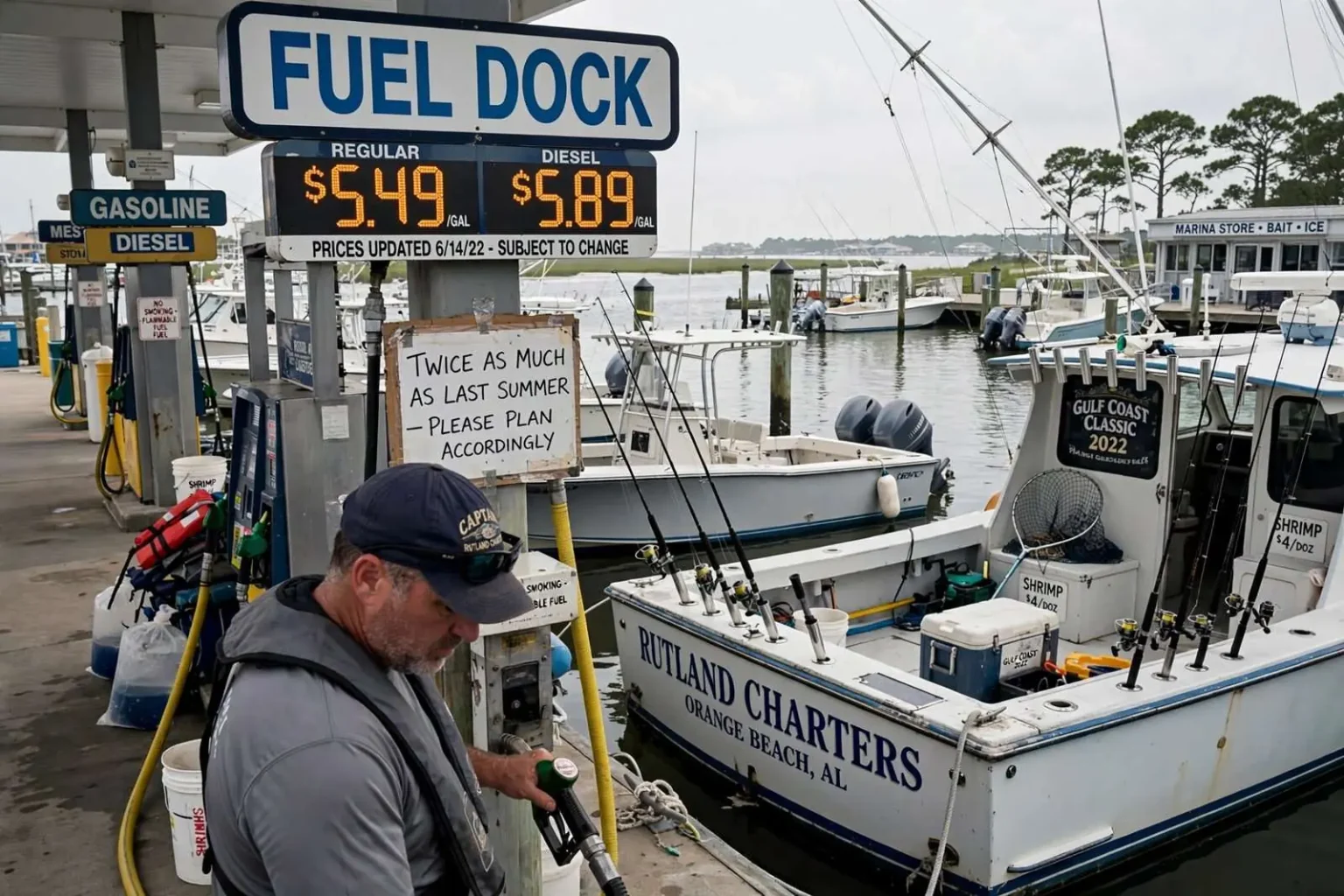
With gas prices running nearly double what they were a year earlier, the pain at the pump in 2022 extended well past commuters — all the way to the fuel docks of the Alabama Gulf Coast. The spring and early-summer surge in gasoline and diesel prices, driven by tight global supply and surging post-pandemic demand, hit the boating season squarely in the middle of its busiest stretch, just as Memorial Day gave way to the peak summer run of anglers and vacationers heading for the water.
For a coastal economy built around boats, the spike was more than a nuisance. Charter fishing operations out of Orange Beach, Gulf Shores and Dauphin Island burn hundreds of gallons on a single offshore run, marinas along the Intracoastal Waterway and Mobile Bay reprice their dockside fuel almost weekly, and weekend anglers who once thought nothing of a long run to the rigs found themselves doing the math at the pump before they ever left the slip. Boating, by its nature, is one of the most fuel-intensive forms of recreation there is — and 2022 made that impossible to ignore.
Charter captain Richard Rutland, who makes his living on the water, said rising fuel costs were eating into every trip. “I kind of feel like I’m on every one of my trips… hitting my max limit on what I feel comfortable as far as burning in fuel every day,” he said.
Rutland’s predicament is one that nearly every working captain on the Gulf Coast recognized that summer. A charter boat that idles out of a pass and then runs forty or fifty miles offshore to reach productive water can spend a serious share of a trip’s charter fee on fuel alone, before ice, bait, tackle, crew pay and maintenance are counted. When the price per gallon roughly doubles, the margin that separates a profitable season from a break-even one evaporates quickly, and captains are left with a choice: absorb the cost, pass it along, or cut back on how far and how often they run.
Raising Prices — and Finding Understanding
To keep pace with skyrocketing costs, Rutland raised his prices — and said most clients understood. “Most everybody has just said hey, we understand and we’re all dealing with it,” he said. “It’s really a hard pill to swallow, you know, having to spend twice as much as we did last summer.”
That dynamic played out up and down the coast. Charter operators, who price their trips a season or more in advance in many cases, found themselves renegotiating with repeat clients and explaining to first-time customers why a half-day trip cost noticeably more than the year before. Most anglers, having just filled their own trucks and their own gas cans at eye-watering prices, were in no position to argue. The frustration for captains was less about the clients and more about the squeeze itself — working harder than ever for the same effective income, with every extra dollar of fuel revenue going straight out the transom.
The ripple effects reached well beyond the charter fleet. Fuel is one of the largest line items in the entire coastal recreation economy, and when its price doubles, the pain spreads to bait camps, tackle shops, marina stores, boatyards and the restaurants and condominiums that depend on the boating traffic those businesses generate. In communities like Orange Beach and Dauphin Island, where summer boating activity underwrites a large share of the local economy, the fuel spike of 2022 was treated as a genuine economic concern, not a passing inconvenience.
Weekend Boaters Change Their Habits
Recreational boaters were adjusting too. The changes were less about whether people went boating and more about how — where they ran, how long they stayed out, and how far from the dock they were willing to wander with fuel prices per gallon at levels most boaters had never seen.
Weekend boater Larry Kirby said he was staying closer to shore: shorter runs and inshore fishing instead of offshore trips made outings easier on the wallet. It is a common trade-off along the Alabama coast, where the protected waters of Mobile Bay, Bon Secour Bay and the bays and lagoons behind the barrier islands offer productive fishing for speckled trout, redfish and flounder without the long, fuel-hungry run through Perdido Pass or the Mobile ship channel and out into open Gulf water.
Filling up wasn’t cheap either — “if you’ve got a 50-gallon boat, you’re going to spend 250 bucks,” Kirby said. At roughly five dollars a gallon at the dock, a tank that cost a little over a hundred dollars the previous summer had become a two-hundred-fifty-dollar proposition, and that was for a modest midsize rig. Owners of larger center consoles and cruisers, with fuel capacities several times that size, faced four- and five-hundred-dollar fill-ups just to get back to the level they left the dock with.
For many families, the calculation went further than the fuel itself. Towing a boat to the ramp means paying for gasoline in the tow vehicle as well, and a weekend outing that once felt routine suddenly carried a combined fuel bill that made shorter, closer-to-home trips the sensible default. Inshore fishing, kayaks, and bay-oriented outings all gained ground as boaters looked for ways to stay on the water without staying at the fuel dock.
Tournament Season Feels the Pinch
The timing made matters worse. Summer along the Alabama Gulf Coast is tournament season, when charity billfish tournaments, rodeos and king mackerel events draw fleets of boats — some of them burning thousands of gallons over a weekend — into the marinas of Orange Beach, Gulf Shores and Destin just to the east. Tournament fishing is fuel-intensive by design: teams run long distances to find fish, and every additional dollar per gallon raises the cost of competing. Entry fees and sponsorship budgets that were set months earlier suddenly had to stretch further, and some weekend tournament anglers quietly trimmed their offshore outings in between events to compensate.
Still, neither high fuel prices nor tournament costs were keeping captains off the water. “I don’t ever want to feel like I am not doing something as a result of gas prices coming up,” Rutland said. “I want to provide the same experience I’ve always been providing.”
That resolve is characteristic of the working fleet. Charter fishing on the Alabama Gulf Coast is a tradition as much as a trade, built on generations of family operations and a client base that returns year after year for the chance at red snapper, amberjack, grouper and, in the offshore tournaments, billfish. Captains who survived downturns, oil spills and hurricanes were not about to let a fuel market dictate whether they went to work. Instead, they adjusted — raising prices where they could, trimming idle time and running more efficiently, and leaning on the loyalty of customers who understood that the cost of a day on the water had genuinely changed.
What It Means for the Coast
The summer of 2022 served as a stress test for the Gulf Coast boating economy, and the results were mixed but instructive. Demand for charter trips remained strong through the season, buoyed by pent-up travel appetite and Alabama’s popular red snapper seasons, which drew anglers from across the Southeast. But operators emerged with a sharper awareness of how exposed their business model is to fuel costs, and many said they would build fuel surcharges and price flexibility into future seasons rather than absorbing spikes after the fact.
For recreational boaters, the era of cheap runs offshore became a reminder that boating budgets need margin. Marinas responded with loyalty discounts and fuel programs, and anglers increasingly planned trips around fuel prices the way they always planned around weather. The lesson of that summer was not that people stopped boating — the boats still went out, the tournaments still ran, and the charter fleet still met its clients at the dock. It was that every gallon counted twice as much, and everyone from the weekend angler with a 50-gallon tank to the charter captain running offshore before dawn felt it.
Marina operators felt their own version of the squeeze. Fuel docks must buy gasoline and diesel by the tanker load, and when wholesale prices climb, the dock has to either raise its prices or sell inventory at a loss — and passing costs along to boaters who are already grumbling is a delicate balance. Some docks along the coast added high-flow pumps and extended hours during peak season to move more fuel with less waiting, while others promoted fuel discounts bundled with overnight slips and restaurant credits to keep visiting boaters coming in. Every gallon sold at a lower margin meant the dock had to move more volume to stay whole.
As one season of doubled fuel prices gave way to the next, the hope along the coast was simple: that the market would settle, the fuel docks would ease back toward something like normal, and the only hard math left on the water would be the kind captains actually enjoy — counting fish, not dollars.