Two Pensacola Protest Leaders Named to Police Citizens Advisory Committee
Two Pensacola activists, Kyle Cole and Haley Morrissette, have been nominated to a new citizens advisory committee reviewing the city's Police Department.
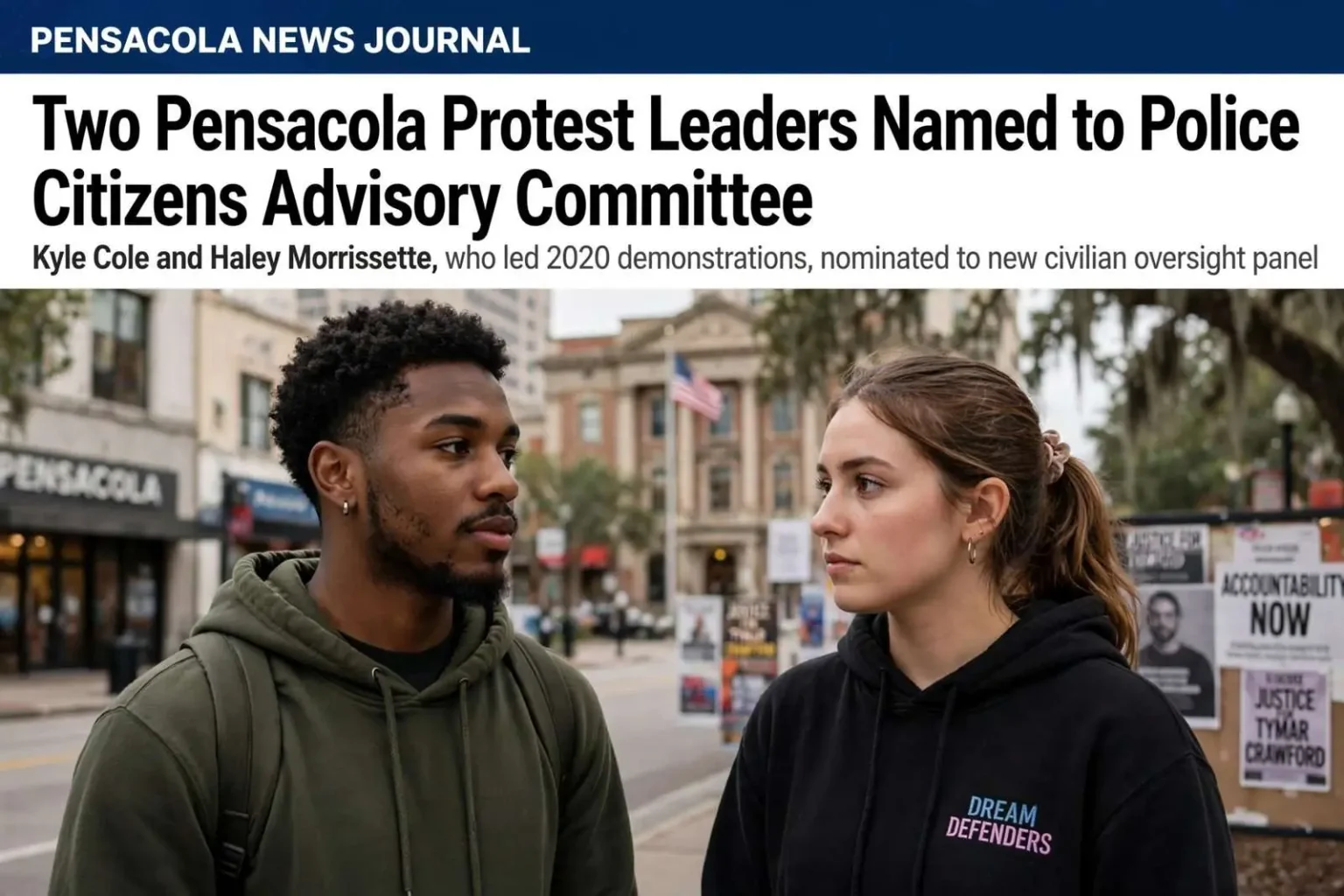
Two young activists who helped lead Pensacola’s recent demonstrations have been nominated to serve on a citizens advisory committee the city is forming to review the Police Department. Mayor Grover Robinson said he hopes to have the committee organized and meeting before the end of the year, a timeline that would put the panel to work less than a year after the death of George Floyd sparked protest marches through the streets of the Panhandle’s largest city.
Two of the mayor’s four nominations went to Kyle Cole, who became a prominent voice in Pensacola’s protests following the killing of George Floyd, and Haley Morrissette, an activist with the group Dream Defenders. Both spent months organizing and appearing at demonstrations that drew hundreds of participants to downtown Pensacola, the Pensacola Bay Center area and neighborhood streets on the city’s north side, keeping pressure on city hall to answer calls for greater police accountability.
Morrissette has been leading protests and calling for the committee since last summer, after Pensacola police shot and killed Tymar Crawford. Her nomination marks a notable turn: an organizer who campaigned for the panel’s creation will now hold a seat on it, giving the citizen body a direct link to the street-level demands that prompted the city to act. Advocates had argued for months that residents needed a formal channel to raise complaints and push for policy changes rather than relying on occasional public-comment periods at council meetings.
A committee with a mandate
The panel will hear citizens’ complaints and recommend improvements to the Police Department. Its creation reflects a pattern seen in cities across Florida and the nation since 2020, where municipal governments have stood up civilian review bodies to give residents a structured way to flag misconduct, question use-of-force incidents and suggest reforms without waiting for internal investigations to surface problems on their own.
Morrissette said she looks forward to taking part in upcoming budget hearings and serving as a liaison between residents and city government. Budget work may prove to be one of the committee’s most consequential duties. Pensacola’s annual spending plan determines how many officers the department can field, what training and equipment it can afford, and how much money flows to alternatives such as crisis intervention programs. A citizens committee with a voice in that process would have leverage that complaint review alone does not provide.
So far, Morrissette and Cole are the only people of color on the committee, according to the city. That imbalance has already drawn attention, given that questions of policing and accountability in Pensacola, as elsewhere, weigh heavily on Black residents and other communities of color. The composition of the panel is likely to evolve as remaining appointments are made, and advocates are expected to press for the finished committee to look more like the city it serves.
How the panel comes together
City council members have nominated three others — Laura McKnight, Charles Bare and Drew Buchanan — and additional council members and the mayor are expected to name more appointees by the end of the week. Under Pensacola’s strong-mayor form of government, the council sets policy and confirms major appointments, so a body that blends mayoral and council picks gives both branches a stake in the committee’s credibility. Each nominating official choosing members also spreads ownership of the panel’s work across the whole council rather than tying it to the mayor’s office alone.
The sequencing matters for another reason: the mayor’s stated goal of having the committee organized and meeting before the end of the year leaves little slack. Members will need to adopt operating rules, decide how complaints are submitted and reviewed, and establish a meeting schedule before any substantive work begins. Committees of this kind typically spend their first months on logistics — records access, confidentiality of pending complaints, and how recommendations get transmitted to the police chief and the mayor — before turning to individual cases.
The context that produced it
The push for a citizens advisory committee in Pensacola intensified after the death of Tymar Crawford, who was shot and killed by Pensacola police. Protesters gathered repeatedly in the months that followed, and organizers made the committee a central demand, arguing that residents deserved an official body dedicated to hearing their concerns. The demonstrations of summer 2020, driven nationally by the killing of George Floyd in Minneapolis, gave that local campaign fresh momentum and a wider audience.
Pensacola is not alone among Florida cities in taking this step. Communities across the state have debated, and in many cases created, citizen oversight bodies since 2020, with designs that vary widely — some committees are purely advisory, offering recommendations the department may accept or ignore, while others hold subpoena power or a formal role in reviewing internal affairs findings. Pensacola’s version, as described so far, sits in the advisory camp, which makes the willingness of city leaders to act on its recommendations the decisive factor in its success. The strength of any such panel usually depends less on its name than on its access to records, its independence, and whether city leadership acts on what it recommends.
For residents, the practical questions are straightforward: how to file a complaint, whether proceedings will be public, and how quickly the committee can respond. For officers, the panel represents an outside set of eyes on a profession that has faced intense scrutiny nationwide. Both audiences will be watching how the committee is seated and whether its early meetings signal a body with real work to do or a symbolic gesture.
What the nominees bring
Kyle Cole emerged as a prominent organizer during the 2020 protests, appearing at marches and rallies that kept accountability in front of city officials week after week. Haley Morrissette’s affiliation with Dream Defenders connects the committee to a statewide organization founded in Florida after the 2012 death of Trayvon Martin, a group that has built its reputation on youth organizing, criminal justice reform and voter engagement. Dream Defenders chapters across Florida have pushed for policies ranging from an end to for-profit policing to greater investment in communities, and Morrissette’s presence gives the Pensacola panel a member familiar with that broader reform agenda.
The council-nominated members — Laura McKnight, Charles Bare and Drew Buchanan — round out a group that so far blends protest-movement experience with established local voices. Buchanan has long been part of Pensacola’s civic conversation through his work in local media and community initiatives, and the council’s other picks bring their own networks and perspectives. How those perspectives mesh, and whether the committee can speak with one voice when it disagrees with the department, will shape its effectiveness more than any single appointment.
The complaints the panel will inherit
Any new oversight body arrives with a backlog of public frustration. Residents who felt their complaints went nowhere through ordinary channels will test the committee first, and how those early cases are handled will set expectations for everything that follows. Clear intake procedures, published meeting schedules and plain-language explanations of what the committee can and cannot do will be essential if the panel is to avoid becoming another dead end for frustrated residents. Transparency about outcomes — what was reviewed, what was recommended, what changed — is the single biggest factor separating committees that build trust from those that fade from public view.
What to watch next
Three things will signal whether the committee develops teeth. The first is staffing and access: a review body cannot evaluate complaints it cannot see, so its ability to obtain police records and case files will be an early test. The second is the budget hearings Morrissette flagged — if the committee’s recommendations begin appearing in the city’s spending decisions, residents will have evidence that the panel carries weight. The third is follow-through on complaints: whether residents who bring concerns see responses, referrals or policy changes rather than silence.
The timeline the mayor has set is ambitious. Committees that must organize, adopt rules and begin meeting within weeks often stumble on process questions, and skeptics of citizen review will be watching for early missteps. Supporters, including the activists whose protests made the panel possible, argue that speed matters too — a committee that takes a year to hold its first meeting risks losing the public trust it was created to build.
For now, the nomination of two of the city’s most visible protest leaders is the story. It signals that Pensacola intends to seat critics of the department, not only defenders of it, on the body charged with reviewing the department’s work. Whether that mix produces constructive reform or friction will become clear once the committee holds its first meetings and takes up its first complaints — work the mayor wants underway before the year is out.