
Two Shootings in One Hour: Car Shot Up on Le Grande Drive, Juvenile Wounded Near I-65
Mobile police investigated two shootings in one hour — a car hit by gunfire on Le Grande Drive and a juvenile wounded near I-65 — with one arrest made.
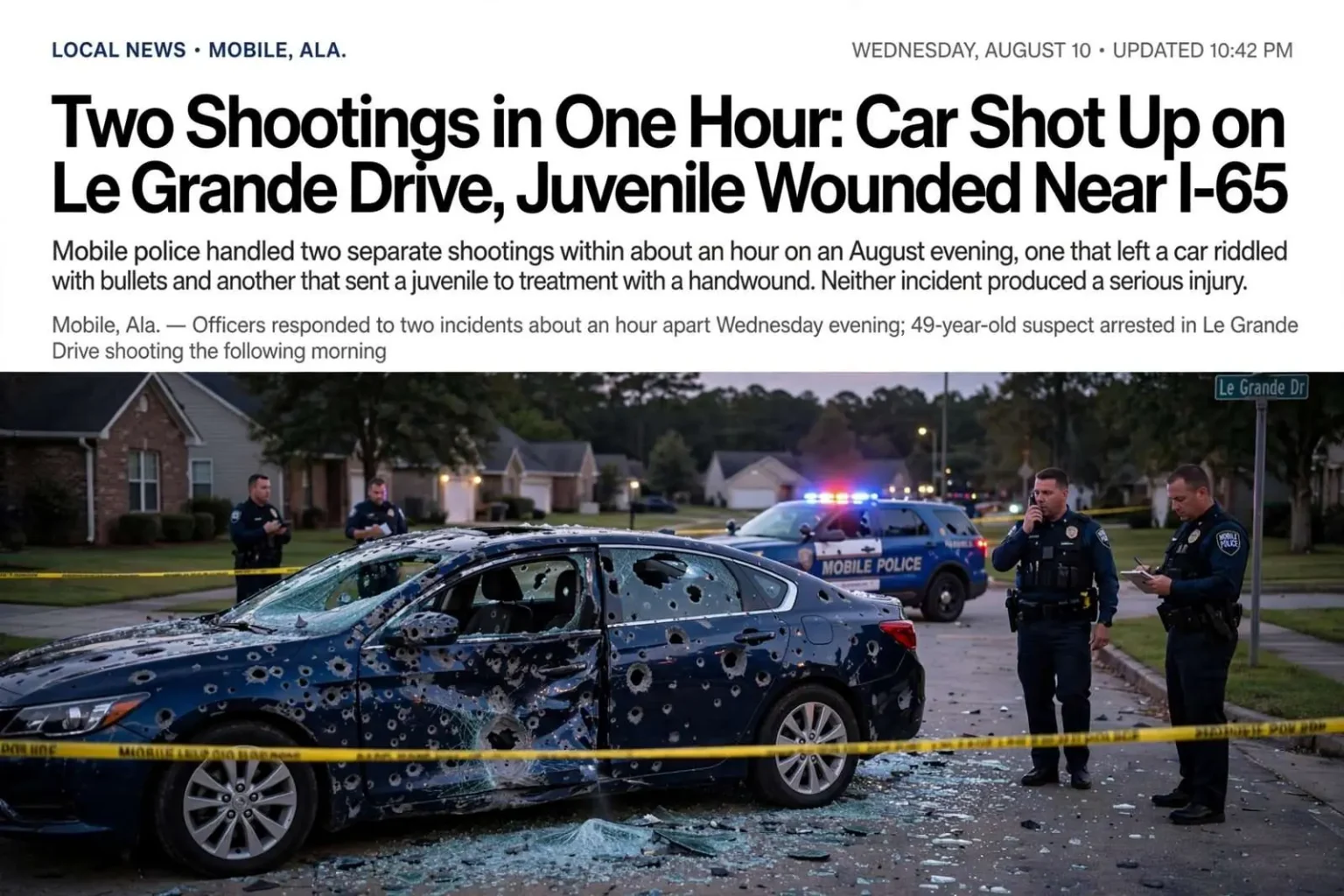
Mobile police handled two separate shootings within about an hour on an August evening, one that left a car riddled with bullets and another that sent a juvenile to treatment with a hand wound. Neither incident produced a serious injury, but together they occupied officers across the city on a single Wednesday night.
Less than an hour before the first call, around 7:30 p.m., officers responded to the Extended Suites off the I-65 service road after a juvenile was found shot in the hand. Police said his injuries were not life-threatening.
Then, around 8:15 p.m., officers were called to Le Grande Drive after a report of a possible shooting. On arrival they found a car that had been shot; Mobile Police confirmed no one was injured in that incident. Officers at the scene said the shooting appeared to be related to domestic violence.
A suspect was later taken into custody in the Le Grande Drive case: police said 49-year-old Ava Sanders was arrested the following morning in connection with the shooting. Both incidents remained under investigation by the Mobile Police Department.
A car shot on Le Grande Drive
The Le Grande Drive call came in around 8:15 p.m. Wednesday, Aug. 10, as a report of a possible shooting. When officers reached the scene, they found a car that had been struck by gunfire. No one was injured in the shooting.
Officers at the scene said the shooting appeared to be related to domestic violence. That classification matters in how the case is handled: domestic-related shootings are investigated with an eye toward the relationship between the people involved, the history of calls at the address and the safety of everyone in the household, not just the damage done to the car. A vehicle shot up in a domestic dispute is treated as evidence of violence that all too easily becomes violence against a person.
The arrest came quickly. Police said 49-year-old Ava Sanders was taken into custody the following morning in connection with the case. A next-day arrest in a shooting investigation usually reflects witnesses who stayed at the scene, evidence collected from the vehicle itself and officers who knew where to find the suspect — the kind of clearance that domestic-related shootings see more often than random gunfire, because the people involved are known to each other.
Le Grande Drive sits in a residential part of the city where shots fired after dark travel far in the quiet, and neighbors are frequently the first to call. In this case, the report of a possible shooting brought officers to a scene with a damaged car, no victim and a domestic story behind it.
A juvenile wounded near I-65
The night’s other shooting unfolded earlier and closer to the interstate. Around 7:30 p.m., officers responded to the Extended Suites off the I-65 service road, where a juvenile had been found shot in the hand. Police said his injuries were not life-threatening, and he was treated for the wound.
The Extended Suites and the extended-stay hotels that line the I-65 corridor present a recurring challenge for Mobile police. Rooms rented by the week house a shifting mix of traveling workers, displaced families and, at times, the sort of short-term traffic that generates calls — disturbances, thefts and occasional violence. A shooting that touches a juvenile at one of those properties sets off an investigation into how he was shot, by whom, and why a minor was in the line of fire at a hotel off the interstate.
A hand wound sounds minor in the ledger of gun violence, but police and trauma physicians caution against reading it that way. Hands are packed with small bones, tendons and blood vessels, and a gunshot there can cost a young person long-term function even when it poses no threat to life. The boy’s age also raises the stakes of the investigation: a juvenile shot anywhere in the city draws attention from investigators beyond the precinct level, and the adults around him become part of the inquiry.
How the two calls stack in time shows the pressure on patrol shifts. The juvenile call came in around 7:30, and the Le Grande Drive report landed at 8:15 — with crime scene work, witnesses and paperwork still open on the first when officers rolled to the second. Mobile’s evening shift absorbed both, sorting one into a domestic-violence arrest and the other into an ongoing investigation into who shot a child’s hand at a hotel off I-65.
Different scenes, same night, same questions
Neither incident fits the profile of the street-corner gunfire that dominates the city’s shooting statistics, and that is part of what made the night’s pairing notable. One case was domestic, with an arrest made before the next shift change. The other involved a child wounded at an extended-stay hotel, with the shooter unidentified and the motive unknown. Together they show the range of calls that fall under the same category — shots fired — and the different paths an investigation takes depending on whether the people involved are known to each other.
In the Le Grande Drive case, the domestic classification and the quick arrest of Ava Sanders suggest the investigation will move toward the court system, where the charge will reflect what the evidence shows about the relationship, the weapon and the intent behind the gunfire. Domestic violence cases in Mobile are handled with the added layer of victim safety planning, and prosecutors weigh a defendant’s history when the allegation involves shooting at a household member’s vehicle.
The juvenile’s case has none of those anchors, at least publicly. Police released no suspect, no motive and no account of how the boy came to be shot in the hand at a hotel off the service road, and investigators will be working backward from the scene: interviews at the hotel, any camera footage from the property and the account of whoever brought the boy to attention. Cases involving juvenile victims also typically involve family services, because the first question in any child-shooting investigation is who was responsible for him when it happened.
Extended-stay properties along I-65 have been the subject of focused police attention in Mobile for years, with the department at times working with hotel operators on lighting, camera coverage and registration practices. A shooting that wounds a child at one of these properties lands in the middle of that ongoing conversation between the city and the hospitality businesses that line the interstate.
What comes next
Both cases remained under investigation by the Mobile Police Department, which means the public account of either night could still change. In the hotel shooting, investigators will be seeking anyone who saw or heard anything around 7:30 p.m. near the Extended Suites off the I-65 service road, and tips from witnesses are typically the decisive factor in cases where a victim is young and a shooter is unknown.
In the Le Grande Drive case, the arrest of Sanders the morning after the shooting moves the matter into the courts, where the evidence gathered from the scene — the car, the shell casings, the statements taken on the street — will support whatever charges prosecutors file. Domestic violence shootings that do not kill are, in the accounting of advocates and police alike, near misses, and the response system built around them exists for the next incident as much as the last one.
For the neighborhoods involved, the two calls left different marks. On Le Grande Drive, the story ends with a bullet-riddled car, a woman in custody and no one hurt — a night that could have ended far worse did not. Off the I-65 service road, it ends with a child’s bandaged hand and an open question about who fired the shot, one that Mobile police investigators are still working to answer.
Gunfire that misses everyone is still gunfire, and police treat it that way. A shooting into an occupied vehicle or a hotel where children are present is charged based on what could have happened as much as what did, and Alabama law allows assault and reckless-endangerment counts even when no one is struck. The distinction matters for cases like Wednesday’s: the absence of injuries lowers the urgency but not the seriousness with which detectives and prosecutors treat the file.
Citywide, Mobile’s shooting numbers are tracked week by week, and each incident like these two enters that ledger — a car shot on a residential street, a juvenile wounded in a hotel room corridor or parking lot. The department’s public-facing count separates fatal from non-fatal shootings, and non-fatal cases like Wednesday’s are where witnesses matter most: victims survive, scenes stay intact longer, and the people who saw something are usually still nearby when officers arrive.


