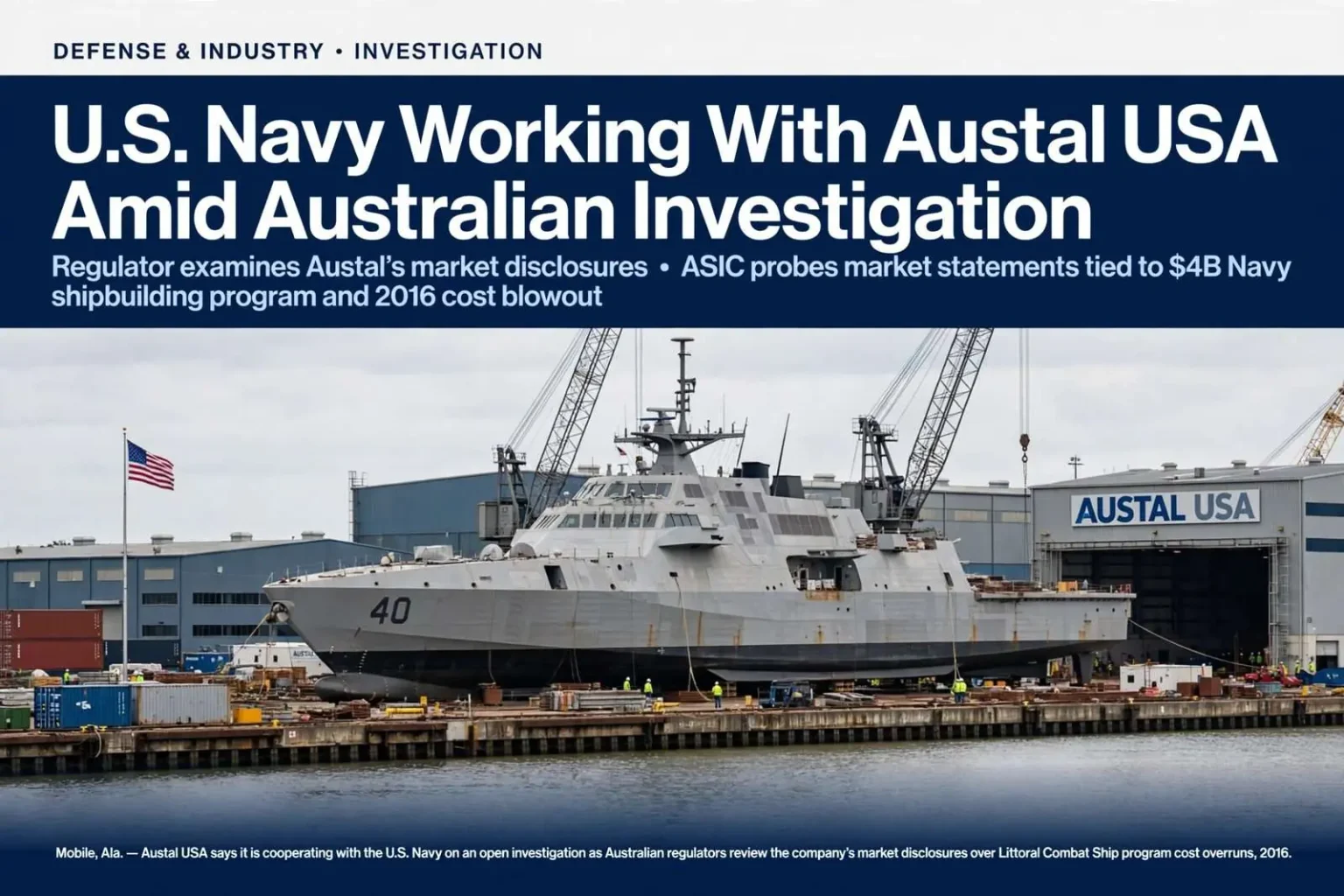
Regulator examines Austal’s market disclosures
Australian authorities are investigating Austal, the shipbuilder behind the Austal USA facility in Mobile, over market disclosures tied to a U.S. Navy shipbuilding program. According to a report in The West Australian, Austal disclosed that it is assisting an investigation by the Australian Securities and Investments Commission (ASIC) into market announcements made ahead of a warning in June 2016 that the company would post a $122 million annual loss. The probe reaches from the company’s Australian headquarters to the Gulf Coast shipyard where its most valuable work is carried out.
The scope of the probe centers on what investors were told as the program’s finances deteriorated. ASIC is examining market disclosures connected to a cost blowout on Austal’s $4 billion U.S. Navy shipbuilding program. The loss was blamed on soaring costs to build 11 Littoral Combat Ships for the Navy and triggered a steep drop in the company’s stock price, ending a long run in which the Mobile-built program had been presented to shareholders as the company’s growth engine.
The timeline regulators are tracing
Austal disclosed the loss about seven months after market updates that warned of margin pressure on the Littoral program. That seven-month gap is the terrain the investigation is mapping: what the company said in its updates as costs climbed, what it knew about the size of the overrun at the time, and whether the market’s picture of the program’s health matched the company’s internal accounting. Margin warnings gave investors notice that something was wrong, but the eventual loss figure suggested the problem had grown well beyond what the earlier language conveyed.
The company has said the Australian agency is reviewing the December updates. December updates occupy a sensitive place in the timeline, sitting closest to the moment when the scale of the cost overrun was becoming clear internally. Regulators examining a disclosure sequence typically reconstruct the internal financial picture month by month and compare it with each public statement, looking for the point where the two diverged. Whether the December updates crossed that line is the question ASIC has set out to answer.
The financial stakes behind the inquiry were substantial. A $122 million annual loss for a shipbuilder of Austal’s size represented a dramatic reversal, and the stock price drop that followed the warning erased significant shareholder value in short order. Losses of that kind on fixed-price defense contracts are borne directly by the builder, which is why the program’s cost performance translated so directly into the company’s reported results.
What Austal USA is saying
On the American side of the operation, Austal USA said it is working with the U.S. Navy on an open investigation. The statement positions the Mobile shipyard as a cooperating participant rather than a target, and it acknowledges that the program’s troubles are of interest to the program’s customer as well as to Australian regulators. The Navy has its own contractual mechanisms for reviewing cost and performance on major shipbuilding programs, and an open investigation between the company and its customer runs parallel to whatever ASIC determines in Australia.
In a press release, the company said it is continuing business as usual during the investigation and has not released further details. That posture serves two purposes: it reassures the workforce, suppliers and Navy stakeholders in Mobile that production continues, and it observes the practical limits of what a company under regulatory review can say publicly. Investigations of this kind constrain corporate communications, and companies in Austal’s position typically say little beyond confirming that they are cooperating until the matter resolves.
The Mobile connection
Austal USA’s shipyard on the Mobile River is where the Littoral Combat Ships at the center of the story are built, and the facility has grown into one of the largest industrial employers in the Mobile area. The yard builds an aluminum trimaran variant of the class under the Navy’s two-team production arrangement, and the 11-ship commitment represents years of sustained work for designers, welders, electricians and the wide network of Gulf Coast suppliers that feeds the production line. Any financial distress at the parent company, or any uncertainty about the program’s future, is felt first in questions about the pace of that work.
The Mobile operation also matters to the parent company’s identity. Austal built its reputation on fast aluminum ferries before winning the Navy work, and the American shipyard became the company’s largest operating site as the Littoral program ramped up. When the $122 million loss warning landed in June 2016, it was the Mobile-built program that investors reevaluated, even though the announcement itself was made from Australia. The two halves of the company are tightly linked: the yard produces the ships, and the Australian capital markets fund the work.
The parent company is headquartered in Henderson, Western Australia, and its shares trade on the Australian Securities Exchange — the market whose disclosure rules are at the heart of the ASIC review.
Fixed-price risk in shipbuilding
The cost blowout that triggered the loss illustrates the risk structure of fixed-price defense construction. Under fixed-price contracts, the shipbuilder agrees to deliver ships at a set price and absorbs the difference when costs rise. Large programs built with new designs, new materials and immature production processes are particularly exposed, and the Littoral Combat Ship class — a fast aluminum trimaran unlike anything else in the fleet — carried all of those risks. Soaring costs to build the 11 ships flowed straight through to the company’s books once they exceeded the contract prices.
The class itself has drawn sustained scrutiny in the United States, with critics in Congress and the Pentagon questioning its cost, survivability and mission modules over successive budget cycles. That public debate forms the backdrop to the Australian inquiry: a program whose economics were already controversial became the source of the company’s largest financial setback, and the way the company communicated that deterioration to investors is now the subject of regulatory review. The two controversies are separate, but they feed the same underlying question about the program’s future.
How ASIC investigations work
ASIC, the Australian Securities and Investments Commission, is the national regulator responsible for company law, financial services and market integrity. When it investigates market disclosures, it gathers company records and communications, reconstructs what executives knew and when, and evaluates whether public statements complied with continuous disclosure obligations. Outcomes range from closing the matter with no action to negotiated resolutions or court proceedings, and the process commonly runs for many months given the volume of material involved.
Austal’s decision to disclose the investigation and describe its cooperation follows standard practice for listed companies. Australian disclosure rules obliged the company to tell the market about the inquiry once it became material, and the company’s statement that it is assisting the investigation tells investors as much as it can while the review proceeds. The West Australian’s report of the disclosure brought the matter to a wider public, including readers on the Gulf Coast who follow the Mobile shipyard’s fortunes.
What to watch
For the Mobile area, the significant signals to watch are the programmatic ones. Production on the Littoral class continued while the Australian inquiry proceeded, and the Navy’s own decisions about future shipbuilding budgets will matter more to the shipyard’s workforce than any finding in Australia. Still, the company’s financial health shapes everything from hiring to supplier contracts, and a clean resolution of the ASIC review would remove one of the uncertainties hanging over the parent company’s standing with investors.
Until then, the company’s own description stands: business as usual, cooperation with the authorities on both sides of the Pacific, and no further details released. The December updates remain the documented focus of the Australian agency’s review, and the seven months between those updates and the June 2016 loss warning remain the period whose disclosure record will ultimately be judged. For a company whose flagship program is built on the Mobile River, the resolution will be watched closely on both ends of its operation.
Lessons from a program under pressure
The Austal episode has become a case study in how fixed-price defense programs communicate trouble, and it is being watched by analysts on both sides of the Pacific. When a major program turns from growth driver to source of losses, the disclosure sequence matters as much as the losses themselves, because investors price the stock on what they are told between reporting periods. The seven months between the margin-pressure updates and the June 2016 loss warning gave regulators a defined window to examine, and the December updates within that window are now the documented focus of the agency’s review.
For shipbuilders generally, the case underscores the discipline that fixed-price contracting demands. Navies around the world favor fixed-price arrangements because they cap the government’s exposure, but that structure requires builders to estimate accurately across years of production, absorbing material price swings, labor cost growth and design changes along the way. When estimates fall short, the losses can be enormous, and the temptation to soften interim communications is exactly what securities regulators exist to police.
The workforce watching from Mobile
In Mobile, the story has been followed less through stock charts than through the shipyard’s hiring hall and supplier network. Thousands of workers draw their livelihoods from the Littoral program, and the region’s maritime supply chain — from aluminum fabricators to marine equipment houses — depends on the yard’s production schedule staying full. Corporate governance questions in Australia feel distant from the production floor, but the company’s access to capital, its credit standing and its board’s confidence all trace back to how investors judge the parent company’s management.
The company’s statement that it is working with the U.S. Navy on an open investigation speaks to that dual audience. The Navy, as the program’s customer, has a direct interest in the contractor’s financial condition and in any questions about how program problems were handled. A cooperative relationship through an open investigation keeps the contractual machinery running — deliveries, inspections, follow-on work discussions — while the reviews on both continents take their course.
Australia’s continuous disclosure regime
The legal framework behind the inquiry is Australia’s continuous disclosure regime, which requires listed companies to keep the market informed of material developments as they occur. The regime is among the stricter in the world, and regulators take a dim view of companies that allow the market to trade on incomplete pictures of known problems. ASIC’s enforcement powers in such matters range from civil penalty proceedings to criminal action in serious cases, and even investigations that end without enforcement tend to produce changes in how a company manages its market communications.
The $4 billion program value attached to the Navy work gives a sense of the scale involved. A cost blowout across a contract portfolio of that size can swing a company’s results by hundreds of millions, which is precisely what happened when costs to build the 11 ships soared. The December updates under review sat closest to the moment when that arithmetic was becoming unavoidable, and the seven months that followed tested the company’s disclosure practices all the way to the June 2016 warning that finally quantified the damage.
Waiting on a resolution
Neither the company nor the regulator has indicated how long the investigation will run or what outcome it expects. Companies assisting such inquiries rarely speculate in public, and Austal’s press release — business as usual, no further details — reflects that discipline. What is public is the frame: an investigation by ASIC into market announcements, a company cooperating, a Navy program under its own separate review, and a shipyard in Mobile continuing to build.
For Gulf Coast readers, the practical takeaway is that the inquiry is a financial story with industrial consequences rather than an immediate threat to the yard. Ships continued sliding down the Mobile River ways while the matter unfolded, and the Navy continued taking deliveries. The company’s investors, regulators and board will settle the disclosure questions in Australia; the shipyard’s future will be settled by the program decisions that follow, in Washington and in the company’s own bidding on the next generation of Navy work.