MOBILE, Ala. — Max Fowler grew up watching quarterbacks. Not casually, the way most kids watch football, but closely — tracking how they moved, how they read a defense, how they carried themselves in a huddle. The list he studied reads like a decade of Alabama football: A.J. McCarron, Mac Jones, Bryce Young. He followed others as well, working to identify what separated the successful ones from the rest.
What Fowler was doing, whether he framed it that way at the time or not, is a form of study that quarterback coaches spend considerable effort trying to instill. Film work is standard at every level, but voluntary observation — watching because you want to understand, not because a coach assigned it — tends to produce a different quality of retention. Coaches across the state often note that the quarterbacks who improve fastest are the ones who arrive at the facility already having asked themselves the right questions about what they saw on Friday nights and Saturday afternoons.
The three quarterbacks he named represent notably different profiles. McCarron was a game manager in the most respectful sense of the term, operating a powerful offense without unforced errors. Jones was a precision passer with exceptional command of timing and placement. Young was an improviser, capable of extending plays past the point where the design had broken down. Studying all three suggests an interest in the position broadly rather than an attempt to model any single player.
That breadth matters. McCarron, who led Alabama to back-to-back national championships under Nick Saban, built his career on ball security and poise in the biggest moments. Jones, another national champion for the Crimson Tide, turned precision into an art form, hitting thin throwing windows in rhythm and repeatedly finding receivers in stride on deep crossing routes. Young, the Heisman Trophy winner who is now playing on Sundays, showed that a quarterback without ideal size can still control a game through pocket movement, anticipation and sheer competitiveness. Each profile demands something different from the players around him, and each offers a lesson about how many valid ways there are to play the position well.
The dream, stated plainly
Fowler dreamed of being in their position — literally and figuratively. Playing quarterback at the college level. Directing an offense. That ambition is common among high school quarterbacks. What is less common is arriving at a program like UMS-Wright, where the position carries genuine expectation, and being handed the keys.
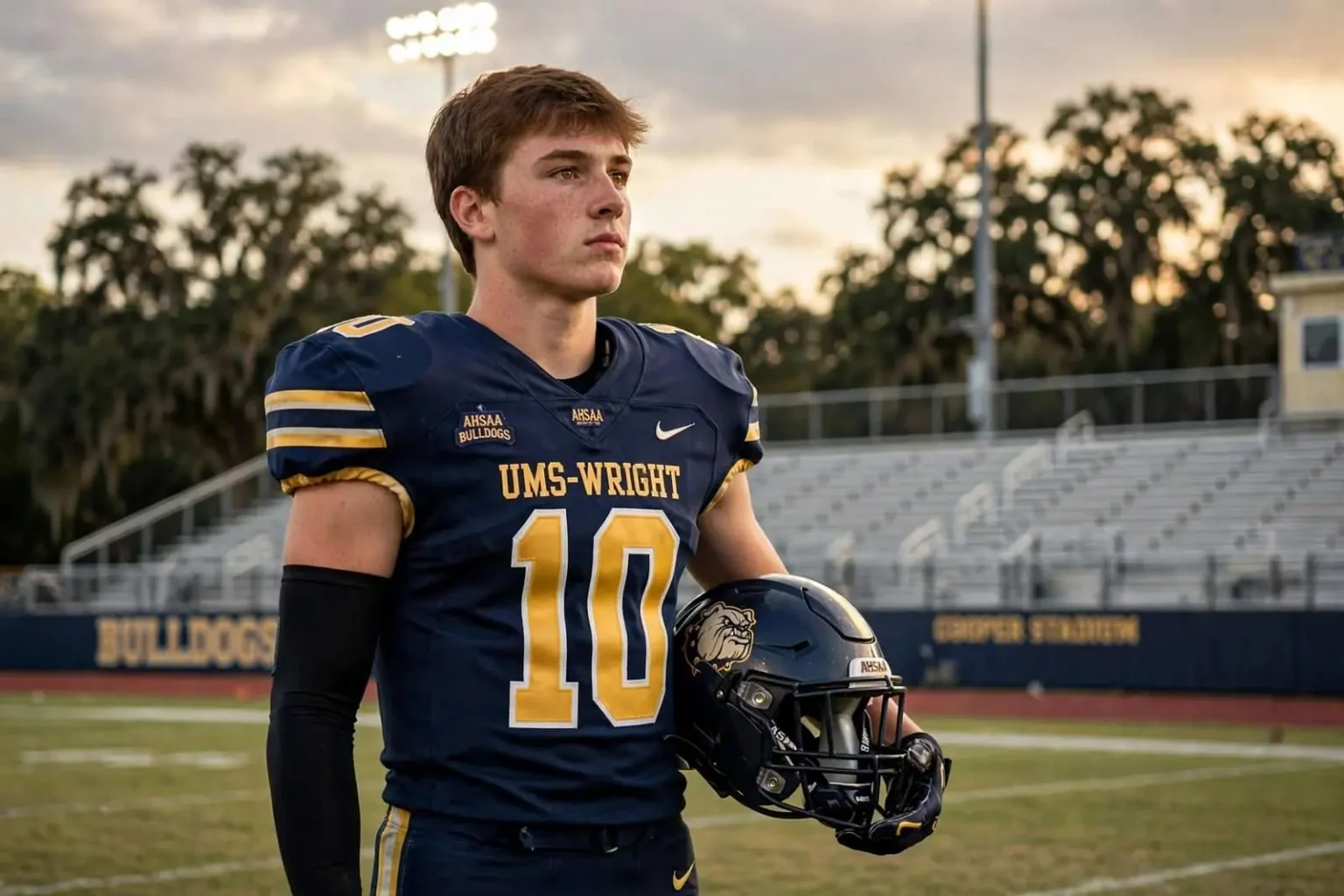
UMS-Wright Prep is one of the most established athletic programs in Mobile, and its football tradition stretches back generations. The Bulldogs play in the Alabama High School Athletic Association’s largest private-school classifications and have spent much of the past two decades as a perennial playoff contender, with multiple state titles to their credit. Facilities such as Cooper Stadium, the program’s long-time home field, and a culture built on discipline and fundamentals have made UMS-Wright a place where young players grow up expecting to win, not hoping to.
That expectation falls hardest on the quarterback. At programs like UMS-Wright, the position is not a place to learn on the job quietly; it is the visible face of the offense, the player who touches the ball on every snap and answers for every three-and-out. Stepping into that role as a starter means accepting that the student section, the stands and the opposing defensive coordinator are all studying you with the same intensity you once reserved for McCarron, Jones and Young.
Fowler’s path to that moment ran through the ordinary apprenticeship of a high school quarterback: scout-team reps, summer seven-on-seven competitions, weight-room afternoons and classroom sessions installing the offense. Players who eventually become comfortable starters tend to describe those years in similar terms — a slow accumulation of repetitions that turns what once looked chaotic into something almost procedural.
Where he is now
For Fowler, the current season represents the intersection of years of preparation and actual opportunity. The Bulldogs’ offense runs through him now, which means the reads he studied on television are ones he makes himself, at speed, with a defense arriving. By his own account, he is exactly where he wants to be.
For a player who spent his childhood charting how great quarterbacks handled third down, the education has become participatory. Reading a coverage on a screen is one thing; doing it while a blitzing linebacker closes from the edge is another. Coaches like to say the game slows down for quarterbacks with experience, and the only way to earn that experience is to play through the moments when it still moves very fast.
High school football on the Gulf Coast provides a demanding laboratory. Mobile and Baldwin County produce some of the most competitive schedules in Alabama every fall, and Class 5A and 6A regions in the southern part of the state routinely send deep playoff runs through programs like UMS-Wright, Saraland, St. Paul’s and Spanish Fort. Friday nights in Mobile County carry the kind of atmosphere — packed bleachers, marching bands, generational loyalties — that makes the pressure of a starting job feel real rather than theoretical.
The developmental arc Fowler is living through is familiar to anyone who follows Alabama high school football. The state has become one of the richest producers of quarterback talent in the country, feeding signal-callers to SEC programs and beyond. Part of that pipeline runs through film study like Fowler’s: prospects who grow up within driving distance of Tuscaloosa and Auburn absorb the college game as a template long before they are candidates to play it.
McCarron’s example, in particular, resonates in Mobile. The Mobile native arrived at Alabama as an in-state prospect with questions to answer and left as one of the most decorated quarterbacks in school history, a two-time national champion and a Heisman Trophy runner-up. For local players, his career is proof that the distance between watching on a couch and playing on a big stage can be covered from right here along the Gulf Coast.
What the study becomes
The habits Fowler built as a fan are the ones coaches try to formalize once a player reaches varsity. Quarterbacks at every Mobile-area program spend part of each week breaking down their next opponent, charting tendencies and identifying the rotations and blitz triggers that will decide a game. The difference between assigned film work and self-directed study is usually visible on the field: a quarterback who already knows what a safety’s pre-snap alignment means makes decisions a half-second faster, and at football speed, half a second is the entire play.
There is also a leadership dimension that the three quarterbacks Fowler studied all share. McCarron was famously demanding of his teammates and unafraid of the moment. Jones earned the trust of an entire locker room with meticulous preparation. Young carried Alabama’s offense through injuries and adversity while remaining, by every account, the hardest-working player in the building. None of those traits can be taught by watching alone, but watching supplies the model — the standard a young quarterback measures himself against when the season gets hard.
Fowler’s own evaluation will be written the same way every high school quarterback’s is: one Friday at a time. Completions and decisions accumulate into a season, and a season into a reputation. What he controls is the preparation behind them — the same instinct that once had him studying McCarron’s footwork now directs how he prepares for a region opponent’s disguised coverage.
The college ambition remains exactly that, an ambition. High school quarterbacks in Alabama face long odds in the recruiting process simply because the state produces so many strong candidates every cycle. But the qualities that make a recruiting profile — accuracy, decision-making, command of an offense, poise under pressure — are the same qualities that make a high school offense run, and they are built in seasons like the one in front of him.
For now, the Bulldogs have a quarterback who arrived at his starting job with an unusual amount of context for it. He has seen, in detail, what excellence at the position looks like: the controlled aggression of McCarron, the metronomic precision of Jones, the improvisational competitiveness of Young. Translating observation into execution is the work of the season, and it is the part of football he has wanted to do for as long as he can remember.
The Bulldogs’ schedule will supply the tests. Region play in the Alabama High School Athletic Association is unforgiving — every district game carries playoff implications, and Mobile’s private-school powers trade blows with public-school programs across the county each September and October. Quarterbacks are judged in those games by the standards Fowler already knows by heart: protect the ball, take what the defense gives, and make the throw when the moment asks for it.
By his own account, Fowler is exactly where he wants to be. That is not a small thing for a high school senior. The position he spent a childhood studying is now his, in a program where it matters, in a city that cares deeply about the game. The studying phase is over. The season he spent preparing for has started, and the reads — the ones he used to watch other people make — belong to him now.
How far that preparation carries the Bulldogs this fall remains to be seen. What is already clear is the shape of the foundation beneath it: years of attention paid to the right details, in a program that rewards exactly those details, by a player who wanted the job badly enough to learn it before he ever held it. In high school football, that is usually where good seasons begin.