
Unemployment claims in southwest Alabama down sharply from 2020 peak
New unemployment insurance claims in southwest Alabama fell to 1,516 for the week of May 2-8, down sharply from more than 4,600 during the same week in.
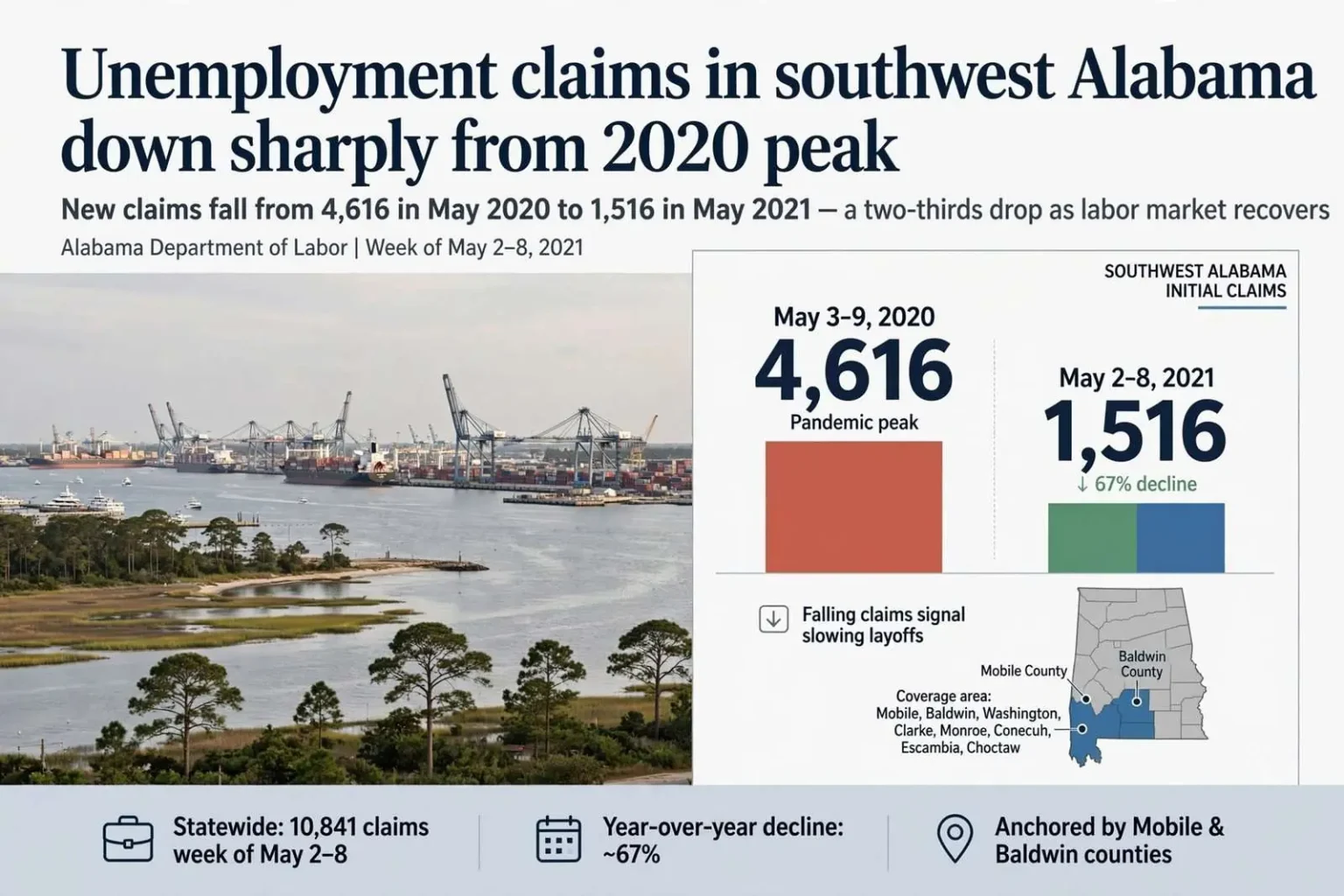
The Alabama Department of Labor has released initial unemployment insurance claims for the week of May 2-8, showing 1,516 new claims filed in the southwest Alabama coverage area. The figure marks a sharp turnaround from the depths of the pandemic: during the week of May 3-9, 2020, the same area recorded 4,616 initial claims as the pandemic drove widespread job losses. In other words, new claims in southwest Alabama were down roughly two-thirds from where they stood at the same point on the calendar a year earlier.
Statewide, 10,841 initial claims were filed either online or by telephone during the week of May 2-8, with about 8,434 of those estimated to be COVID-19 related. Even a year into the pandemic, that share showed how thoroughly the virus continued to shape the state’s labor market — businesses still adjusting to capacity limits, workers still sidelined by illness or quarantines, and employers still recalibrating staffing as demand shifted from sector to sector.
What the numbers measure
Initial claims are the front door of the unemployment insurance system. They count people who filed a new application for benefits during the week — workers who lost a job and are seeking support — rather than everyone who remains out of work. Because they are reported weekly and with little lag, initial claims serve as one of the most current gauges of labor market stress available to economists, employers and state officials. A falling trend in initial claims generally signals that layoffs are slowing, even before hiring data catches up.
The distinction matters when reading a report like this one. The 1,516 southwest Alabama claims do not mean the region’s unemployment rate is a particular figure; they mean that a certain number of newly laid-off or newly eligible workers filed that week. Many people who lost jobs in 2020 remained out of the labor force entirely in 2021, having retired early, stayed home with children or delayed a return while health concerns persisted. Those individuals do not show up in new claims at all.
Jefferson County and the industry breakdown
Jefferson County led the state with 1,716 claims during the week, a familiar position for Alabama’s most populous county and home to Birmingham. Population alone explains much of that: the county’s labor market is the largest in the state, so even a modest rate of new filings produces the highest raw total. Claims were filed either online or by telephone, channels the Department of Labor built up to handle the crushing volume of spring 2020, when in-person offices closed and the state processed a historic surge of applications.
The industries with the most claims in Alabama that week told a story of a state still working through the pandemic’s uneven effects. Administrative and support and waste management services led with 931 claims, followed by manufacturing with 914, retail with 869, accommodation and food services with 816, and health care and social assistance with 774.
Each line of that list points to a different pressure. Administrative and support services — staffing agencies, temporary help firms, cleaning and security contractors — move with their client industries, so claims there often reflect layoffs spreading indirectly from other sectors. Manufacturing’s total reflected both labor shortages and supply chain disruptions that kept plants from running full schedules. Retail continued to shed positions as consumer habits shifted online. Accommodation and food services, the sector hit hardest in spring 2020, was still dealing with reduced capacity and difficulty attracting workers back. And health care and social assistance claims underscored the strain on frontline workers who had carried the pandemic’s heaviest loads.
For southwest Alabama specifically, the region covered by the report is anchored by Mobile and Baldwin counties and takes in communities stretching from the Gulf Coast up through the piney woods of Washington, Clarke, Monroe, Conecuh, Escambia and Choctaw counties. The area’s economy blends the Port of Mobile and aerospace manufacturing with tourism, shipbuilding, health care, timber and agriculture, a mix that was showing the pandemic’s effects unevenly across the two counties at the center of the region.
Baldwin County’s tourism-dependent communities along the Gulf — Gulf Shores, Orange Beach and the beach neighborhoods of Fort Morgan — had ridden a wave of cancellations in spring 2020, when 4,616 initial claims were filed in the coverage area during the week of May 3-9 alone. By the same week of 2021, with beaches open and visitors returning, the leisure and hospitality jobs that support the coast were coming back, helping drive the region’s new-claims total down to 1,516. Mobile County’s more diversified economy — anchored by the port, shipbuilding at the Austal and BAE facilities, aerospace and the region’s hospital systems — had weathered the trough differently, but the direction of travel was the same.
How the unemployment insurance system works
Alabama’s unemployment insurance program is funded through taxes paid by employers, not out of workers’ paychecks, and benefits are calculated from a worker’s prior wages. To remain eligible, claimants must be able and available to work and actively seeking employment, a requirement the state enforced through weekly certifications even as federal pandemic programs temporarily broadened who could qualify. The claims process runs through the department’s online portal and call centers, both of which saw their workloads transformed during the pandemic.
The week of May 3-9, 2020, against which this report measures itself, sits near the peak of an unprecedented spike. Business closures ordered that spring eliminated millions of jobs nationwide in a matter of weeks, and Alabama’s claims volumes broke every record the state had. Comparing any week in 2021 to the same week in 2020 therefore sets an easy bar — but the comparison still carries information, because it shows how far the labor market has traveled from crisis conditions even as it works through the long recovery.
For the Department of Labor, the weekly reports serve a practical purpose beyond headline numbers. Federal and state administrators use claims data to allocate resources, spot fraud, identify industries under unusual stress and calibrate reemployment services. Employers watch the figures for signals about labor availability. And workers use the system directly, filing claims and certifications that put benefits in motion.
What comes next for the region
The trajectory of the numbers suggested a labor market moving back toward normal, with the usual caveats. Falling initial claims measure slowing layoffs, not robust hiring, and the industries still logging the most claims were the ones facing the most persistent disruption. Workforce development officials across southwest Alabama continued to push training programs, job fairs and partnerships with community colleges aimed at connecting returning workers with open positions, particularly in skilled trades, health care and logistics.
For residents of Mobile, Baldwin and the surrounding counties, the week’s report was good news in the plainest sense: far fewer neighbors were newly out of work than had been the case a year earlier. The challenge ahead, reflected in the industries still filing claims, was completing a recovery that had already come a long way — from 4,616 new claims in the region at the pandemic’s height to 1,516 a year later, with the state’s broader economy reopening week by week behind them.
The unemployment insurance system itself is a product of the 1930s, built as part of the Social Security Act to cushion workers against exactly the kind of sudden, economy-wide shock that 2020 delivered. States administer their own programs within federal rules, which is why benefit levels and eligibility details differ from state to state. Alabama’s system historically paid modest weekly benefits relative to wages, and the pandemic layered temporary federal programs on top of state benefits, expanding who qualified and how long benefits lasted. Those federal programs wound down on their own schedules, separate from the state’s weekly claims reports.
Seasonality also colors any single week’s claims. Southwest Alabama’s economy leans on tourism and construction, both of which hire and shed workers with the calendar, and school-year cycles ripple through food service, transportation and child care. A week in early May sits before the coastal summer rush, when hospitality hiring along the Baldwin County beaches typically accelerates, and after the winter slowdown has passed. Comparing the same week across years — as this report does — helps smooth out those patterns.
For workers filing claims, officials generally advise applying as soon as a job loss occurs, since benefits are not retroactive to the date of separation. Claimants need accurate information about their prior employer and earnings, and they must file weekly certifications to keep benefits flowing. The department’s online filing system remains the fastest channel for most people, with call centers available for those who need help or cannot file online — a lesson from 2020, when digital filing became the only practical option for hundreds of thousands of Alabamians at once.
The longer-term picture for the region’s job market was taking shape around the week’s numbers. The Port of Mobile’s ongoing expansion, the aerospace cluster that has grown around Airbus’ Mobile assembly line, shipbuilding contracts, and the steady growth of Baldwin County’s population all pointed toward demand for workers even as some industries continued to struggle. The open question, visible in the industry list attached to every weekly report, was how quickly the sectors still filing the most claims — retail, hospitality, manufacturing — could stabilize their workforces and rebuild toward pre-pandemic strength.
For the week of May 2-8, though, the Department of Labor’s numbers delivered a straightforward message for southwest Alabama: the wave of new job losses that crested at 4,616 claims a year earlier had receded to 1,516, and the state’s economy, with 10,841 initial claims filed statewide against a pandemic peak that once dwarfed it, continued its uneven climb back.


