
United Airlines Orders 70 Airbus Jets, Significant Number to Be Built in Mobile
United Airlines orders 70 Airbus A321neo aircraft with a significant number to be assembled at the Mobile Alabama manufacturing facility.
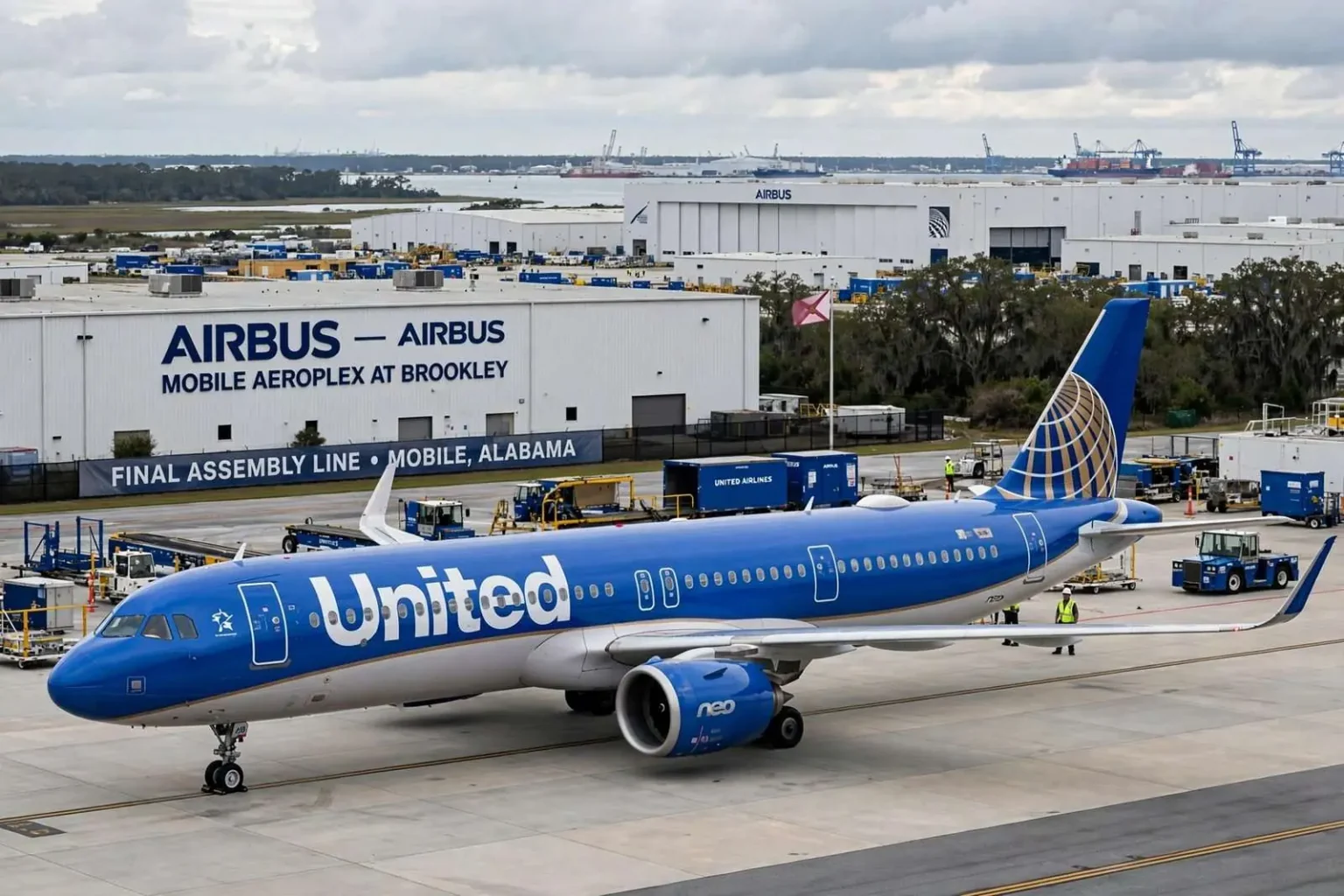
United Airlines has placed a major order for 70 Airbus A321neo aircraft, with a significant portion of the jets set to be assembled at Airbus’s manufacturing facility in Mobile, Alabama, the aircraft maker announced Tuesday. The order ranks among the significant narrowbody commitments in the North American market, and its Mobile connection gives the Gulf Coast’s growing aerospace sector another headline in a decade already defined by the region’s arrival as a commercial aircraft production center.
The deal underscores the growing importance of Mobile’s aerospace sector, which has steadily expanded since Airbus opened its first U.S. final assembly line at the Brookley Aeroplex in 2015. What began as a single assembly operation on the site of the former Brookley Air Force Base has matured into a full production ecosystem — assembly lines, supplier facilities, training centers and a workforce pipeline built around the specific skills that final aircraft assembly demands. Each major order that flows through Mobile feeds back into that ecosystem, sustaining the shifts and the suppliers that keep the lines running.
“Such a significant order from a great airline like United underscores that the A321neo offers unmatched capabilities, operating economics, and passenger friendliness,” said Christian Scherer, Airbus Chief Commercial Officer and Head of International. The A321neo, the largest member of Airbus’s single-aisle A320 family, has become one of the most in-demand aircraft in commercial aviation, prized by airlines for its fuel efficiency and its capacity to fly longer, thinner routes that previously required widebody aircraft.
What the A321neo offers airlines
The aircraft’s appeal rests on economics. The “neo” designation — new engine option — refers to the modern engines and aerodynamic improvements that cut fuel burn substantially compared with the previous generation, and fuel is among the largest line items in any airline’s budget. An aircraft that burns less fuel per seat while carrying more of them changes route economics across a network, letting an airline serve markets profitably that a larger aircraft would empty out and a smaller one would strain to cover.
For a carrier the size of United, the fleet planning logic is straightforward. Narrowbody jets fly the dense domestic trunk routes and the short-haul international sectors; the A321neo’s extended range lets it stretch those narrowbodies across transcontinental routes and, increasingly, across the Atlantic. Airlines have found that passengers respond to the newer cabins — quieter, more spacious, fitted with the latest seating and entertainment — which is part of what Scherer meant by “passenger friendliness” alongside the operating numbers.
Scherer noted that the A321neo will complement United’s future A321XLR aircraft, creating what he described as a privileged market segment. The XLR variant extends the platform’s range even further, opening nonstop routes of a length that historically demanded widebody aircraft. Together, the two variants let a carrier build a layered narrowbody fleet: the neo covering high-frequency core routes, the XLR reaching the longer, thinner markets at the edge of — and beyond — the continent.
“No other aircraft can do what the A321neo can do, and the Airbus team is most gratified by United’s strong affirmation of its premium status,” Scherer added. Statements of that kind are standard in aircraft announcements, but the underlying claim — that the A321neo occupies a segment no competitor currently matches — reflects the market reality that has made the type a fixture of order books across the industry in recent years.
Brookley and the rise of Mobile’s aerospace sector
The Mobile connection is what turns the announcement into local news. Airbus’s facility at the Mobile Aeroplex at Brookley was the company’s first final assembly line in the United States, a deliberate beachhead in the world’s largest commercial aviation market. The site’s history helped make it possible: Brookley was a major Air Force logistics base through the Cold War, and its closure in the 1960s left the city with an airport, deep industrial infrastructure and a waterfront location on Mobile Bay that proved ready-made for aerospace manufacturing.
Since the first Alabama-built aircraft rolled out, the operation has grown into a key hub for Airbus’s North American production, employing thousands of workers in the region. The facility assembles A320-family aircraft for U.S. carriers and has expanded over the years to add production capacity as demand has climbed. Mobile’s aerospace employment has broadened beyond the final assembly line itself — suppliers, maintenance providers and training operations have clustered around Brookley, and the region’s community colleges and universities have built training programs to feed the industry’s workforce needs.
The economic logic of the plant has held up for the city as well as the company. Aerospace jobs are the kind economic developers describe as anchored: they pay above regional averages, they are tied to multi-decade production programs, and they generate a supplier network that cannot easily be moved. Mobile’s successful recruitment of Airbus reshaped the city’s self-image — a port and shipbuilding city that added one of the world’s most recognizable manufacturing brands to its résumé — and every subsequent order announcement renews the case.
The new United order is expected to sustain and potentially grow employment at the facility as production ramps up. Assembly work follows orders the way tides follow the moon: when an airline commits to dozens of aircraft, the production schedule firms up years into the future, and staffing plans follow. For Mobile workers, an order of this size translates into stable shift schedules, continued hiring across the skilled trades — structures, systems, avionics, cabin installation, flight test — and a workload that keeps supplier plants around the region at full rate.
Reading the order from the airline’s side
From United’s perspective, the order reflects the narrowbody arms race under way across the industry. Major carriers have spent the past several years renewing their single-aisle fleets, and the A321neo has been at the center of that process — order books for the type stretch years into the future, and delivery slots are themselves a competitive asset. An airline adding 70 of them is buying capacity certainty: fuel-efficient aircraft, at scale, arriving on a schedule it can plan a network around.
Fleet decisions of this size also ripple through an airline’s entire operation. A common narrowbody type simplifies pilot training, maintenance inventories and scheduling flexibility, and the A321neo’s range flexibility gives network planners options that older narrowbodies never had. United’s commitment to both the neo and the future XLR variant signals a fleet strategy that expects the market for long, thin routes to keep growing — routes that the previous generation of narrowbody aircraft simply could not fly economically.
For Mobile, the significance is that a growing share of those aircraft will bear the Alabama origin that Airbus stamps into its U.S.-built planes. The facility has long emphasized that its aircraft are built in America for American carriers, and a marquee order from one of the country’s largest airlines reinforces the point that Brookley is not a satellite operation but a core part of Airbus’s production system.
What comes next
The practical effects of the order will unfold over years rather than weeks. Aircraft delivery schedules are negotiated and staggered across the life of a fleet plan, and the Mobile lines will slot the United aircraft into a production sequence already populated by other carriers. Between now and those deliveries, the work at Brookley continues at its established rhythm: major assemblies arriving by ship and road from Europe and the company’s other plants, wings and fuselage sections joined on the line, systems installed, engines mounted, paint applied and test flights flown from the runway beside the bay.
The announcement also lands at a moment when Gulf Coast aerospace is diversifying. Alongside the A320-family work at Brookley, the region has added production of other Airbus types and a growing cluster of aerospace employers up and down the I-10 corridor, from Pensacola’s naval aviation complex to the suppliers around Mobile’s port. Each order that keeps the Mobile lines at high rates strengthens the case that the cluster is permanent rather than a lucky recruitment win.
The workforce behind the lines
The people who turn those orders into aircraft are trained largely in Mobile itself. The city’s aerospace workforce pipeline runs from high-school pre-apprenticeships through community college programs and into the assembly halls at Brookley, a system built deliberately after Airbus’s arrival so that the plant’s hiring needs could be met locally. The trades involved — composite structures, electrical systems, cabin installation, quality inspection, flight test support — are specialized enough that a new plant usually imports its workforce, but Mobile built one instead, and that investment now supports every expansion the facility undertakes.
The supplier network tells a similar story. Final assembly is the visible part of aircraft manufacturing, but each jet that rolls out of Brookley represents work done at plants across the region and around the world — fuselage sections and wings shipped in, interiors and systems sourced from companies that located near the customer. A steady order book keeps that network healthy, and the largest orders, like this one, give suppliers the confidence to add their own capacity and staff.
For now, the immediate takeaway belongs to both sides of the transaction. United gains a modern, fuel-efficient fleet backbone with the range flexibility its planners have been asking for. Mobile gains confirmation that the wager it made on aerospace a decade ago keeps paying — with 70 more reasons to believe the jobs at Brookley are built to last.


