University of South Alabama’s Independent Music Collective Hosts First Thanksgiving Benefit Show
The University of South Alabama's Independent Music Collective staged its first Thanksgiving Benefit Show at Satori Coffee, featuring Eric Erdman and more.
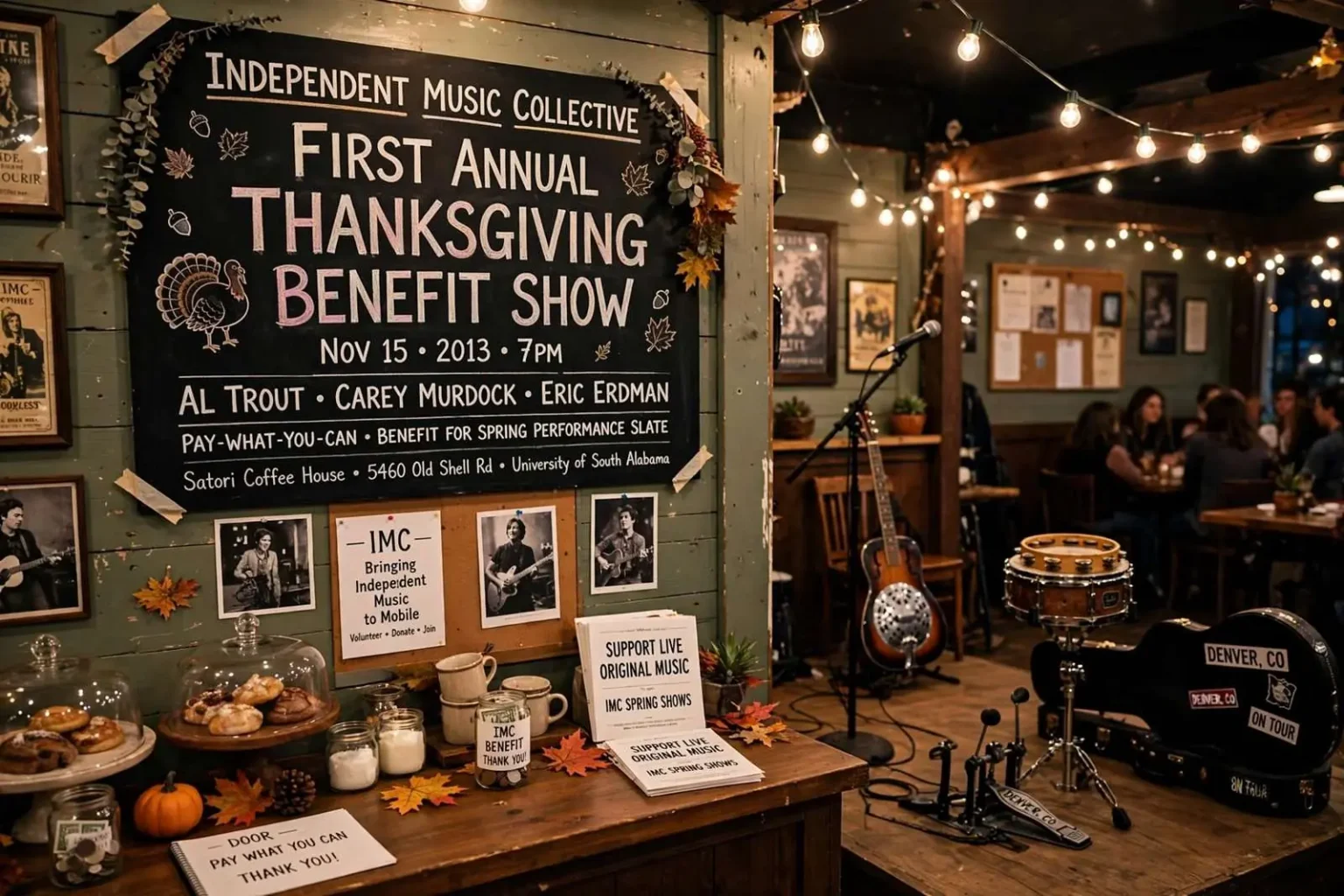
The Independent Music Collective — the University of South Alabama student organization that has become one of Mobile’s quiet engines for live original music — hosted its first annual Thanksgiving Benefit Show on November 15, 2013, at Satori Coffee House on Old Shell Road. Proceeds went toward the IMC’s spring performance slate, and the night brought together touring songwriters and a hometown headliner in one of the city’s most reliable listening rooms.
The group, which brings touring independent musicians to Mobile throughout the year, relies on fundraisers like this one to make those bookings possible. In keeping with its community-minded streak, the benefit broke from the usual ticket model: admission was pay-what-you-can, keeping the door open to students stretching a budget at the end of the semester and to midtown regulars alike.
The timing made sense for the campus calendar. The Friday before Thanksgiving week sends students home, but those still in town had a reason to stay for the weekend — a bill built around songwriting, staged a few blocks from the university’s academic core.
Three Songwriters, Three Styles
The night’s lineup mixed national travelers with a hometown headliner. Al Trout of Denver, Colo., billed himself as a purveyor of “mongrel Americana,” a self-applied label that captures a sound borrowing freely from blues, folk and roots traditions without belonging to any one of them. His one-man setup paired electrified resonator guitar blues with percussion stomped out on a foot-powered drum kit — a busker’s rig turned into a full-band sound by a single performer.
The resonator guitar, with its metallic voice and pre-amplification pedigree, gave Trout’s set a rawness that suited the coffee house’s close quarters. The foot-driven percussion filled out the bottom end, letting one musician carry a room that bigger acts cover with a rhythm section. It was the kind of performance the IMC’s shows exist to present: an artist with a distinctive approach, heard at close range.
Carey Murdock of Nashville, Tenn., brought a road-worn songwriter’s résumé to the middle slot. He had toured extensively across the U.S. and Europe, including a recent supporting run with Shovels & Rope — the Charleston duo whose rise through the Americana ranks made that opening slot a credential in its own right. Murdock’s songs leaned on the traveling life, and his years on the road showed in the ease of his delivery.
Supporting runs like the one with Shovels & Rope occupy a specific place in a working songwriter’s career: opening for a band on the way up puts an artist in front of rooms full of listeners primed for new music, night after night, across markets the headliner’s routing covers. For Murdock, the Mobile date marked a return to the smaller rooms where he built his base between those bigger runs.
Eric Erdman of Mobile closed the night. The longtime frontman of local favorites The Ugli Stick, fifteen years into that band’s run, was out supporting his 2012 solo album “My Brother’s Keepers.” The solo work gave Erdman room to step away from the full-band arrangements of The Ugli Stick and show the songwriting that had kept that band a Mobile institution for more than a decade. The album’s material, stripped of the band’s heavier arrangements, put the lyrics at the front of the mix where a listening room could catch every line.
For local audiences, Erdman’s name carried its own draw. The Ugli Stick’s blend of rock, funk and reggae-inflected pop made the band a staple of the Mobile scene, and its frontman’s solo material offered a different register — more acoustic, more introspective, and built around lyrics rather than groove. His slot anchored the bill with a hometown favorite while complementing the two out-of-town acts.
A College-Town Fundraiser in Miniature
Thanksgiving weekend is a quiet one for live music in most college towns, and Mobile is no exception. Students scatter to family gatherings, regulars travel, and venues thin out their calendars. The IMC’s choice to stage its benefit on that Friday was a deliberate play for exactly the audience still in town — the students who could not make the trip home, plus the midtown listeners for whom a night of songwriting is a standing appointment.
The structure of the evening reflected the organization’s understanding of its audience. Three acts with distinct styles, a setting that kept the focus on the songs, and an admission policy that asked for support rather than demanded it — all of it added up to an event that felt more like a community gathering than a commercial show.
Satori Coffee: The IMC’s Home Room
Satori Coffee, at 5460 Old Shell Road near the USA campus, had long served as the IMC’s home venue, its listening-room atmosphere a natural fit for songwriter-driven bills. The shop’s layout puts the audience close to the performer, and the room’s acoustics reward quiet dynamics — the opposite of a bar stage, where conversation competes with the music.
That intimacy shapes the kind of show the IMC books. A coffee house audience listens, and artists who thrive in that environment tend to be writers first — performers whose material holds up at whisper volume. The venue’s location on Old Shell Road, on the corridor that links midtown Mobile to the university, also makes it an easy stop for students walking from campus. The room’s modest stage has hosted hundreds of sets by traveling and local songwriters alike.
For the touring acts, a room like Satori offers something larger venues cannot: an audience that is there for the songs. National acts routinely note that small listening rooms produce their most memorable shows, and the IMC’s ability to offer that setting is a large part of why independent musicians keep accepting Mobile bookings through the student group.
How the IMC Works
The Independent Music Collective operates on a model familiar to student organizations everywhere: limited funds, volunteer labor, and a mission that outpaces the budget. Bringing touring musicians to Mobile means covering guarantees, hospitality and promotion for each date, and a semester of shows depends on fundraisers like the Thanksgiving benefit to stay solvent. Students handle the booking calls, the sound setup, the promotion and the door — the entire apparatus of a small record label and promoter rolled into one campus group.
The pay-what-you-can admission reflected the group’s priorities. Rather than price the show at a level that guaranteed a strong take, the IMC left the door open — betting that a generous room would support the cause, and that students and regulars alike would give what they could. The approach has long defined the organization’s community-minded character.
The fundraiser model says something about how small music scenes actually function. Venue relationships, booking contacts and volunteer crews do not appear out of nowhere; they are built by organizations that keep showing up, semester after semester, and by audiences that answer the ask. A November benefit is the unglamorous engine work behind the spring’s concerts — the show that funds the shows.
The benefit’s proceeds were earmarked for the spring performance slate, meaning the money raised in November would become bookings, sound and promotion when the spring semester’s schedule rolled around. Every dollar from the door translated directly into future shows for the city.
Why It Matters for Mobile’s Music Scene
Organizations like the IMC fill a niche that commercial venues rarely touch. Original, touring independent music — the songwriters and small bands crossing the country in vans — needs advocates in mid-sized cities where the club circuit is thin. A student group with a venue relationship and a willing audience can give those acts a date on the map that they would not otherwise have.
The cumulative effect is significant. Each touring act that plays Mobile takes the city’s name back into the booking networks where future tours are routed. Each local audience that hears a national-level songwriter in a small room builds the habit of supporting original music. And each student who helps run an IMC show learns the booking, promotion and production skills that keep scenes alive after they graduate.
For students heading home for the holiday break and midtown regulars alike, it made for an easy Friday night: local music, touring acts and a fundraiser all in one room. The first annual Thanksgiving Benefit Show gave the IMC a new tradition to build on — one show in November whose proceeds would echo through every booking the organization made when spring came.
The formula on display that night — one touring solo performer, one national songwriter on the way up, one hometown headliner, all in a listening room near campus — is the same formula that has made the IMC one of Mobile’s quiet engines for live original music. The Thanksgiving benefit promised to keep that engine running through the year ahead.