
Urgent care clinics report flu surge across Mobile and Baldwin counties
Urgent care clinics in Mobile and Baldwin counties report a late-season flu surge, with schools closing and waiting rooms filling up.
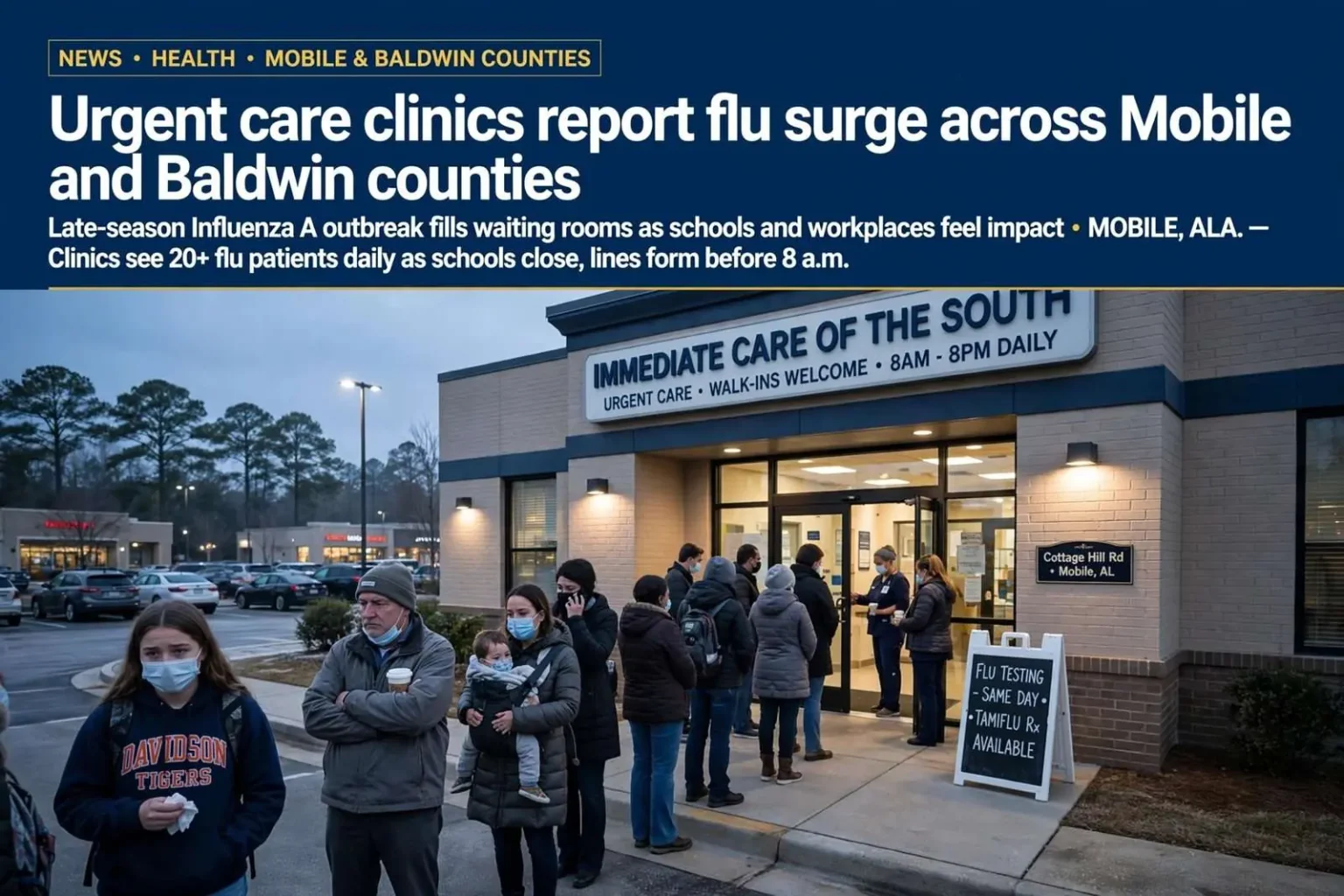
MOBILE, Ala. — Urgent care clinics across Mobile and Baldwin counties say they are seeing a sharp rise in flu cases after a late start to the season, turning waiting rooms busy across the two-county region as Influenza A makes its way through schools, workplaces, and families.
Dr. Marty McDonald at Immediate Care of the South on Cottage Hill Road said his clinic has averaged about 20 lab-confirmed flu patients a day since the previous week — a volume that transformed the clinic’s daily rhythm almost overnight. The Cottage Hill Road location draws patients from across west Mobile, and McDonald said the typical mix of minor injuries and routine illness has been crowded out by a wave of influenza cases arriving daily.
The experience of patients tells the story from the other side. A Davidson High School student visiting the clinic described fever, sore throat, congestion and chest discomfort — the constellation of symptoms that has marked this season’s Influenza A strain. Students like her have become a familiar sight in urgent care waiting rooms as the illness has moved through area schools, sending home the kind of broad, grade-spanning absences that signal a genuine outbreak rather than scattered sickness.
The surge is regional in scope. Seven urgent care clinics contacted in Mobile and Baldwin counties all reported being busy with flu patients, and one clinic reported more than a dozen people waiting before it opened at 8 a.m. — a line forming in the dark outside a facility that had not yet unlocked its doors. Baldwin County’s clinics, serving communities from Daphne to Foley, reported the same pattern as Mobile’s: steady streams of febrile patients, rapid tests confirming flu again and again, and pharmacies working to keep antiviral medications stocked.
A Late-Start Season Arrives All at Once
The current wave follows a late start to the flu season, a pattern that health officials say can make outbreaks feel more abrupt. When influenza arrives late, fewer people have been exposed or vaccinated yet, and the virus can sweep through a population that has built no seasonal immunity — turning what might otherwise be a gradual buildup into a steep spike within days. Late seasons also tend to catch schools and workplaces mid-winter, when indoor gathering and close contact accelerate transmission.
Influenza A, the strain driving most of the local cases, is typically the more severe of the two flu types that circulate in humans. It mutates quickly, spreads efficiently, and accounts for the majority of hospitalizations in most seasons. Doctors said most cases they are seeing are Influenza A, and they are recommending Tamiflu, rest and fluids for those diagnosed — the antiviral working best when started within the first 48 hours of symptoms, which is part of why urgent care clinics, with same-day visits and rapid testing, have become the front line of this season’s response.
Schools have been among the first institutions to feel the surge. At least two area schools closed because of illness: Clarke Preparatory School in Grove Hill, a private school north of Mobile in Clarke County, and the Chickasaw Learning Center in the city of Chickasaw. Closures of that kind — rare in ordinary flu seasons — indicate absentee rates high enough that school leaders concluded instruction was impossible and that closing for a deep-clean and a break in the transmission cycle was the better public health choice.
The closure of the Chickasaw Learning Center is particularly telling, since early-childhood facilities both amplify influenza transmission and suffer from it severely. Young children shed flu virus for longer periods than adults, have less disciplined hygiene, and carry the virus home to parents and grandparents. A learning center closure protects not just enrolled children but the extended households of an entire neighborhood.
What Doctors Are Advising
Physicians across the region are delivering a consistent message: those diagnosed with flu should take Tamiflu as prescribed if their doctor recommends it, rest, and push fluids, while those who have not yet been vaccinated should get a flu shot. Vaccination remains the single most effective step, and doctors stressed that it is not too late — flu seasons run for months, and immunization now protects recipients for the remainder of the season even if it does not prevent the current wave from reaching them.
The flu shot’s benefit this season is compounded by the strain’s severity. Influenza A seasons tend to produce more complications — pneumonia, dehydration, and worsening of chronic conditions — particularly among the elderly, infants, pregnant women, and people with asthma, diabetes, or heart disease. Urgent care physicians urged those higher-risk groups to seek care early rather than waiting out symptoms, since antiviral treatment and monitoring work best before complications set in.
The practical advice extends beyond medicine to daily habits that slow transmission. Doctors urged anyone with fever to stay home until it has resolved for a full day, to cover coughs, to wash hands frequently, and to disinfect the shared surfaces — doorknobs, counters, car interiors — where influenza virus can survive for hours. Families with sick members were advised to designate separate bathrooms where possible and to keep vulnerable relatives away from the patient during the contagious phase, which typically runs from a day before symptoms appear to roughly a week after.
When to Seek Care
Urgent care clinics emphasized that most flu cases can be managed at home with rest, fluids, and over-the-counter fever reducers, but certain warning signs warrant immediate medical attention: difficulty breathing, chest pain, persistent high fever, confusion, severe weakness, or symptoms that improve and then return worse. In children, dehydration, bluish lips, and refusal to drink are the red flags parents are told to watch. The surge has not overwhelmed emergency rooms so far, but doctors want patients to choose urgent care for routine flu rather than defaulting to hospital emergency departments, which need to reserve capacity for true emergencies.
The regional picture explains why Mobile and Baldwin clinics were hit simultaneously. The two counties form a single economic and social unit — workers commuting across Mobile Bay on the Interstate 10 bridge, families shuttling between the city and the Eastern Shore, students at schools whose athletic teams travel across county lines weekly. A virus that gains a foothold in one county’s schools reaches the other within days, which is why the seven clinics contacted by reporters described essentially the same patient loads on the same days.
The late-season surge also complicates planning for employers. Businesses in Mobile and Baldwin counties are contending with clustered absences as entire departments fall ill within the same week, and service industries — restaurants, retail, medical offices themselves — report the strain of covering shifts with workers who are either sick or home with sick children. Health officials’ standard advice to employers is to relax attendance policies for flu-like illness rather than press sick employees to come in, since a single contagious worker can undo weeks of prevention.
For families in Mobile, Chickasaw, Prichard, Saraland, and across the bay in Baldwin County, the season’s lesson is straightforward: this flu wave is here, it is Influenza A, and it is moving fast through schools and workplaces. The clinics that watched a dozen patients line up before 8 a.m. expect similar crowds in the days ahead, and the two schools that closed will reopen into the same environment that closed them. The tools available — Tamiflu for the diagnosed, flu shots for everyone else, and ordinary patience for those riding out the fever — remain the region’s best defense until the wave crests and, as flu seasons always do, recedes.
The numbers from McDonald’s clinic offer a measurable gauge of the wave. Twenty lab-confirmed patients a day at a single urgent care location implies an attack rate in the surrounding community that health departments usually only see at seasonal peaks, and lab confirmation matters: rapid tests distinguish influenza from the other respiratory viruses — common colds, RSV, and COVID-19 — that circulate alongside it and produce similar symptoms. When one clinic alone logs dozens of confirmed cases weekly, the true volume in the community, including those who never get tested, is a multiple of what the clinics record.
Pharmacists across the region have become part of the front line as well, filling Tamiflu prescriptions within hours of diagnosis and fielding questions about over-the-counter symptom relief. Antiviral shortages at individual pharmacies have been reported in past surges, and doctors advised patients to call ahead rather than assume stock. For most patients, though, the prescription is adjunct to the basics the doctors keep repeating — rest and fluids — and the illness runs its course in five to seven days for most healthy adults.
The contrast with last season’s timing underscores the current challenge. A flu season that arrives in December builds gradually through the holidays; a season that arrives late and spikes hard compresses the same volume of illness into a shorter window, straining clinics, schools, and pharmacies all at once. Mobile and Baldwin counties are living through that compressed version now, with urgent care lobbies full, two schools closed, and physicians urging the unvaccinated to get their shot while the wave is still rising rather than after it has passed through their household.


