An independent foundation with deep financial ties to the University of South Alabama is quietly bankrolling one of the school’s most competitive academic tracks, pouring hundreds of thousands of dollars a year into the university’s Honors Program. The USA Foundation, which operates separately from the university itself, contributes $750,000 annually to the Honors Program, according to program director Michael Doran. The steady stream of private support has helped the program grow from a modest experiment into one of the most visible academic success stories on the Mobile campus.
The arrangement is notable because of how the money moves. The foundation is not a line item in the university’s operating budget, and its gifts are not subject to the same swings that can affect state appropriations. That independence gives the Honors Program a level of stability that few academic units on campus can count on, allowing planners to commit to scholarships, enrichment activities and faculty-supported research year after year without waiting on legislative cycles or tuition projections.
The program, founded in 1999, has grown into a fixture on the Mobile campus and has produced a long line of student leaders, including the university’s current student government president. Over more than two decades, honors alumni have gone on to graduate and professional programs, careers in health care, engineering, education and business across the Gulf Coast and beyond. For a university that has worked hard to raise its academic profile since opening its doors in the 1960s, the Honors Program has become one of the clearest signals that South Alabama can compete for the region’s strongest students.
Doran said the foundation’s board takes real pride in watching honors students succeed, and that relationship goes beyond a check written once a year. He regularly briefs the foundation’s board on student accomplishments and brings top-performing students to speak directly to board members at their quarterly meetings, a practice many board members reportedly consider a highlight of those gatherings. The format gives donors something rare in institutional fundraising: a face and a story attached to every dollar.
Honors students at South Alabama are required to complete a thesis within their chosen field of study, working alongside university faculty mentors to conduct independent research that is ultimately reviewed by a thesis committee. The requirement puts undergraduates through a version of the same process graduate students face, from drafting a proposal to defending their findings before faculty. Once approved, that research is often published and submitted to national academic journals, giving students an accomplishment that stands out on applications to medical school, law school and graduate programs.
A Direct Line From Donors to Students
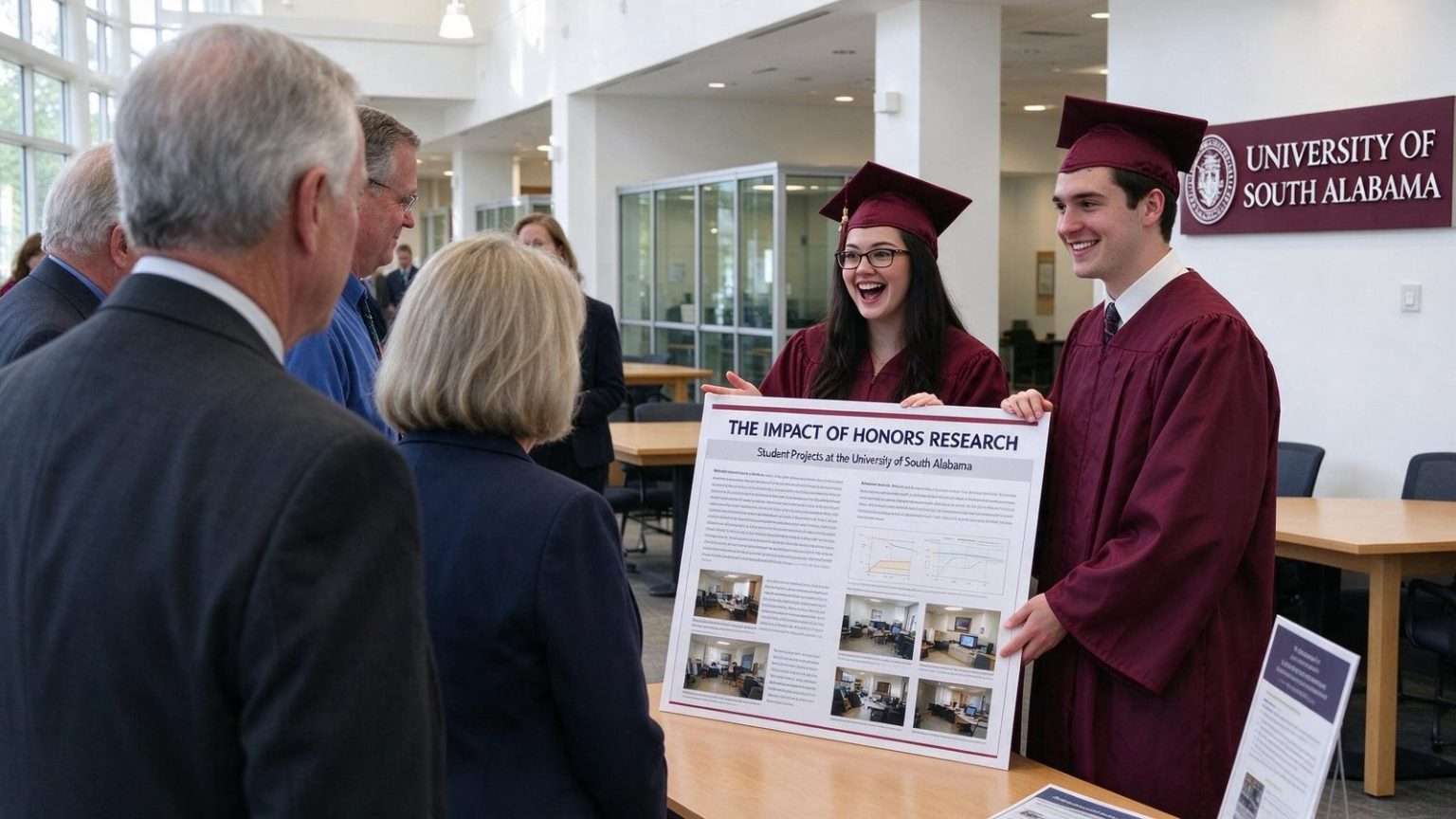
Recently, students Bethany Cobb and George Moore presented their ongoing research projects to foundation board members, giving donors a direct look at where their money goes. Presentations like theirs have become a regular feature of the relationship between the program and the foundation, turning what could be an abstract act of philanthropy into something concrete and personal for the board.
Foundation members also regularly attend student thesis presentations and the university’s annual Honors Symposium, where students present their research findings through poster displays, an event that gives the broader campus community a chance to see the results of a year or more of independent academic work. The symposium has grown into one of the highlights of the academic calendar, drawing faculty, students and visitors from across the campus to walk the poster sessions and question student researchers about their methods and conclusions.
Beyond scholarship money, which is awarded competitively based on academic merit, the foundation also treats Honors Program students to enrichment experiences that would otherwise be out of reach for many undergraduates. Cultural outings, trips and special events tied to the program give students time together outside the classroom, building the kind of cohort identity that retention researchers say keeps high-ability students enrolled and engaged through graduation.
Why the Foundation Model Matters in Alabama
The USA Foundation operates as a separate legal entity from the university, a structure common across Alabama public higher education. Such foundations raise and manage private assets, accept gifts from donors and direct spending toward priorities that may not be covered by state funding. At a time when public universities across the state are managing tight budgets, private foundation support has become an increasingly important complement to tuition and appropriations.
For the Honors Program, that support is what makes the small details of the program possible. Faculty mentoring of undergraduate thesis research takes time that is not always compensated through normal teaching loads. The annual symposium, the quarterly board briefings and the enrichment calendar all carry costs that a program funded solely through general university money would struggle to cover. The foundation’s $750,000 annual commitment absorbs much of that burden.
The competitive merit scholarships funded through the program also play a role in recruitment. South Alabama draws students from Mobile and Baldwin counties as well as the Florida Panhandle and Mississippi, and it competes with larger in-state flagships for the same high school valedictorians and National Merit qualifiers. A well-funded honors track with guaranteed research opportunities and a defined community gives recruiters a concrete answer to families weighing offers from bigger names.
What the Thesis Requirement Means for Students
The thesis requirement is the backbone of the South Alabama honors experience. Students select a topic within their major, typically during their junior year, and spend their remaining time on campus designing a research question, gathering data or source material, and writing a substantial final document. A faculty mentor guides the work, and a committee reviews the finished thesis, often requiring an oral defense before approval.
The process mirrors what students will encounter in graduate school, where independent research and committee review are standard. That preparation matters for honors students, many of whom are aiming for competitive professional programs in medicine, dentistry, law and the sciences. A published paper or a journal submission listed on a resume is a tangible differentiator, and South Alabama’s program has made that outcome a routine expectation rather than an exception.
The student presentations before the foundation board serve a second purpose beyond donor relations. Standing up to explain months of research to an audience of non-specialists forces students to sharpen their communication skills, a competency employers consistently rank among the most valuable. Board members, many of them business and community leaders from the Mobile area, get to ask questions and see how students think on their feet, and students get practice translating academic work into plain language.
A Two-Decade Track Record
Since its founding in 1999, the program has graduated classes of students who have carried the honors thesis experience into their careers. Alumni include leaders in local health care, educators across the region and student government presidents who went on to careers in public service. The fact that the university’s current student government president came up through the honors track is the kind of detail program directors point to when describing the program’s culture of leadership.
The program’s longevity is itself a signal. Academic initiatives on university campuses often rise and fall with administrations and funding cycles. The Honors Program has endured for more than two decades, sustained by the steady private support that keeps its scholarships and enrichment calendar intact regardless of budget weather elsewhere on campus.
The annual Honors Symposium ties the whole system together. Each year, students load their findings onto poster boards and present to anyone who wanders through, from chemistry professors to prospective students and their parents. For younger students considering the program, the symposium offers a preview of what participation requires. For faculty, it is a showcase of the undergraduate research culture that distinguishes the program from a standard course of study.
The Broader Picture for Mobile
The impact of the program extends past the campus perimeter. Mobile’s economy has been working to build a deeper base of professional and technical employment, from aerospace and manufacturing to health care and shipping along the port. Students who complete demanding undergraduate research in fields like biology, engineering and business often stay in the region after graduation, feeding local employers and graduate programs at the University of South Alabama’s own colleges of medicine and engineering.
Private investment in high-ability students also strengthens the university’s position in statewide conversations about higher education funding and academic reputation. Every honors graduate who earns a place in a competitive medical school or publishes research as an undergraduate becomes a small piece of evidence that the university can deliver a first-tier academic experience on the Gulf Coast.
For now, the relationship between the foundation and the program continues on the rhythm Doran described: quarterly briefings, student visits to board meetings, symposium attendance and the annual commitment of $750,000. It is a model built on proximity, with donors close enough to the students to see the return on their gifts in person, and students close enough to the donors to understand exactly who made their opportunities possible.