USA Graduate Students Turn Fishing Rodeo Catches Into a Year’s Worth of Gulf Research
University of South Alabama graduate students used this year's Alabama Deep Sea Fishing Rodeo to collect hundreds of fish samples, gathering in one weekend what normally takes a year of research.
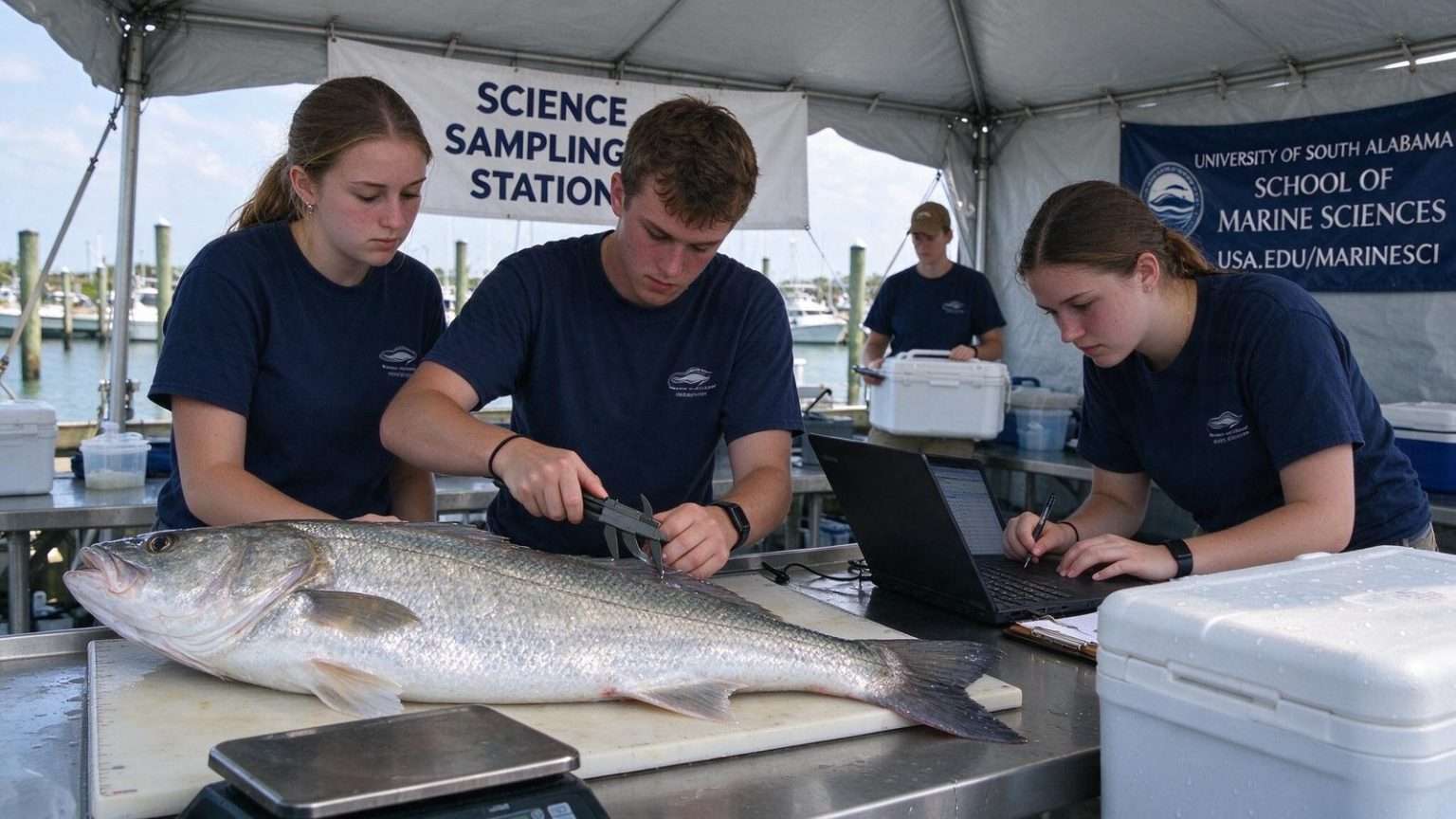
While thousands of anglers brought their catches to the docks during the Alabama Deep Sea Fishing Rodeo hoping to win a prize, a group of University of South Alabama graduate students used the same weekend to collect research data on Gulf fish populations. For three days each summer, the tournament grounds on Dauphin Island transform into one of the busiest marine science field sites on the northern Gulf Coast, as fish that might otherwise never reach a laboratory arrive by the truckload for measurement, sampling and study.
The rodeo, held annually on Dauphin Island and billed as the world’s largest deep sea fishing tournament, has become a valuable research opportunity for the university’s fisheries program. The event draws competitors from across the region and beyond, with categories spanning everything from inshore species to the large offshore game fish that make the northern Gulf a destination for serious anglers. That sheer volume of fish passing over the scales in a single weekend is precisely what makes the tournament so useful to scientists, who would need months of independent sampling effort to assemble a comparable collection.
“We believe here in our science tent that science and angling go hand in hand,” said Kyran Roe-Weaver, a USA fisheries research graduate student. The motto captures the spirit of an arrangement that has developed between tournament organizers and university researchers over many years, one that turns a celebration of recreational fishing into a working laboratory without diminishing the experience for the anglers themselves.
More than 100 students took part in the effort this year, working out of a science tent set up at the tournament grounds. The students, drawn from the university’s fisheries research programs, rotate through stations where fish are weighed, measured, identified and sampled. For many of the graduate students, the rodeo weekend represents the single most intense data collection stretch of their year, and for some it is their first exposure to the pace and volume of large-scale field sampling.
A Year of Samples in a Single Weekend
Roe-Weaver said the goal was to collect close to 500 samples over the weekend, a haul that would typically take close to a year to gather under normal research conditions. The compressed timeline is what makes the rodeo so valuable from a research standpoint. Instead of scheduling individual collecting trips throughout the year, negotiating access to boats and dealing with the weather cancellations that come with offshore fieldwork, researchers can gather a wide, representative slice of the tournament catch in one concentrated effort.
Those samples give researchers insight into the health of fish populations in the northern Gulf, information that is shared directly with rodeo organizers. By examining the age, size and species composition of the fish brought in by anglers, researchers can track how populations are trending over time, how recruitment of young fish is holding up, and whether the fish being caught are larger or smaller than in previous years. Because the tournament catch spans such a broad range of species and habitats, from shallow bays to deep offshore waters, the data offers a regional picture that is difficult to obtain any other way.
The sampling work also connects to broader fisheries science conducted along the Alabama coast, where university researchers, state biologists and federal scientists have long collaborated on assessing the stocks that support both commercial and recreational fishing. Recreational angling is a major economic driver for coastal Alabama, and decisions about seasons, size limits and catch limits depend on having reliable biological data about the fish themselves. Collections like the one assembled at the rodeo feed into that larger body of knowledge.
USA fisheries professor Dr. Sean Powers said the data collected at the rodeo has informed changes to the tournament itself over the years, including adjustments to which species are eligible and size requirements for species of particular conservation concern. That feedback loop is one of the more distinctive features of the partnership. Rather than science and competition operating side by side without interaction, the findings from the science tent have shaped the rules of the tournament, tightening eligibility for species where the biological evidence suggested additional caution was warranted.
For anglers, the changes serve as a visible reminder that the fish they pursue are a shared resource whose health depends on careful management. Tournament organizers have generally embraced those adjustments, recognizing that the long-term future of the event depends on sustainable fish populations. The arrangement has become a model of how a major recreational event and a research institution can each strengthen the other’s mission.
Partnership Built Over Decades
The relationship between the university and the rodeo reflects the broader research presence that has grown up around Dauphin Island, an anchor for marine science on the Alabama coast. The island hosts a cluster of research and educational institutions, and the annual tournament gives students at those programs a chance to put classroom training to work on a scale few other settings can match. Generations of fisheries students have gotten their start among the weigh stations and sample tables of the rodeo grounds.
Powers said the partnership benefits more than just the science. “The most important experience my students get is learning how to talk to the public,” he said, adding that students need to know how to both gather information from anglers and share findings back with them.
That public-facing skill set is often the hardest one to teach in a university setting. In the science tent, students field questions from curious children, competitive anglers and skeptical veterans of decades of Gulf fishing, all in the same afternoon. Learning to explain what a sample will be used for, why a particular species matters, or how a population assessment works — in plain language, without jargon — is a professional skill that serves graduates whether they end up in academia, state agencies or federal fisheries management.
The exchange runs in both directions. Anglers who stop by the tent carry away a better understanding of the research being done on the fish they pursue, and many come back year after year to ask about findings or share observations from their own time on the water. Longtime fishermen often hold decades of firsthand knowledge about changing conditions, and conversations at the rodeo give researchers an informal channel for that kind of observational information.
What It Means for the Coast
For coastal residents, the work done at the rodeo each summer has practical consequences that extend well beyond the tournament weekend. The health of Gulf fish populations shapes the length of recreational seasons, the bag limits that govern a day of fishing, and the overall vitality of a coastal economy built in part on fishing tourism. Data collected from tournament catches contributes to the scientific foundation behind those management decisions.
The science tent has also become a fixture of the rodeo experience for many families, who treat a stop at the sampling tables as part of their annual trip to the island. Children who come to see the giant fish on the leaderboard leave having seen researchers at work, an encounter that fisheries educators regard as one of the most effective forms of science outreach available to them.
As the rodeo continues to draw record crowds to Dauphin Island each July, the partnership between its organizers and the university’s fisheries program stands as an example of how a beloved tradition can double as a scientific asset. Nearly 500 samples that might have taken a year to collect are instead gathered in a single weekend, hundreds of students gain irreplaceable field experience, and the anglers who make the event possible get to see, up close, how their catches contribute to understanding and protecting the waters they fish.
From the Dock to the Database
The journey of a single rodeo fish illustrates how the operation works. An angler brings a red snapper or king mackerel to the weigh station, where tournament officials record the catch for the leaderboard. From there, the fish moves to the science tent, where students log its species, length and weight before taking the biological samples the research teams need. What began as a competition entry becomes a data point in a long-running record of the northern Gulf’s fish populations, joining collections that stretch back through years of tournaments.
The continuity of that record is part of its scientific value. A single year’s sample says relatively little on its own, but a consistent sampling effort repeated at the same event, with the same methods, year after year, allows researchers to detect trends that would otherwise be invisible. Shifts in the average size of a species, changes in the proportion of younger fish, or the appearance of species not typically present in tournament catches can all signal broader changes in the ecosystem.
University officials say the rodeo collaboration also strengthens ties between the research community and the recreational fishing industry, two groups that do not always see eye to eye on questions of regulation. Working side by side over a tournament weekend builds the kind of mutual familiarity that makes later conversations about management easier. Anglers come to see the researchers as neighbors rather than outsiders, and researchers gain a firsthand appreciation for the economic and personal stakes that fishing families have in the resource.
The program’s leaders describe the annual weekend as a win that compounds over time: each summer’s class of students trains the next, each summer’s samples extend the record, and each year of cooperation deepens a partnership that has become as much a part of the Alabama Deep Sea Fishing Rodeo as the leaderboard itself.