USA Health CEO Natalie Fox Lands on National Academic Medical Center Leaders List for Second Year
Natalie Fox, DNP, PNP-BC, has been named to a national roster of 95 academic medical center chief executives for 2026, two years after appearing on a healthcare leaders under 40 list. She oversees a system with more than 7,200 employees, three hospitals and a cancer institute.
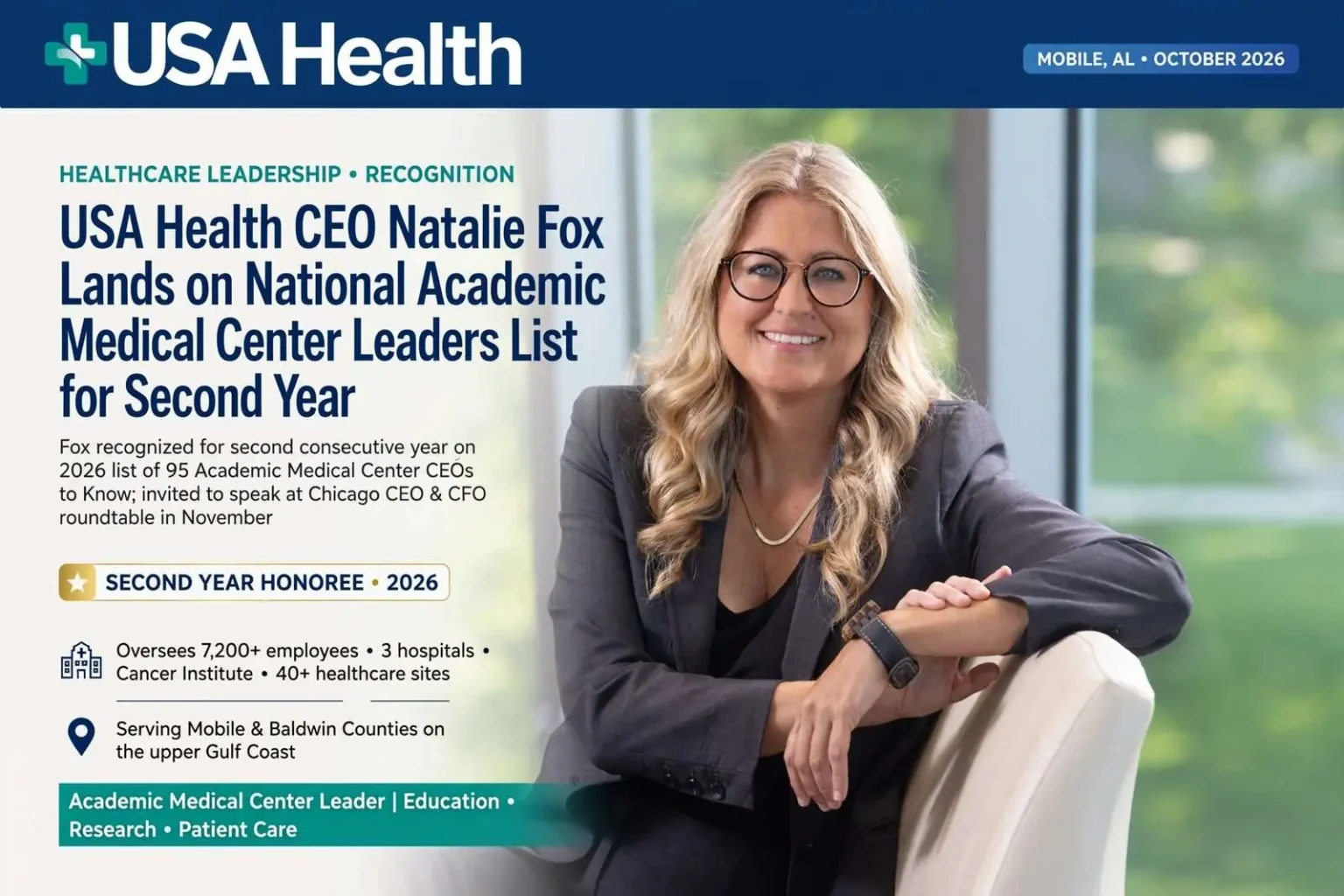
MOBILE, Ala. — For the second consecutive year, the chief executive of USA Health has been included on a national list recognizing the leaders of academic medical centers, a category of institution that sits at the intersection of patient care, medical education and research.
Natalie Fox, DNP, PNP-BC, was named to the roster of 95 Academic Medical Center CEOs to Know 2026, a recognition of her leadership at the University of South Alabama’s academic health system. The listing follows an earlier national recognition: in 2024, Fox was one of only 42 people in the United States named to a Rising Stars: Healthcare Leaders Under 40 list.
As part of the 2026 recognition, Fox has been invited to serve as a speaker at a CEO and CFO roundtable planned for November in Chicago.
The scale of the organization she runs
Fox oversees the strategy, performance and operations at USA Health, which includes more than 7,200 employees, three hospitals, a cancer institute and more than 40 healthcare delivery sites.
Those figures deserve a moment of attention, because they describe one of the largest single employers on the upper Gulf Coast. An organization of more than 7,200 people is not simply a group of clinicians; it encompasses nurses and physicians alongside pharmacists, therapists, laboratory scientists, imaging technologists, environmental services staff, food service workers, billing specialists, information technology teams, security personnel and administrators. A health system of that size functions as a small city with a payroll, a supply chain, a physical plant and a round-the-clock operating tempo that never pauses for holidays or weather.
The three hospitals, the cancer institute and the more than 40 delivery sites also describe a geographic footprint. Delivery sites in a system of this kind typically include outpatient clinics, specialty practices, primary care offices and diagnostic locations distributed across a service area rather than clustered on a single campus. For residents of Mobile and Baldwin counties, that dispersion is the practical difference between driving to a hospital campus for a routine follow-up and seeing a physician closer to home.
What an academic health system actually is
The distinction embedded in the recognition — academic medical center, rather than hospital or health system generally — is not a formality. Academic health systems carry three obligations at once, and each pulls on the same finite resources.
The first is clinical care, including the most complicated cases in a region. Academic centers tend to accumulate complexity because they maintain the subspecialty depth, intensive care capacity and around-the-clock coverage that community hospitals often cannot support on their own. When a smaller hospital transfers a patient, it is frequently to an institution of this type.
The second obligation is education. Academic health systems train medical students, residents and fellows, along with nursing students and a range of allied health professionals. That training is the mechanism by which a region reproduces its own workforce; physicians and nurses disproportionately practice near where they trained, which is why teaching capacity in a place like Mobile has consequences that extend well beyond the students themselves.
The third obligation is research, and it is the one most likely to be invisible to patients. Clinical trials, translational science and health services research all require infrastructure — regulatory oversight, coordinators, data systems — that costs money and generates prestige more reliably than it generates revenue.
The editors of the national list described the demands of the job in those terms. “Leading these institutions demands a rare combination of clinical vision, research acumen, academic leadership and operational command,” the editors wrote, adding that the CEOs recognized on the 2026 list are redefining what is possible at the highest levels of medicine.
Academic medical centers are often home to the most complex patient care and the most consequential medical research, and they also serve as the training ground for the next generation of the healthcare workforce. Balancing those roles is the central managerial problem of the job: teaching slows clinical throughput, research consumes margin, and the clinical enterprise pays for much of both.
A career built inside the system she now leads
Fox has been a dedicated leader at USA Health since 2011, serving in roles focused on advancing population health and reducing barriers to care. That tenure is notable in an industry where senior executives frequently move between organizations and regions; Fox’s advancement occurred within the same system, in the same city, over more than a decade.
Her earlier roles included assistant administrator and chief nursing officer for the USA Health Physicians Group. A chief nursing officer is the senior executive accountable for nursing practice across an organization — staffing models, clinical standards, professional development and the quality and safety measures that depend most directly on bedside care. It is one of the most operationally demanding positions in any health system, and it is an increasingly common route into the chief executive’s office.
Her credentials reflect a clinical rather than a purely administrative background. The DNP designation refers to a Doctor of Nursing Practice, a terminal practice-focused doctorate in nursing that emphasizes translating evidence into clinical and systems improvement, as distinct from a research doctorate. PNP-BC denotes board certification as a pediatric nurse practitioner. Fox earned her bachelor’s, master’s and doctoral degrees in nursing from the University of South Alabama, meaning the executive now leading the university’s health system was educated within the same institution.
The two areas the announcement identifies with her earlier work — population health and barriers to care — are terms worth unpacking. Population health refers to managing the health outcomes of a defined group of people rather than only treating individuals as they present for care. In practice that means screening rates, chronic disease control, immunization coverage and the coordination of care across settings. Barriers to care describes the obstacles that sit between a patient and treatment they are otherwise eligible to receive: distance, transportation, cost, appointment availability, insurance status, language, or simply not knowing where to go.
The pandemic response and the awards that followed
Fox played a critical role in leading the health system’s COVID-19 testing and vaccination response in partnership with the City of Mobile. For that work she received a Mobile Community Health Leadership Award and an Exceptional Citizenship Award in 2022. In the same year she received Alabama’s Top Nurses Lifetime Achievement Award for her enduring contributions to the nursing profession.
The operational demands of a mass testing and vaccination effort are easy to underestimate in hindsight. Programs of that kind require sites, staffing rosters assembled from people who already had full-time assignments, cold-chain storage and handling, scheduling systems, supply forecasting, documentation and reporting, and coordination with municipal government — all executed while the underlying guidance changed repeatedly. That the effort was run in partnership with the City of Mobile points to the coordination between a health system and local government that such campaigns require.
Appointments beyond the health system
Beyond her executive duties, Fox has been appointed by Alabama Gov. Kay Ivey to the Alabama Certificate of Need Review Board, and she serves as the USA president’s designee on the board of the new Alabama School of Healthcare Sciences.
Certificate of need is one of the less understood mechanisms in health policy, but its practical effect is considerable. Under certificate of need programs, healthcare providers must obtain state approval before undertaking certain projects — building or expanding facilities, adding particular services, or acquiring major equipment. The stated rationale is to avoid duplicative capacity and the cost increases that can follow from it. The programs also mean that decisions about where new healthcare capacity may be built are made, in part, through a state review process rather than solely by individual institutions. A seat on the review board is therefore a position with regional consequences.
Her role with the Alabama School of Healthcare Sciences connects her to workforce development at an earlier stage of the pipeline than residency or nursing school — the point at which students are first deciding whether a healthcare career is available to them.
What the recognition does and does not establish
Industry lists of this kind are a fixture of healthcare trade publishing, and readers are entitled to a clear-eyed view of what they represent. A listing of CEOs to know is an editorial selection reflecting the judgment of the publication’s editors about the leaders worth watching in a given year. It is not an audit, a performance ranking, or an assessment of clinical quality, financial results or patient outcomes at any institution. It reflects professional visibility and standing among peers.
That said, the pattern here is meaningful on its own terms. Repeat inclusion in consecutive years, an earlier national under-40 recognition in 2024, a speaking invitation at a national roundtable, a gubernatorial appointment to a state regulatory board and a seat on the board of a new state healthcare education institution together describe an executive whose profile extends well beyond the local market. For a health system in Mobile competing for physicians, nurses, research funding and philanthropic support against much larger metropolitan institutions, that kind of visibility is a recruiting asset in itself.
What to watch
The facts in the announcement point toward several things worth following in the coming year.
- The November roundtable in Chicago. Fox has been invited to speak at a CEO and CFO roundtable, an event that pairs chief executives with chief financial officers — a pairing that reflects how closely strategic and financial decisions are linked in health systems operating on thin margins.
- Certificate of need decisions. Her seat on the state review board places her within a process that shapes where healthcare capacity is added in Alabama, including in the coastal counties.
- The Alabama School of Healthcare Sciences. As a new institution with USA representation on its board, its development is worth tracking for its effect on the healthcare workforce pipeline.
- Workforce and access. Population health and reducing barriers to care are the two priorities the announcement associates with Fox’s career at USA Health. Those are the areas against which local residents can most directly measure the system’s performance over time.
USA Health remains the academic health system for the University of South Alabama, and its scale — more than 7,200 employees, three hospitals, a cancer institute and more than 40 healthcare delivery sites — makes its leadership decisions consequential well beyond the university’s campus. For Mobile and Baldwin counties, the health of that institution is not an abstraction; it is where a substantial share of the region’s most complex care is delivered and where a substantial share of its future clinicians will be trained.